






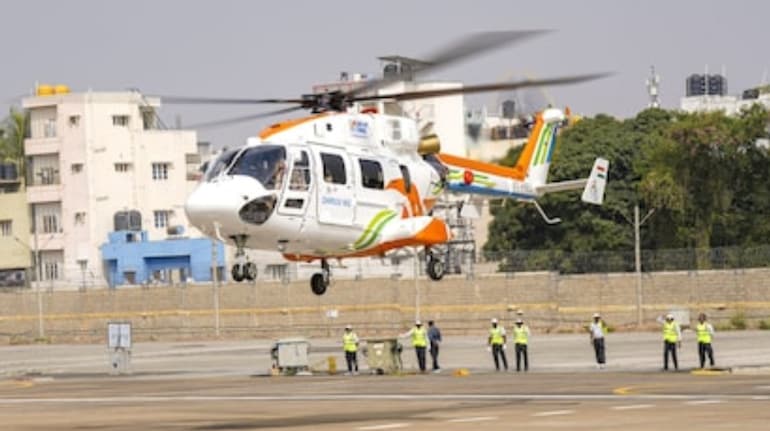

In a significant boost to India's indigenous aerospace capabilities, the next-generation multi-role civil helicopter Dhruv NG successfully completed its maiden flight on Tuesday, marking a major milestone in domestic helicopter manufacturing. Positioned as a cost-effective alternative to imported light twin-engine helicopters, the aircraft was developed by Hindustan Aeronautics Limited (HAL).
Union Civil Aviation Minister Ram Mohan Naidu flagged off the helicopter and described it as a powerful reflection of India's growing technological prowess and self-reliance in aviation.
#WATCH | Bengaluru, Karnataka | Union Civil Aviation Minister Ram Mohan Naidu flags off the inaugural flight of the Advanced Light Helicopter, Dhruv-NG, a civil variant of the indigenous helicopter showcased by HAL at the 2025 Aero India show. pic.twitter.com/AJBh0XCyV7— ANI (@ANI) December 30, 2025
Designed and built to cater to the civil aviation market, the Dhruv NG features cutting-edge upgrades focused on safety, comfort, and operational efficiency. Officials said the helicopter is equipped with a world-class, civil-certified glass cockpit and an advanced avionics suite that enhances pilot awareness and overall flight safety.
The 5.5-tonne light twin-engine helicopter has been engineered to operate effectively across India's varied and challenging terrain, while also meeting stringent global civil aviation standards.
Speaking after witnessing the inaugural flight, Naidu termed the occasion a "very important milestone in Indian aviation history" and lauded the collective efforts of HAL's designers, engineers, and technicians. He remarked that HAL, traditionally driven by defence manufacturing, was now transitioning into a balanced organisation with equal focus on defence and civil aviation.
Calling the moment especially meaningful in his role as civil aviation minister, Naidu said the Dhruv NG symbolised India's confidence, capability, and commitment to the Aatmanirbhar Bharat initiative. He recalled examining the helicopter at Aero India earlier this year and expressed satisfaction that the long-awaited maiden flight had been achieved within a year.
Ahead of the take-off, the minister also flew in the cockpit alongside the pilot to personally assess the helicopter's advanced systems and features.
Naidu further described the Directorate General of Civil Aviation's (DGCA) handover of the type certificate for the indigenous Shakti engine as a "defining moment" for India's civil aviation sector.
Highlighting the rapid expansion of the aviation industry, he said India had emerged as the world's third-largest domestic aviation market, driven by Prime Minister Narendra Modi's vision of affordable air travel. However, he acknowledged that building a strong domestic manufacturing ecosystem remained a critical challenge.
He noted that India is expected to induct more than 1,000 helicopters over the next 10 to 15 years, largely supported by the UDAN (Ude Desh ka Aam Nagrik) regional connectivity scheme aimed at making aviation more inclusive and accessible.
According to HAL officials, the Dhruv NG represents a major leap in indigenous rotary-wing technology, with a strong emphasis on safety, performance, and passenger comfort. The helicopter is powered by twin Shakti 1H1C engines, offering higher power ratings and the advantage of domestic maintenance support.
Safety enhancements include crashworthy seats, self-sealing fuel tanks, and a reliable twin-engine configuration that ensures high redundancy. For improved ride quality, advanced vibration control systems have been incorporated, making it suitable for VIP and medical evacuation missions.
The helicopter has a maximum take-off weight of 5,500 kg, a top speed of about 285 kmph, a range of roughly 630 km with a 20-minute reserve, and an endurance of around three hours and 40 minutes. It can operate at altitudes of up to 6,000 metres and carry an internal payload of approximately 1,000 kg.
Its spacious and modular cabin, measuring 7.33 cubic metres, can be customised for multiple civilian applications. In VIP or VVIP configuration, it offers luxury seating for four to six passengers, with an overall capacity of up to 14 passengers. In the air ambulance role, the Dhruv NG can accommodate four stretchers along with a doctor and medical attendant.
Additional mission profiles include offshore operations, law enforcement duties, search and rescue, and disaster relief.
HAL said the Dhruv Civil NG is positioned as a high-performance, economically viable alternative to imported light twin-engine helicopters, reinforcing India's push towards self-reliance in civil aviation manufacturing.
Discover the latest Business News, Sensex, and Nifty updates. Obtain Personal Finance insights, tax queries, and expert opinions on Moneycontrol or download the Moneycontrol App to stay updated!
Find the best of Al News in one place, specially curated for you every weekend.
Stay on top of the latest tech trends and biggest startup news.





