






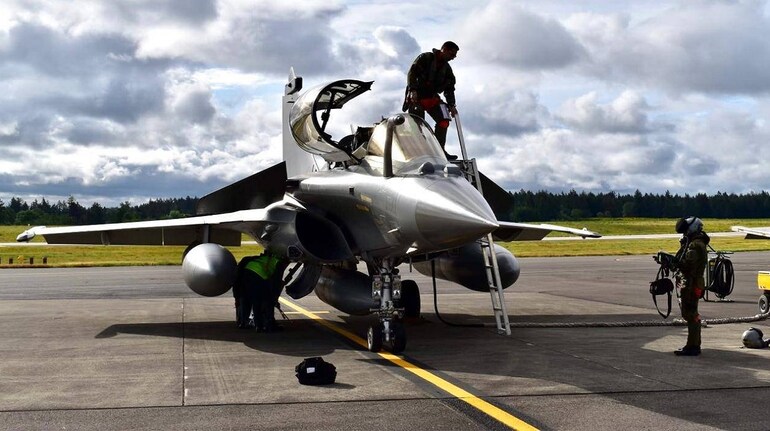

The Defence Acquisition Council (DAC), the defence ministry's highest decision-making body on capital procurement, is set to meet today under the chairmanship of Defence Minister Rajnath Singh, with two significant proposals on its agenda - the acquisition of 114 Rafale fighter jets and the approval of long-endurance high-altitude surveillance platforms.
The meeting assumes importance as it could pave the way for one of the Indian Air Force's (IAF) largest fighter jet inductions in recent years. The proposal to procure 114 Rafale jets from France's Dassault Aviation had cleared a key stage last month when the Defence Procurement Board, headed by Defence Secretary Rajesh Kumar Singh, endorsed it.
A final approval from the Cabinet Committee on Security (CCS), led by Prime Minister Narendra Modi, would be required after the DAC's decision.
The potential deal also carries diplomatic weight. India and France are expected to advance discussions during French President Emmanuel Macron's visit to India from February 17 to 19, when he is scheduled to meet Prime Minister Modi.
The IAF had formally sought the additional 114 jets in September last year as part of a broader strategy to rebuild its shrinking squadron strength. The Air Force currently operates 36 Rafale fighters, while the Indian Navy has placed orders for 26 naval variants. Expanding the fleet is expected to enhance operational readiness and bring down long-term maintenance costs through economies of scale.
Infrastructure to support additional Rafale squadrons is already in place. A training and maintenance, repair and overhaul (MRO) facility is functional at the Ambala air base. The IAF is understood to have the space, trained personnel, tooling and spare parts to induct two more squadrons - roughly 36 to 38 aircraft - without delay.
If cleared, the new jets are expected to be produced under a 'Make in India' framework, with Dassault partnering an Indian company. The French manufacturer would integrate Indian-origin weapons and missile systems on the aircraft and enable secure data links to ensure seamless connectivity with India's radar and sensor network. Technology transfer for airframes is also envisaged, with key suppliers such as Safran (engines) and Thales (avionics) participating in the process. Once the transfer of technology is fully implemented, indigenous content in the aircraft could rise to an estimated 55-60%.
Alongside the Rafale proposal, the DAC is also expected to consider approving solar-powered High-Altitude Pseudo Satellite Vehicles (HAPS) for persistent surveillance. These stratospheric platforms are designed to operate at altitudes of around 20 kilometres - significantly higher than commercial aircraft - and can remain airborne for extended durations.
HAPS combine features of satellites and unmanned aerial vehicles, offering long-endurance reconnaissance capabilities at a fraction of the cost of space-based systems. They do not require rockets or launch vehicles, making deployment comparatively simpler. India's National Aerospace Laboratories has already conducted tests of such a platform, while DRDO and Bengaluru-based NewSpace Research and Technologies are developing their own variants.
With only a handful of countries - including the US, UK, Germany, Japan, South Korea and New Zealand - investing in such systems, the DAC's deliberations today could mark a critical step in strengthening both India's combat airpower and next-generation surveillance capabilities.
Discover the latest Business News, Sensex, and Nifty updates. Obtain Personal Finance insights, tax queries, and expert opinions on Moneycontrol or download the Moneycontrol App to stay updated!
Find the best of Al News in one place, specially curated for you every weekend.
Stay on top of the latest tech trends and biggest startup news.





