






When people talk about 1971, the map in their head usually ends at Dhaka. But the war had a stubborn tail in the southeast, where the coast, the port complex around Chittagong, and the road running down to Cox’s Bazar created a potential exit ramp for Pakistani forces. That road had a name that kept popping up in Indian planning: the Arakan road, running from Dhaka to Chittagong and then down towards Cox’s Bazar and Burma, as Indian accounts later noted.
For India, “securing the southeastern flank” was not just a neat phrase. It was about denying Pakistan options. If East Pakistan’s garrisons could slip out through the Chittagong Cox’s Bazar belt, regroup, or even trigger a messy cross-border spillover, the war’s endgame would get longer, uglier, and diplomatically more complicated.
Why Cox’s Bazar was a military lever
Cox’s Bazar mattered for two very practical reasons. One, it had an airfield that could support local resupply, movement of personnel, and at the very least, morale. Two, it sat on the coastal strip that connected to Chittagong’s wider maritime ecosystem. If you were trying to choke East Pakistan’s coastal arteries, you did not ignore Cox’s Bazar.
That is why, even before the final land battles were done, the Eastern Fleet’s concept of operations explicitly included striking ports such as Chittagong and Cox’s Bazar and destroying airfields and coastal shipping.
The first hard hit came from the sea
The Indian Navy’s carrier INS Vikrant and its air group made Cox’s Bazar one of the early, headline targets once hostilities were declared. The official history of the 1971 war records that the Fleet was ordered to carry out a strike on Cox’s Bazar on the morning of December 4, and that Sea Hawks launched from Vikrant attacked the Cox’s Bazar airfield, setting key installations and fuel dumps on fire and damaging or destroying vehicles on the runway, with no aerial opposition.
This is the part that often gets missed in simplified war summaries. The strike was not about symbolism. It was systems work. Take away the airfield’s utility, shake up coastal confidence, and keep the pressure on the whole Chittagong-facing belt.
Indian Express reporting on Vikrant’s operations captures the same operational pattern in more narrative terms, describing Sea Hawks striking Cox’s Bazar and Chittagong and hammering shipping and harbour infrastructure as the blockade tightened.
Choking the coastline was also about psychology
There is a cold logic to airfield cratering and port strikes, but there is also the human layer. If you are a garrison commander watching your coastal lifeline get pounded and your ability to move by air shrink, your choices narrow fast. That psychological squeeze is part of why sustained naval air operations in the east had effects that went beyond the immediate damage.
A The Print retrospective on 1971 notes that Vikrant’s aircraft hit targets including the Cox’s Bazar airfield and struck shipping at Chittagong, reinforcing how quickly the eastern maritime picture turned hostile for Pakistan.
The Arakan road problem and the fear of an escape
Even as Indian forces drove towards Dhaka, planners were thinking one move ahead: what if the enemy tries to bolt southeast? Indian Express, in a separate 1971-related report, points out why the Arakan road was viewed as “of prime importance” because it could be used by the Pakistan Army to escape into Burma once defeat looked inevitable.
This is where Cox’s Bazar stops being just “a place the Navy bombed” and becomes a key node in a bigger closure plan. If the road and the coast both stay usable, you have an open valve. If you keep hitting the airfield and tighten the sea picture, and then physically place troops to block movement, you are trying to shut the valve.
Romeo Force and the attempt to slam the door shut
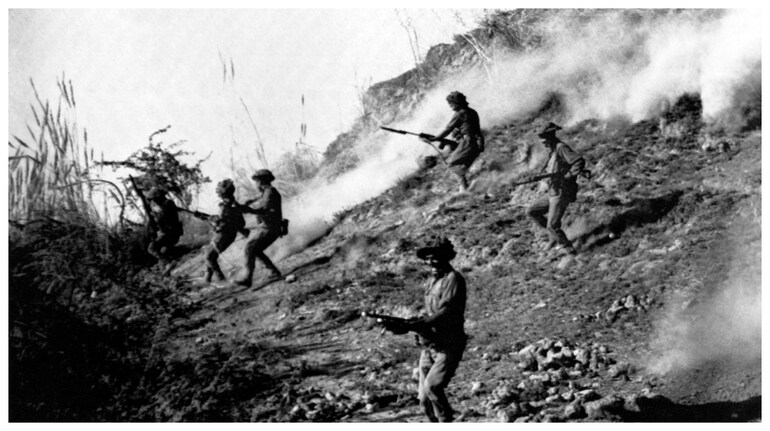
The idea of using ad hoc forces to intercept retreating troops shows up in Indian accounts of a “Romeo Force”, created with naval help, aimed at capturing Pakistani troops running from Cox’s Bazar and Chittagong. A Times of India feature quoting a veteran describes sailing on a civilian cargo ship to block fleeing troops and claims large captures of enemy personnel in the closing phase.
Two things can be true at once here. First, the intent was clear: stop a breakout to the southeast. Second, the execution was messy, shaped by speed, fog of war, and the simple fact that by mid-December the entire theatre was moving faster than neat planning maps.
So did India “capture Cox’s Bazar” in a clean, flag-planting sense? The better way to describe it is that India and the Mukti Bahini progressively made Cox’s Bazar militarily unusable as an escape-enabling base, then moved to physically control the routes around it as Pakistan’s overall collapse accelerated. The airfield strike on December 4 is a concrete marker for that shift.
How the southeastern flank fit into the larger victory
Dhaka’s surrender did not happen in a vacuum. It happened because the Pakistani military in the east was being cut into chunks, outpaced, and isolated. In that broader picture, the Cox’s Bazar Chittagong belt mattered because it was one of the last areas where geography offered Pakistan a different kind of option: sea movement, coastal dispersal, and the Burma direction as a theoretical bolt-hole.
By attacking Cox’s Bazar’s airfield early, maintaining pressure on coastal shipping and ports, and positioning forces to block the Arakan road logic, India was tightening the endgame. It reduced the chance of an organised withdrawal, shortened the timeline to capitulation, and limited the risk of a post-surrender guerrilla tail led by units that escaped intact.
What this tells us about 1971, beyond the headline maps
The capture and neutralisation of places like Cox’s Bazar is a reminder that wars end when exits close. Big cities fall, sure. But it is the boring, grinding work of shutting down routes, wrecking logistics, and making “Plan B” impossible that often turns a campaign into a collapse.
Cox’s Bazar was not the centre of gravity of 1971. But it was a lever. And in the final weeks, India pulled that lever hard, from the deck of Vikrant in early December to the late-war push to block movement along the southeast corridor.
Discover the latest Business News, Sensex, and Nifty updates. Obtain Personal Finance insights, tax queries, and expert opinions on Moneycontrol or download the Moneycontrol App to stay updated!
Find the best of Al News in one place, specially curated for you every weekend.
Stay on top of the latest tech trends and biggest startup news.




