






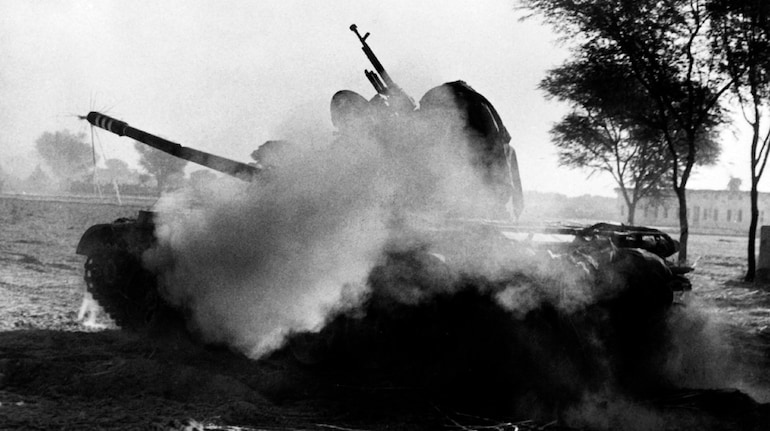

The war in the east is often remembered for its speed. Columns racing forward, rivers crossed in daring moves, and a surrender that came in just 13 days. Against that narrative, the Battle of Hilli feels almost out of place. It was slow, costly, and stubborn, a fight where weeks passed and the front barely shifted. Yet it was precisely this grinding nature that made Hilli matter.
Hilli, a small border town in the Dinajpur region of East Pakistan, sat astride an important approach from India’s western flank into the northern districts. For Pakistani commanders, it was a place to dig in and delay. For India, it became one of the hardest fights of the eastern campaign.
A defence built to hold
Unlike many Pakistani positions in the east, Hilli was not lightly defended. Troops had months to prepare. Villages were fortified, trenches dug, mines laid, and artillery targets carefully registered. The terrain helped the defender. Paddy fields, canals, and narrow approaches limited manoeuvre and forced Indian infantry to advance in the open.
Indian units attacking Hilli in November 1971 quickly realised this would not be a breakthrough battle. Assaults met intense small-arms and artillery fire. Positions changed hands, only to be counterattacked after dark. Progress was measured in yards, not kilometres. Casualties mounted, and the fight settled into a pattern of attack, consolidation, and renewed resistance.
This was not the kind of battle that made headlines. It was exhausting, repetitive, and unforgiving.
Why Hilli mattered
Hilli’s real importance lay not in how fast it fell, but in how long it held. Pakistani troops tied down here could not be pulled back to defend other sectors. While Indian forces advanced rapidly elsewhere, especially along axes leading to the Meghna and Dhaka, Hilli fixed Pakistani units in place.
For Pakistan, the choice was deliberate. Hold ground, inflict losses, and hope that time and international pressure might change the political equation. But delay came at a cost. As the larger situation deteriorated, Hilli became increasingly isolated. The men fighting there were still engaged in fierce local battles, even as the strategic outcome of the war was slipping away.
The human experience of attrition
For the soldiers on the ground, Hilli was defined by repetition and endurance. Attacks meant crossing exposed ground under fire, clearing fortified houses, and then holding on through the night. There were no sweeping manoeuvres to relieve the pressure, only persistence and firepower applied methodically.
Veterans of the sector have described the frustration of hard-fought gains that looked insignificant on a map. Yet those same accounts underline the discipline required to keep going. Small-unit leadership mattered enormously. So did morale, which had to be sustained in conditions where victory felt distant and abstract.
On the Pakistani side, the defence was equally grim. Units fought knowing that reinforcement or relief was unlikely. Their task narrowed to holding on, inflicting damage, and delaying an enemy whose overall momentum was clearly building elsewhere.
Overshadowed, but not irrelevant
When the war ended with the surrender at Dhaka on December 16, Hilli was quickly overshadowed. The decisive images were of swift advances and political collapse, not trench-by-trench fighting in the north. But Hilli had played its part.
It demonstrated the limits of static defence in East Pakistan. Well-prepared positions could slow the Indian advance, but they could not change the strategic balance once India committed fully to the eastern campaign. Hilli absorbed time, attention, and lives, yet it could not prevent the broader unravelling of Pakistani control.
What Hilli tells us about 1971
The Battle of Hilli complicates the popular story of the 1971 war. It shows that the campaign was not uniformly fast or easy. In some places, India accepted attrition because the larger strategy allowed it. Time was on its side, and clarity of political and military objectives mattered more than speed on every front.
Hilli also reminds us that wars are shaped as much by the battles we barely remember as by the ones that dominate memory. Not every decisive fight ends in a dramatic collapse. Some work quietly, grinding down an enemy’s options until collapse elsewhere becomes inevitable.
In that sense, Hilli deserves to be remembered not for how quickly it fell, but for how long it held, and what that endurance reveals about the nature of the 1971 war and the road to Bangladesh’s liberation.
Discover the latest Business News, Sensex, and Nifty updates. Obtain Personal Finance insights, tax queries, and expert opinions on Moneycontrol or download the Moneycontrol App to stay updated!
Find the best of Al News in one place, specially curated for you every weekend.
Stay on top of the latest tech trends and biggest startup news.





