






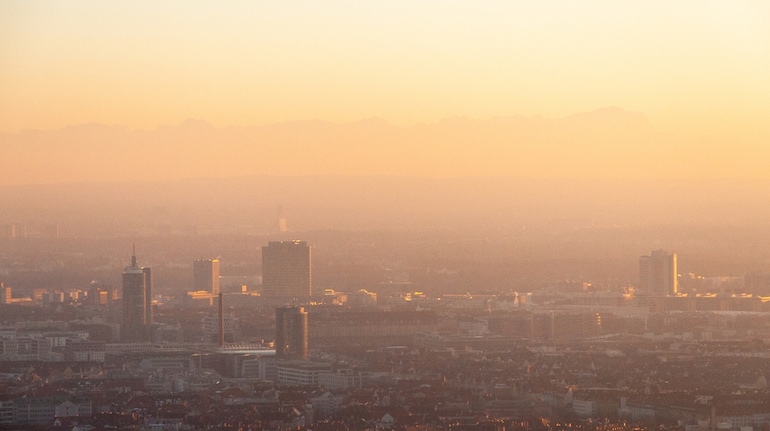
As winter deepens over the National Capital Region (NCR), Delhi’s struggle with hazardous air pollution shows no signs of abating. Despite a range of policy measures, the Delhi government has increasingly signalled its dependence on favourable weather conditions — including wind and rain — to bring down the Air Quality Index (AQI), a move that has drawn both scrutiny and political debate.
On Monday, December 22, Delhi’s AQI hovered in the ‘very poor’ category with a reading of 366, according to the Central Pollution Control Board (CPCB). Several areas, including Narela, slipped into the 'severe' pollution bracket, with AQI readings hitting 418 — levels that pose serious health risks.
While a slight reprieve came around December 21 — when wind patterns helped thin dense fog and marginally improved the AQI to around 377 — the index still remained within unhealthy limits.
Meanwhile, the India Meteorological Department (IMD) issued a yellow alert for Delhi due to dense fog and cold conditions, warning that adverse weather could continue to aggravate pollution.
The Delhi government, led by Chief Minister Rekha Gupta and Environment Minister Manjinder Singh Sirsa, has publicly underscored the role of meteorological factors like wind speed, fog and moisture in influencing air quality.
Sirsa has repeatedly explained that significant AQI improvement often depends on favourable natural conditions and that cloud seeding — an artificial rain-inducing technology — only works when the weather cooperates.
While officials framed cloud seeding as a science-driven component of pollution control, critics have questioned its effectiveness. An IIT Delhi study pointed out that cloud seeding tends to be limited in winter due to dry air and lack of sufficient moisture, reducing its real-world impact when most needed.
Sirsa has also reaffirmed the government’s commitment to clamp down on polluting industries and enforce emission norms, noting that industries operating without permits will face strict action.
Political and public pushback
The opposition has criticised the government’s cloud seeding efforts as symbolic and insufficient against a deep-rooted pollution problem. Congress leaders labelled the initiative a “cruel joke”, arguing that political rhetoric on weather-dependent solutions distracts from structural issues like vehicle emissions and industrial pollution.
Public frustration has spilled over into protests, with residents and activists staging demonstrations demanding stronger state action as AQI levels repeatedly remain in unhealthy categories.
Policy measures alongside weather dependence
Beyond weather-linked approaches, the Delhi government has been rolling out emissions and infrastructure measures aimed at longer-term improvement.
Even as officials point to favourable weather as a key factor in short-term air quality improvement, the Delhi government has outlined a set of policy measures it says are aimed at longer-term pollution control.
Central to this approach is expanded investment in public transport, with increased funding cleared for the Delhi Metro’s Phase IV expansion. The government has argued that strengthening mass transit is critical to cutting private vehicle use, a major contributor to the city’s pollution burden.
Attention has also turned to road dust, a persistent winter pollutant. The Municipal Corporation of Delhi has announced a phased two-year plan to repair internal roads, focusing on resurfacing damaged stretches and improving dust-suppression measures. Civic officials say the move is intended to reduce the resuspension of particulate matter during peak pollution months.
At the regional level, authorities have enforced stricter curbs under the Graded Response Action Plan as air quality worsened. These include restrictions on construction activity, limits on diesel generator use and staggered office timings across parts of the National Capital Region to ease traffic congestion and curb vehicular emissions.
Vehicle emissions have been another focus area, with tighter enforcement of Pollution Under Control norms and restrictions on older, high-emitting vehicles. Fuel stations have been instructed to deny fuel to vehicles without valid certificates, a step the government says is aimed at gradually reducing the vehicular load that intensifies Delhi’s annual winter smog.
Meteorology vs man-made sources
Experts warn that while weather plays a major role in short-term AQI variations, long-term air quality improvement hinges on reducing emissions from vehicles, industries and stubble burning in neighbouring states — problems that weather alone cannot solve. Meteorological conditions like low wind speeds and thermal inversions trap pollutants close to the ground, making seasonal spikes an annual reality without systemic interventions.
Meanwhile, the Centre has reiterated that India follows its own national air quality standards and does not recognise global pollution rankings as official. In Parliament, the government said international indices and WHO air quality guidelines are advisory in nature and that no authoritative country-wise air pollution ranking exists worldwide.
Discover the latest Business News, Sensex, and Nifty updates. Obtain Personal Finance insights, tax queries, and expert opinions on Moneycontrol or download the Moneycontrol App to stay updated!
Find the best of Al News in one place, specially curated for you every weekend.
Stay on top of the latest tech trends and biggest startup news.




