






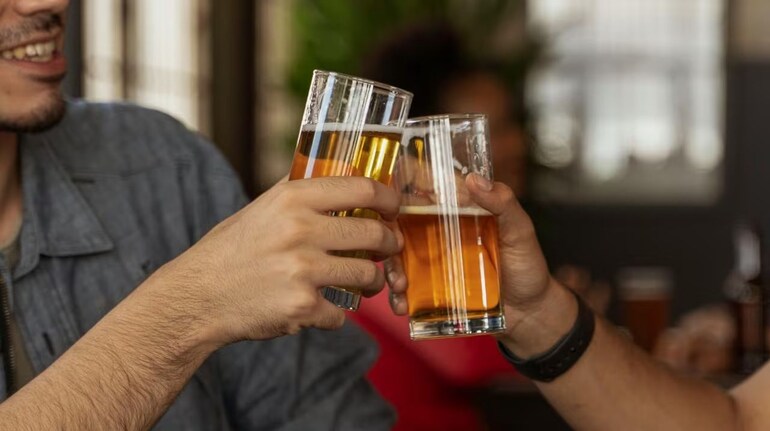

India sold more than 40 crore cases of Indian Made Foreign Liquor (IMFL) in 2024–25, reinforcing its position as one of the world’s largest and fastest-growing spirits markets. Within that vast national landscape, Chandigarh — a Union Territory with a population of barely 12.5 lakh — stands out not for its absolute volumes, but for its striking per capita consumption.
While Chandigarh ranks 22nd in absolute IMFL sales nationally, an adjustment for population places it among the most liquor-intensive territories in the country, outpacing even traditionally high-consuming southern states.
The assessment is based on data provided by the Chandigarh Administration and compiled by the Confederation of Indian Alcoholic Beverage Companies (CIABC), the apex industry body.
According to CIABC data, national IMFL sales rose from 39.62 crore cases in 2023–24 to 40.17 crore cases in 2024–25, reflecting a growth of 1.38%. The southern states continue to dominate, accounting for roughly 58% of total IMFL sales.
Karnataka led with 6.88 crore cases, followed by Tamil Nadu at 6.47 crore, Telangana at 3.71 crore, Andhra Pradesh at 3.55 crore and Kerala at 2.30 crore. Among northern states, Uttar Pradesh sold 2.51 crore cases, Rajasthan 1.37 crore and Haryana 1.18 crore. Delhi recorded 1.18 crore cases, marking a decline of about 6% from the previous year, while Maharashtra sold 2.72 crore cases.
The CIABC figures reflect IMFL sales alone — including whisky, rum, brandy, gin, vodka and other domestically manufactured spirits — and exclude Imported Foreign Liquor (IFL) and country liquor.
Chandigarh’s IMFL sales in 2024–25 stood at 17.39 lakh cases. When divided by its estimated population of 12.5 lakh, this works out to roughly 1.39 IMFL cases per person annually — nearly five times the national average of approximately 0.28 cases per person.
When total liquor consumption is considered — including IMFL, IFL and country liquor — the numbers climb further. According to Chandigarh Administration data for 2025–26 (up to January 31), the Union Territory sold 23,02,291 total cases, comprising 17,39,329 IMFL cases, 1,18,518 IFL cases and 4,44,444 country liquor cases.
This translates to approximately 1.84 total liquor cases per resident per year — more than 6.5 times the national IMFL per capita average.
Measured against the adult population (15 years and above), estimated at around 10 lakh, per capita consumption stands at roughly 2.3 cases per adult annually — or nearly 28 bottles per adult each year. Against the legally eligible population (25 years and above), estimated at around 6.7 lakh, the figure rises to approximately 3.44 cases per eligible adult, equivalent to over 41 bottles annually.
These ratios place Chandigarh among the highest per capita consuming territories in India. Even the southern heavyweights fall behind Chandigarh on a per capita basis.
Karnataka’s 6.88 crore IMFL cases against a population of roughly 6.8 crore amount to around 1.01 cases per person. Telangana stands at approximately 0.95, Tamil Nadu at around 0.83 and Kerala at roughly 0.64 cases per person annually. Maharashtra and Uttar Pradesh, despite large absolute volumes, record significantly lower per capita figures — approximately 0.22 and 0.10 respectively — due to their vast population bases.
Over the five financial years from 2021–22 to 2025–26 (up to January 31, 2026), Chandigarh recorded a cumulative liquor offtake of 1,10,09,027 cases across all three categories. At 12 bottles per case, this translates to approximately 13.21 crore bottles sold over five years.
The sharpest annual increase came in 2022–23, when total consumption rose from 19,48,149 cases to 22,59,259 cases — an increase of nearly 16%. The surge was linked to excise policy recalibration and competitive vend auctions that year. Since then, annual consumption has remained above 22 lakh cases, stabilising at elevated levels.
For 2025–26, consumption up to January 31 has already crossed 23 lakh cases, indicating that full-year figures may comfortably exceed 24 lakh cases if current trends continue.
In comparison, CIABC data shows that national IMFL sales for the nine-month period from April to December 2025–26 stood at 32.09 crore cases.
Chandigarh’s excise administration attributes its structured market to policy design and enforcement mechanisms. The data suggests that a combination of high disposable incomes, urban density, liberalised retail structures and regulatory enforcement has created a compact but exceptionally active liquor market.
Discover the latest Business News, Sensex, and Nifty updates. Obtain Personal Finance insights, tax queries, and expert opinions on Moneycontrol or download the Moneycontrol App to stay updated!
Find the best of Al News in one place, specially curated for you every weekend.
Stay on top of the latest tech trends and biggest startup news.





