






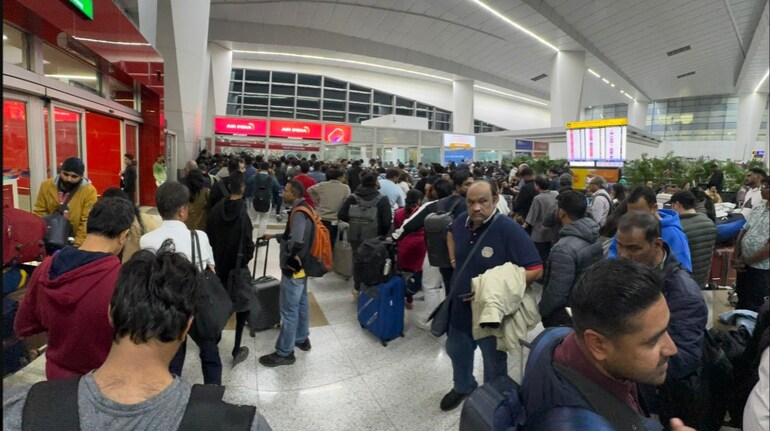

Delhi woke up to dense fog on Tuesday morning after the India Meteorological Department (IMD) upgraded its warning from an orange alert to a red alert for dense fog, effective until Tuesday afternoon. The weather agency warned that visibility could fall sharply, increasing the chances of major disruptions to air, road and rail traffic in the national capital and several parts of north India.
According to the IMD, visibility levels at the Indira Gandhi International (IGI) Airport and Safdarjung observatory dropped to as low as 50 metres around 8 am. Conditions improved slightly by 9 am, when visibility increased to about 100 metres. The fog was caused by calm winds, high moisture levels and falling temperatures, which are typical winter conditions in the region.
The IMD advised people to remain cautious while commuting, especially during early morning hours, as foggy conditions can significantly affect travel safety.
However, despite the red alert, Delhi Airport said in its morning update that flight operations were running smoothly as visibility improved later in the day.
The impact of fog was felt on Monday, with at least 128 flights cancelled, eight diverted and nearly 200 delayed due to poor visibility, according to flight-tracking website Flightradar24.
The airport is currently operating under Category-III conditions, which allow aircraft equipped with special systems to land even in very low visibility. Major airlines including Air India, IndiGo and SpiceJet issued travel advisories, warning passengers about possible delays, diversions and cancellations in the coming days.
Air India said dense fog could affect departures and arrivals at Delhi and other northern and north-eastern cities. Passengers were advised to check flight status regularly and plan their travel accordingly.
Meanwhile, the Directorate General of Civil Aviation (DGCA) has declared the period from December 10 to February 10, 2026, as the official fog season window, during which fog-related disruptions are expected to remain frequent.
Railway services were also impacted, with several trains running behind schedule due to reduced visibility across northern India.
Severe air pollution adds to woes
Apart from fog, Delhi continued to struggle with severe air pollution. The city recorded a 24-hour Air Quality Index (AQI) of 401, placing it in the ‘severe’ category, according to data from the Central Pollution Control Board (CPCB).
Data from the CPCB’s SAMEER app showed that air quality was ‘severe’ at 24 monitoring stations, while 13 stations recorded ‘very poor’ air. An AQI between 401 and 500 is considered ‘severe’ and poses serious health risks, especially to children, the elderly and people with respiratory problems.
The Air Quality Early Warning System said Delhi’s air quality is likely to remain ‘very poor’ on Tuesday and Wednesday, before slipping back into the ‘severe’ category on New Year’s Day.
Discover the latest Business News, Sensex, and Nifty updates. Obtain Personal Finance insights, tax queries, and expert opinions on Moneycontrol or download the Moneycontrol App to stay updated!
Find the best of Al News in one place, specially curated for you every weekend.
Stay on top of the latest tech trends and biggest startup news.





