






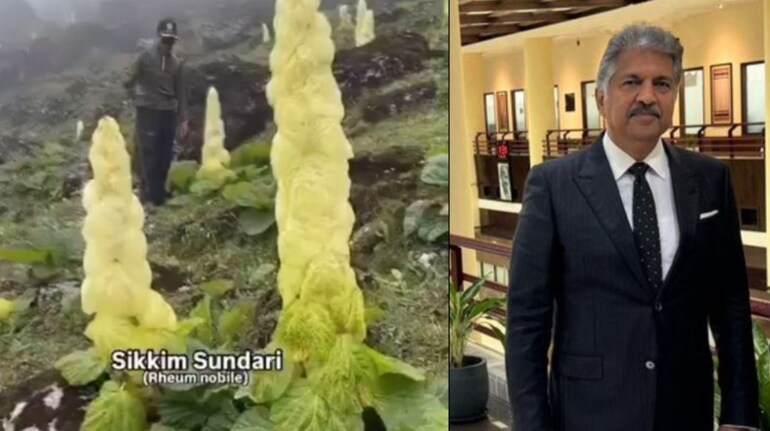
Mahindra Group chairman Anand Mahindra on Sunday shared his admiration for a rare Himalayan plant, calling it one of nature’s most extraordinary creations and admitting that it was never mentioned in his school biology textbooks.
The plant, locally known as Sikkim Sundari or Rheum nobile, grows at extreme altitudes in the Eastern Himalayas and has a life which is a masterclass in patience, as described by Mahindra.
I knew nothing about this extraordinary marvel: the ‘Sikkim Sundari’ Thriving at staggering altitudes of 4,000–4,800 meters, this "Glasshouse Plant" stands like a glowing tower against the mountains. Its life is a masterclass in patience. It is monocarpic, which means that… pic.twitter.com/keoMSmGcUl— anand mahindra (@anandmahindra) December 21, 2025
In a post on X, Mahindra expressed wonder at how such remarkable native species often go unnoticed, while textbooks focus on flora from distant regions. His post focused on the plant, which is found in Sikkim, eastern Nepal and southeast Tibet, at heights ranging from 4,000 to 4,800 metres above sea level.
A plant that waits decades to bloom
Calling it a “masterclass in patience”, Mahindra explained that the Sikkim Sundari spends most of its life growing quietly underground. For 30 years, it survives as a small rosette of leaves, storing energy in harsh alpine conditions marked by freezing temperatures and intense ultraviolet radiation.
Then, in a “single heroic act”, the plant shoots up to nearly two metres tall, forming a towering, pagoda-like structure. It flowers once, releases its seeds, and then completes its life cycle. Mahindra said this slow and purposeful growth was deeply inspiring and symbolic of endurance in extreme conditions.
The ‘Glasshouse Plant’ of the Himalayas
Sikkim Sundari is also known as the “Glasshouse Plant” due to its unique appearance. According to botanical sources such as Flowers of India, the plant has translucent, straw-coloured bracts with pink edges that overlap to form a cone-shaped tower.
These bracts act like a natural greenhouse, allowing sunlight to pass through while protecting the delicate flowers from cold winds and strong UV rays. This creates a warm microclimate inside, helping the plant survive at high altitudes.
Because of its height and pale colour, the plant can be seen clearly from across mountain valleys, standing out against the rugged terrain.
Cultural, medicinal and local importance
Beyond its visual appeal, the Sikkim Sundari has cultural and practical value. Locally known as Chuka, its acidic stems are edible and used in traditional dishes. The plant’s bright yellow roots, which can grow 3 to 7 feet long, are also used in traditional Tibetan medicine.
The plant typically flowers between June and July, making it a seasonal highlight in the high Himalayas. After its single bloom and seed dispersal, the plant dies, a final act after decades of quiet survival.
Mahindra ended his post by encouraging people to explore regions like Sikkim and reconnect with local biodiversity. He also raised an important question why Indian schools do not have these wonders in their curricula. “I wonder if current Indian school curricula finally reference this local legend?” he asked, while concluding his post.
Discover the latest Business News, Sensex, and Nifty updates. Obtain Personal Finance insights, tax queries, and expert opinions on Moneycontrol or download the Moneycontrol App to stay updated!
Find the best of Al News in one place, specially curated for you every weekend.
Stay on top of the latest tech trends and biggest startup news.




