








STT collection is expected to be subdued this year as volumes in the cash and derivative market may remain muted, driven by volatility and hike in securities transaction tax (STT) on future and options trading, said experts.
For FY27, the government has estimated that it will collect Rs 73,700 crore via STT, which is lower than the FY26 budget estimate of Rs 78,000 crore for STT collection. The levy has already seen a dip in FY26 due to reduced volumes especially in the F&O segment prompting the government to revise its STT collection estimate for the current financial year downwards to Rs 63,700 crore.
Trading volumes in the derivatives segment moderated in calendar year 2025 compared to 2024, with the average daily turnover coming down to Rs 2.36 lakh crore in 2025 from average turnover of Rs 3.64 lakh crore in the previous year, a drop of almost 35 percent, trading data from the National Stock Exchange shows.
Similarly, in the cash market, data from Bloomberg shows that the average monthly cash turnover fell in 2025 compared to 2024, to Rs 1.07 lakh crore from Rs 1.24 lakh crore, indicating a similar cooling in trading activity in the cash market. While STT has not been hiked for the cash market, lower volumes, if they continue, will mean lower tax collection.
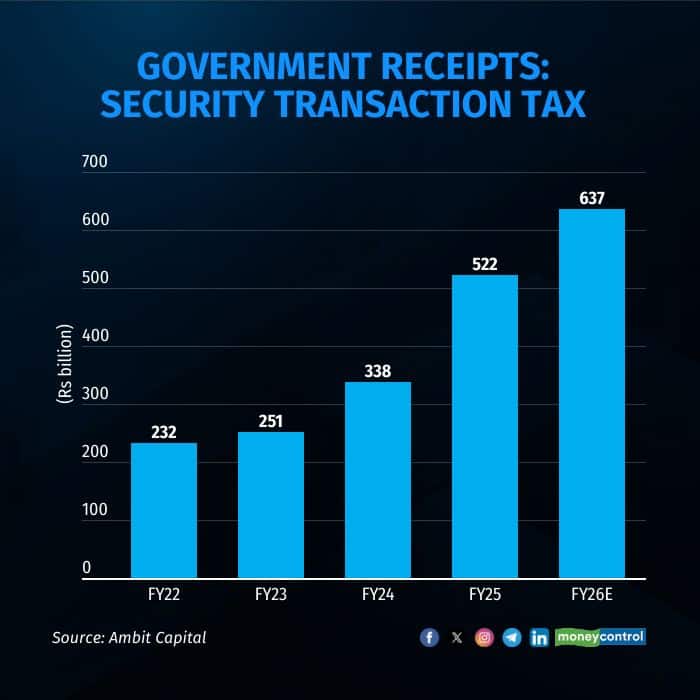 STT Collection
Derivative Market Volumes hit
Increase in STT rates for F&O will further impact the derivative market volume, said brokerages.
“STT on derivatives was sharply hiked to 5/12.5/15bps on futures/option premia/option exercise vs 2/1/1bps earlier. This could hurt volumes and market liquidity, though the retail segment has earlier been resilient to such hikes. Exchanges and broking stocks are the primary losers, but a lack of depth in the market could eventually have consequences for overseas institutional flows,” Emkay Capital said in a note.
JM Financial noted that the hike in STT could have significant impact in volumes for discount brokerages as well as wealth managers, platforms that retail investors and HNIs tend to use for derivatives trading.
“On the whole, this can adversely hit volumes—we estimate that a 5%/10%/20% hit on volumes would dent Angel One’s FY27E PAT by 6%/11%/22% while for Groww, a 5%/10%/20% hit on volumes could drag its FY27E PAT by 4%/7%/14%,” the brokerage said in a report.
“Among wealth managers, we expect Nuvama to be most impacted—a 5%/10%/20% hit on volumes would dent its FY27E PAT by 2%/3%/5%,” it added.
To be sure, some brokerages expect the hike in STT to be tax revenue accretive for the government despite the concerns of the move’s impact on trading volumes.
As per Ambit Capital, while higher STT is intended to curb speculation and protect retail investors, evidence so far suggests a limited impact on overall market activity.
“F&O volumes remain highly price-inelastic, as many retail traders continue to pursue high-payoff strategies where incremental costs are relatively immaterial,” it noted.
The brokerage feels that higher STT rates provide the government with a predictable and administratively efficient source of revenue.
“Given the scale of derivatives turnover, even modest increases in transaction taxes translate into meaningful fiscal inflows. Based on the current market mix and activity levels, STT collections could rise materially over the medium term. The government’s estimate of STT collection in FY26E stands at Rs636 bn, while collection till Jan-26 stands approximately Rs480 bn. Share of STT revenue from F&O stands at ~37% and with the recent rate hikes, we expect STT collection to grow in the near term, even with some decline in volumes,” Ambit said.
Discover the latest Business News, Sensex, and Nifty updates. Obtain Personal Finance insights, tax queries, and expert opinions on Moneycontrol or download the Moneycontrol App to stay updated!
Find the best of Al News in one place, specially curated for you every weekend.
Stay on top of the latest tech trends and biggest startup news.





