








Budget 2026 may not have delivered headline-grabbing tax sops, but taken in totality, it stands out as a taxpayer-friendly budget built on continuity, certainty and simplicity. For individual taxpayers, that itself is a relief.
In a welcome move Finance minister Nirmala Sitharaman proposed to implement the New Tax Act, 2025 from April 1, 2026, which marks a structural shift from the long-standing Income Tax Act, 1961, with the objective of simplifying tax law and improving clarity for taxpayers.
The Income Tax Act, 2025 is a comprehensive law that lays down the framework for the levy, administration, collection and recovery of direct taxes in India. Spread across more than 600 pages, it comprises 536 sections, 23 chapters and 16 schedules, covering virtually every aspect of taxation.
In a further reform-oriented step, the government has lowered the TCS rate on overseas remittances under the Liberalised Remittance Scheme for education and medical expenses from 5 percent to 2 percent. This move comes as a meaningful relief for families facing sharply rising costs of studying or seeking treatment abroad. By reducing upfront cash outgo for essential expenses, the change improves short-term liquidity while maintaining oversight of cross-border transactions striking a balance between taxpayer relief and regulatory discipline.
Following the governnment focus on voluntary disclosures, the proposal is made to give leeway to people who have recently relocated like students, young professionals and salaried employees and may have made genuine mistakes of undisclosing income due to lack of awareness.
A one-time compliance window of six months is a welcome move to help such taxpayers. Undisclosed income could be taxed at 30 per cent but without prosecution. The focus is on encouraging voluntary compliance rather than criminal action.
New Tax Regime Remains Preferred Choice
Over the last few years, Finance Minister Nirmala Sitharaman has steadily reshaped India’s personal tax framework moving away from a maze of exemptions to a system anchored in lower rates, fewer conditions and predictable outcomes. Budget 2026 stays firmly on that path.
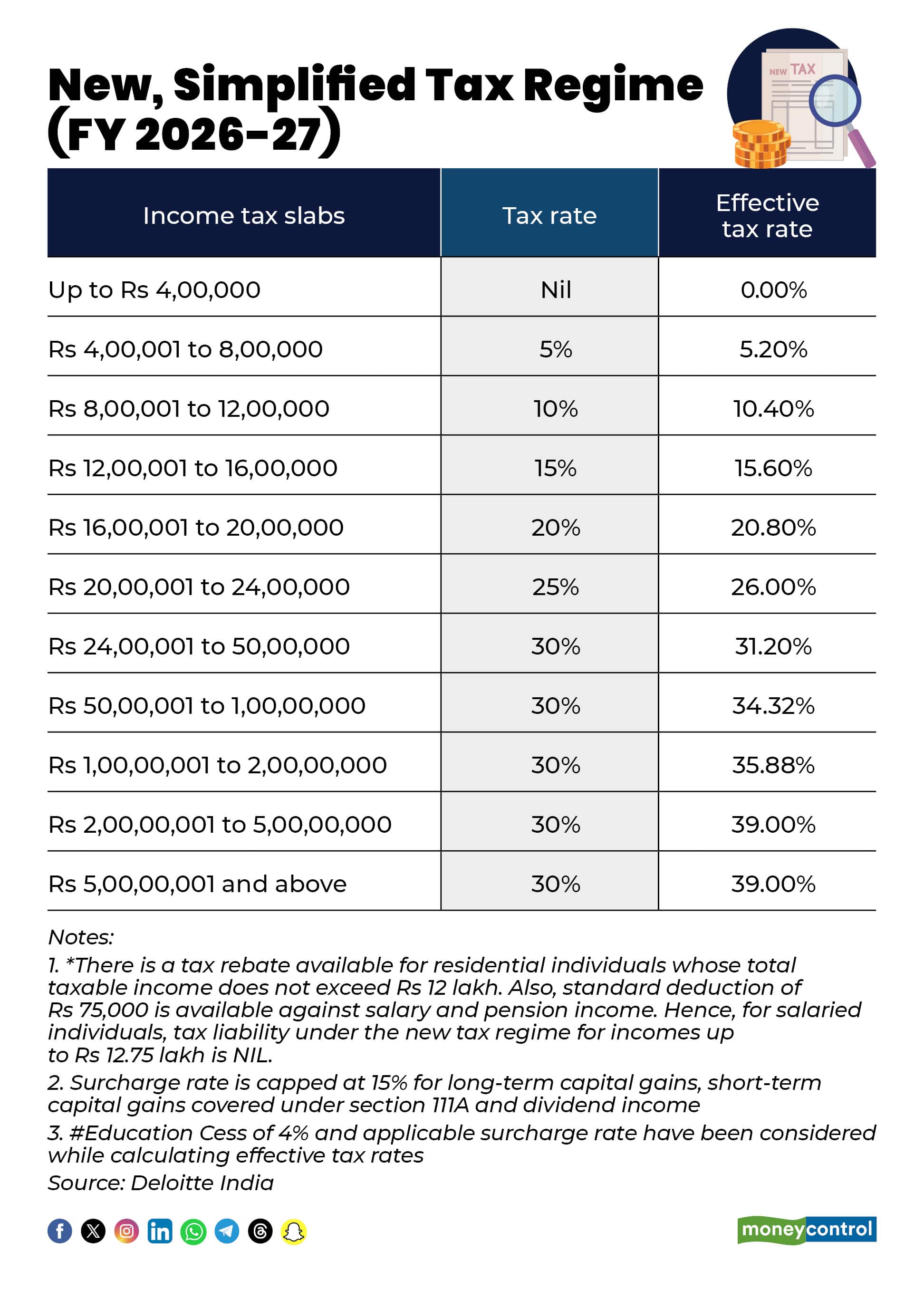
The biggest win for taxpayers has come not in one dramatic announcement, but through incremental changes across recent budgets. The expansion and strengthening of the new tax regime, wider slabs, lower effective rates and a sharply higher rebate threshold have together ensured that a large section of middle-class taxpayers now pay either significantly lower tax or no tax at all. Add to that the higher standard deduction under the new regime, and the math has decisively tilted in favour of simplicity.
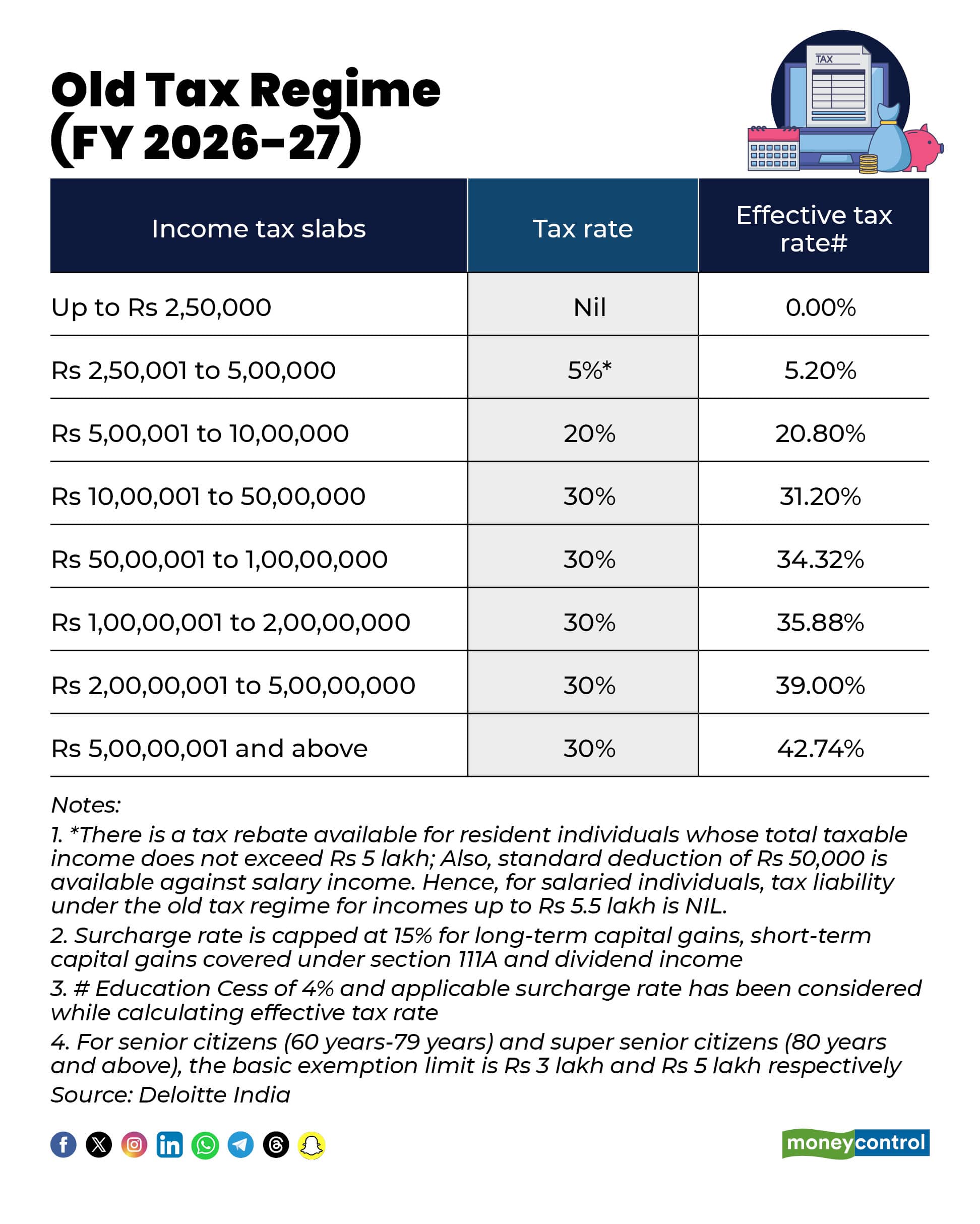
Moreover, the new tax regime follows a more restrained approach, with surcharge capped at 25 percent for incomes above Rs 2 crore, regardless of age. Under the old tax regime, surcharge rates rise steeply with incomen. It is 10 percent for incomes between Rs 50 lakh and Rs 1 crore, 15 percent between Rs 1 crore and Rs 2 crore, 25 percent between Rs 2 crore and Rs 5 crore, and 37 percent for incomes above Rs 5 crore.
As a result, taxpayers in the highest bracket under the new regime face an effective tax rate of 39 percent while it is over 42 percent in the old regime. This makes the new tax regime relatively more attractive for high-income earners.
Surcharge is an additional tax levied on high-income taxpayers over and above the basic income tax, and it plays a significant role in determining the effective tax rate.
What Budget 2026 does particularly well is avoid policy whiplash. After major overhauls to capital gains taxation and slab rationalisation in earlier budgets, this year’s focus on stability sends a clear signal: taxpayers can plan without fear of frequent rule changes. That predictability matters just as much as tax relief.
Old Tax Regime Still Matters
Importantly, the old tax regime has not been dismantled. Those with home loans, HRA benefits and long-term savings commitments still have the option to optimise taxes through deductions. At the same time, first-time earners, professionals and those without complex financial lives can opt for a clean, no-frills tax system.
For AY 2024–25, out of 7.28 crore ITRs filed till July 31, 2024, around 5.27 crore were under the new tax regime, while 2.01 crore remained under the old regime - accounting for roughly 72 percent and 28 percent respectively.
Will Old tax regime continue?
Over decades, the Indian tax system has encouraged household savings through tax-linked instruments like provident funds, insurance, and housing. A sudden withdrawal of the old regime could disrupt long-term financial planning for millions who have committed to these products based on stable tax assumptions.
For now, the debate is less about whether the old regime will be scrapped and more about how long it will coexist alongside the new one.
Budget 2026 is expected to reinforce the government’s preference for simplicity and compliance, but without pulling the plug on a system that still works for nearly a third of taxpayers. For individuals, the message remains unchanged: evaluate both regimes carefully, because choice, at least for now, seems here to stay.
Discover the latest Business News, Sensex, and Nifty updates. Obtain Personal Finance insights, tax queries, and expert opinions on Moneycontrol or download the Moneycontrol App to stay updated!
Find the best of Al News in one place, specially curated for you every weekend.
Stay on top of the latest tech trends and biggest startup news.





