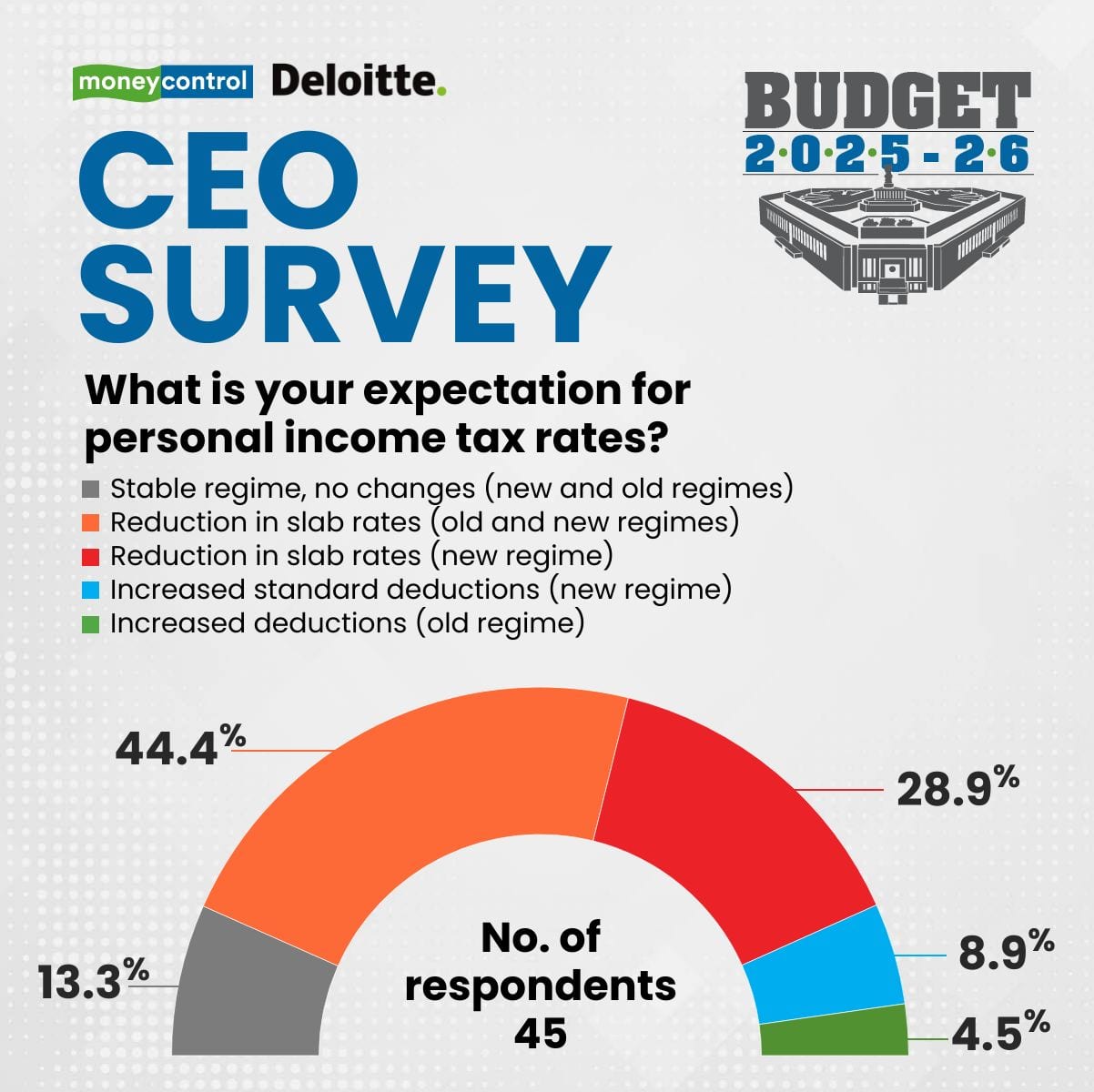
The chorus to reduce income tax slab rates in the upcoming Budget 2025 is growing louder, with over 44 percent of India Inc chief executive officers (CEO) batting for this measure in both old and new tax regimes on February 1, an exclusive Moneycontrol-Deloitte survey of 45 industry leaders showed.
Nearly 29 percent of the respondents said they would like to see Finance Minister Nirmala Sitharaman reduce tax slab rates in the new, minimal exemptions regime.
The study was conducted between January 10 and 22, 2025, across financial services, consumer goods, technology and energy sectors, among others.
Hike in deductions to provide relief to taxpayers
Around nine percent of the CEOs said they were seeking a hike in standard deduction – currently Rs 75,000 – under the new regime. Over 13 percent of the CEOs polled said they were expecting a stable regime, with no changes in either of the income tax regimes.
Sweeping changes in Budget 2024
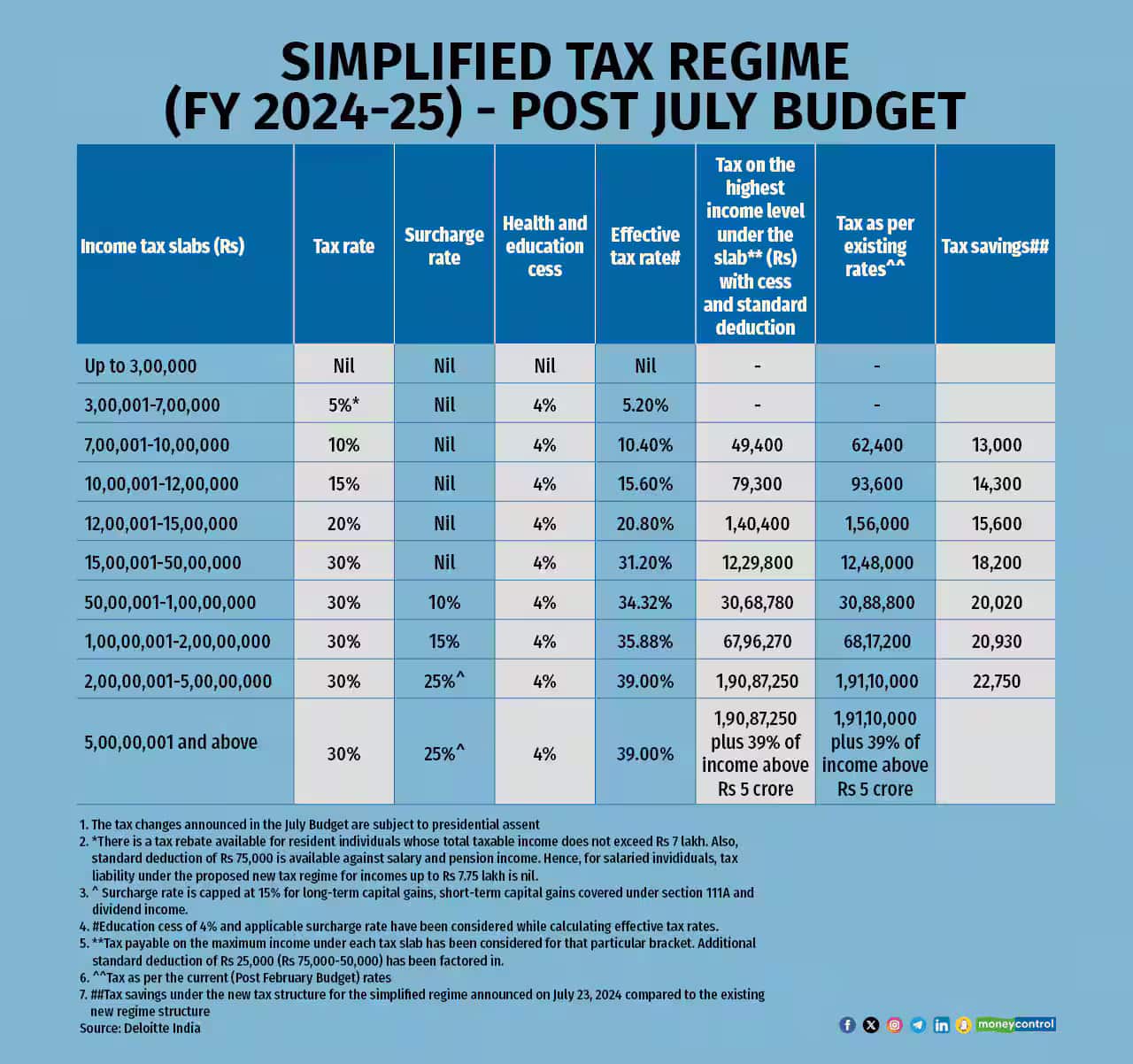
Union Budget 2024 presented in July had introduced a raft of changes to income tax slabs, rates and standard deduction under the new tax regime, besides revamping the capital gains tax structure.
For financial year 2024-25, this is how the income tax slabs and rates under the new regime stack up:
In addition, the finance minister also increased the deduction limit on employers’ contribution to employees’ National Pension System (NPS) account from 10 percent to 14 percent under the new tax regime. The tax break under the old tax regime remains unchanged at 10 percent.
Also read: Top five changes in income tax rules in 2024
Capital gains tax structure revamp in Budget 2024
From FY2024-25, all financial and non-financial assets attract a long-term capital gains (LTCG) tax at 12.5 percent (up from 10 percent in the case of equities), while short-term capital gains (STCG) tax on some assets, for instance equities, is 20 percent.
Moreover, the exemption limit for computing LTCG tax on stocks and equity-oriented mutual fund gains was enhanced from Rs 1 lakh to Rs 1.25 lakh. All listed financial assets held for more than a year are now classified as long-term assets.
On July 23, 2024, the finance minister had reduced the LTCG tax rate on the sale of real estate assets to 12.5 percent from 20 percent, but had also withdrawn the indexation benefits for properties purchased after April 1, 2001. After an uproar, however, the government came up with a solution to soften the tax blow for such individuals.
“The logic of the budgetary proposal on capital gains is that the structure has to be simplified…and to treat all asset classes equally. [Now, after the amendment to the finance bill] tax on the sale of assets purchased before July 23, 2024, can be computed under the old scheme with indexation or the new scheme… and (property sellers can) pay lower tax,” Sitharaman had said on August 7, 2024, explaining the rationale behind the original decision as well as the ‘rollback’.

Discover the latest Business News, Sensex, and Nifty updates. Obtain Personal Finance insights, tax queries, and expert opinions on Moneycontrol or download the Moneycontrol App to stay updated!
Find the best of Al News in one place, specially curated for you every weekend.
Stay on top of the latest tech trends and biggest startup news.