Award-winning Nuala Walsh is CEO of MindEquity Consulting, a former FTSE-50 CMO, Non-executive Director, behavioural scientist, adjunct professor at Trinity College Dublin and Visiting Fellow at the London School of Economics. With 30+ years in global investment management, she has been recognized among the 100 Most Influential Women in Finance and Top 50 Chief Marketing Officers. Today, she consults on reputation management and culture change at Fortune 500 companies, sports and human rights organizations.
Board appointments include President of the Harvard Club of Ireland, Founding Director the Global Association of Behavioral Scientists, Council Member of the Football Association, Chair of the Innocence Project, Advisor at World Athletics and former Vice-Chair at UN Women (UK). A TEDx speaker, she writes for Psychology Today, Forbes, Harvard Business Review, Inc, and has been featured at CNBC, the FT, BBC and Fox Business.
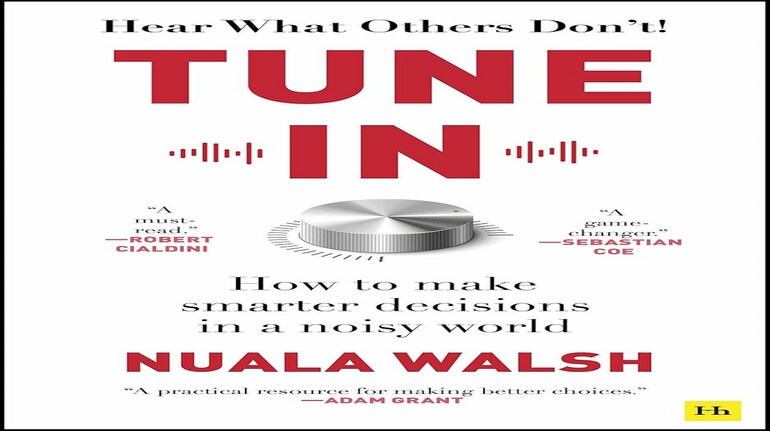
Nuala Walsh’s Tune In: How to Make Smarter Decisions in a Noisy World is packed with information and anecdotes based on her many years of experience. It is the kind of book that one is constantly dipping in and out of. Every time, you visit a page, you learn something new, or manage to look at it with a fresh pair of eyes. Her insistence on the individual tuning in and not being distracted is an important mantra to imbibe. Her sobering but crazy statistic is that people interrupt themselves 44% of the time! With digital distractions this is of epidemic proportions, hampering productivity and self-preservation. She has plenty of examples interspersed with wise advice on how it is possible to cut out the noise and focus; otherwise, it can go horribly wrong as it did for the King of Rock and Roll, Elvis Presley. She explains it brilliantly in the introduction that has been extracted here with permission from the publishers.
Walsh has devised or borrowed various acronyms that encapsulate good wisdom. For instance, the mnemonic SONIC.
Slow down
Organise your attention
Navigate novel perspectives
Interrupt mindsets
Calibrate situations, strangers and strategies
Or this one —BIAS—critical in making decisions. The questions to ask of oneself while fact-checking an important pitch, presentation, or proposal.
Bias: what biases might hinder interpretation?
Intuition: what did I hear that sounded odd or wrong?
Authenticity: what aspects should I probe further?
Signal: what did I not hear that I should have?
Read Tune In. I cannot recommend it enough. It stays with you for a long time. Most likely you will correct your course quietly and steadily by imbibing some of Walsh’s wise advice.
***********
PREFACEDespite popular opinion, the most underestimated risk facing modern society is not economic, political, technological or even climate risk. It’s human decision risk, triggered by our tendency to tune out what really matters.
The cost? Persistent human errors and a collective downgrading of our decisions.
It’s ironic. In a digitised world with countless platforms to express our voice, we hear less than ever. In a visual world saturated with curated images, we’re seen but not necessarily heard.
It’s not our fault, we’re bombarded by an environment that operates against us. Overwhelmed by data, distraction and disinformation, we’ve too little time to pay attention to what truly matters.
You can’t trust all you hear. Why? Because what you hear is rarely all there is.
Most people base decisions on who they see, not what they hear. Most people don’t consider which voices they tune in to. Most people don’t consciously filter the noise around them to decode the right signals when it matters.
We think we hear what matters, but history suggests otherwise. When you think you have the answers, you stop listening and start misjudging.
Today, we misjudge more than ever. But that can change.
In Tune In: How to Make Smarter Decisions in a Noisy World, I reveal why we consistently tune in to the wrong voices, failing to hear what really matters; and why we value what we see more than what we hear. Using decades of scientific evidence, I explain yesterday’s mistakes in order to prevent those of tomorrow.
I offer decision-makers and problem-solvers a menu of easy-to-use techniques to master judgement in high-stakes situations. I highlight the most aggressive derailers that distort what we hear – or don’t hear.
In short, I help you limit decision damage to get more decisions right than wrong. I help you avoid the crippling pain of regret and navigate the modern crisis of tone-deaf leadership.
Tune In is not about listening more or listening better. We already think we’re exceptional listeners and decision-makers. While some of us are, most of us are not. In fact, most of us are binary, biased and bounded in our thinking. The well-intended still only hear at 25% efficiency levels. Even Ernest Hemingway asserts “Most people never listen.”
And there’s no modern app that solves this mental malware.
Tune In is about judging situations more effectively by rebalancing what you see with what you hear and revaluing human explanation over rational explanation.
When you tune in, others feel heard. And only when others feel heard, do they hear you. This is the path to power, performance and prosperity.
While many people appreciate bias blind spots, few recognise the destructive power of deaf spots – until now. What sets Tune In apart is its focus on the dominant hearing-related biases that contaminate our daily decisions.
Who is this book for?This book is for every individual who wants to maximise their decision impact and limit regret. It’s for every ambitious ladder-climber striving to fast-track performance or side-track reputation error. And it’s for the intellectually curious leader and learner, eager to advance their understanding of human behaviour and supplement their professional skillset.
While Tune In doesn’t offer an instant fix, it does provide one guarantee: your impact, credibility and influence will be better off with this understanding than without.
Your decisions matter, more than you think.
In a hyperconnected global world, your decisions may feel small or even insignificant. Yet as a powerholder, each decision can change the direction of someone’s life, whether you’re hiring, firing, entertaining, negotiating, advising, preaching, teaching or issuing executive orders.
Tuning in is the first step to hearing what matters – and what others don’t.
Today, too many employees, customers, environmentalists, citizens, teenagers and minorities feel their voices are not heard. It’s why activism is rising, industries are striking, boards are failing, businesses are imploding, brands are distrusted, and the rate of scandals, scams and suicides is climbing.
Warning bells are not heard until the alarm bells sound.
As problem-solvers, we assume we operate with a full deck of cards. We don’t. Most overlook the hidden ace: understanding human behaviour. Artificial intelligence can’t solve everything. You need human intelligence.
Why did that happen? What did I miss? Why didn’t I see it coming?
Understanding human behaviour empowers you to make sense of the seemingly senseless. For me, that’s as essential as it is fascinating.
But if human error is rising across industries, so is opportunity.
With judgement at an all-time premium, Bloomberg ranks understanding behaviour among the hottest next-generation skills. More than any formal qualification, this psychological edge helps you to make judgements that change lives – yours and those around you.
In a noisy tone-deaf world, mishearing may not be your fault, but course correction is your choice. No one teaches you judgement. It’s expected of those who hold power – and differentiating skill to be mastered.
Mastering judgement begins with appreciating how today’s decisions are shaped by context. I’ll take you on a journey to become a more influential, respected and differentiated tuned-in Decision Ninja, equipped to pre-empt and prevent predictable errors, navigating an era where misjudgement is rising alongside opportunity.
Now, you can harness human insight as an undervalued superpower to live your best life and lead others to do the same.
What can you expect?I think of this book in three ways:
• it’s an insurance policy against future misjudgement;
• it’s a behavioural x-ray that explains past misjudgement; and
• it’s a real-time reputation and performance accelerator
Tune In is structured in three parts.
Part One sheds light on why we tune out and hear less than ever. I explore the nature, scale and cause of the misjudgement problem, explaining how a modern high-speed world affects not only who we hear but also how we decide. I highlight what I call the trilogy of error: psychological blind spots, deaf spots and dumb spots.
This lays the foundation for a pioneering framework introduced in Part Two where I pinpoint ten intangible factors that unconsciously bind and bias our perspectives: power, ego, risk, identity, memory, ethics, time, emotion, relationships and stories. The mnemonic ‘PERIMETERS’ summarises these factors.
I chose this word deliberately to reflect our innate tendency to think in a limited or bounded manner. Passively unmanaged, each factor becomes a potential bias-activating trap because each trap is a predictable source of misinformation.
Collectively, these traps contain a spectrum of 75+ psychological biases, fallacies and effects. But actively managed, each factor can be a rich source of influence, impact and advantage.
I draw on established theories by renowned scholars, esteemed psychologists and decorated scientists, illustrated with a reservoir of handpicked stories I hope you’ll find as meaningful and moving as I do.
Showcasing the art of tuning in the right voices, you’ll hear how a displaced fund manager built a $10 trillion Wall Street empire; an abused wife reinvented as a global rock’n’roll entertainer and an empathetic FBI investigator prompted multiple murder confessions. You’ll also hear how a moon-landing astronaut preferred peer praise to presidential honours; a police officer saved an abducted child after 18 years; and a premier league footballer permanently changed government policy.
You’ll hear how tuning out carries consequences: a CEO stripped of his knighthood; a $65bn fraud that cratered thousands of lives; the greatest miscarriage of justice in British history; widespread Russian Olympic collusion; Silicon Valley founders fired by their own board; and a couple that hid the most barbaric Nazi in history. That’s in addition to persecuted journalists; de-licensed doctors; systemic sexual abuse; maritime disasters; roaming serial killers; and cheating academics.
Each trap warrants a dedicated chapter which you can read independently or revisit when facing a specific decision dilemma.
These judgement traps aren’t exhaustive, the literature on each could fill a library. Appreciating even one can reshape your mindset and retool your skillset. Bullet point chapter highlights are provided for convenience.
To counteract these traps, Part Three unveils an antidote – a menu of 18 science-based strategies that harness what I call ‘decision friction.’ These empirically validated strategies slow down judgement in real time, promote reason over reactance and prevent a predictable rush to misjudgement.
You’ll meet your future self: a confident problem-solving Decision Ninja who skilfully upgrades their judgement capability and preserves both influence and power by selectively tuning in to the voices that matter and tuning out the rest.
The message is clear: when you tune in, you stand out rather than miss out, lose out or get left out.
I know that one book is not enough to neutralise decision risk, but I hope it’s enough to stimulate you to tune in when the outcome matters.
Tune In is simply the start.
INTRODUCTION:THE DEVIL IN DISGUISE
“I am not a product of my circumstances; I am a product of my decisions.”
Stephen Covey
Our decisions stem from the company we keep, our character, external circumstances and context. The internal context of our mind is often underestimated. Even the most highly accomplished individuals can be blind to bias, deaf to decision traps and silent when it matters.
Ironically, even the greatest voice of all time can tune out the voices that really matter.
A LITTLE LESS CONVERSATIONMidway between Tennessee and Alabama nestles Tupelo, a working-class shanty town with a mostly black community. In 1935, a white boy was born in a 300-square-foot, two-room house on 306 Old Satillo Road. For $180, it was built without plumbing or electricity by his hard-working, church-going parents. As I stood within its tiny frame observing the outside WC, I couldn’t help noting the irony that this entire house was smaller than the living room of a property the young man would later acquire for $102,500.
When he was 13, the family relocated to Memphis for a better life. This shy mama’s boy was an outsider in high school and occasionally bullied. After graduation, he drove trucks by day. By night, he embarked on a musical pilgrimage that would change his life.
Lacking formal training, he played guitar by ear and sang with a rare two-and-a-half-octave vocal range. Always experimenting, he fused gospel, pop, blues and country. Over time, his musical experiments would transcend racial boundaries, moulded by the singing style of the black community in which he was raised.
“I don’t sound like nobody,” he declared in 1957.
He didn’t move like nobody either!
His shyness and inhibition evaporated on stage. Electric performances shocked like a supercharged bolt of lightning. His raw talent, smouldering looks and velvety Southern voice seduced audiences everywhere he went. He defied categorisation, “neither male nor female, black nor white, rock nor country.” Growling and grinding, swaggering his hips and quivering his lips, mothers feared this devil in disguise.
His artistic decisions paid off. In 1958, this homespun 19-year-old traded his trucks for Cadillacs and amassed his first million dollars, a far cry from his twin brother’s burial in a pauper’s grave.
Over the next three decades, Elvis Aaron Presley inspired generations and disrupted the music industry forever. He became the greatest solo-selling artist of all time with 18 number one hits, unmatched by Michael Jackson, Madonna or Taylor Swift.
The business changed, but this voice stood the test of time. BB King once said, “To me, they didn’t make a mistake when they called him the King.”
Author Peter Guralnick describes “a transcendent creature of his time. He was so potent... he sort of blew apart the boundaries of his own generation.”
But a sense of invulnerability, exceptionalism and narrow perspective usually accompanies success. Ill-prepared for meteoric fame, Elvis blew apart something else: himself.
The most important determinant of judgement is the context in which you decide – your internal mindset and external environment. In 1957, the same year ‘Jailhouse Rock’ was released, psychologist Herbert Simon introduced the idea of bounded rationality, noting that our perspective is unconsciously bounded by our experience, background, education and social circle. In other words, rational thought is limited by circumstances.
To understand others’ decisions, you must understand their context.
I first visited Graceland in 1990 as a student with my now-husband. As I meandered through the musically adorned gates, I didn’t fully appreciate the effect of context on decisions. That came decades later.
The company we keep and our social connections influence our personal and professional decisions. As astronaut Buzz Aldrin once wrote, “Show me your friends and I’ll show you your future.”
A cocooning inner circle, the “Memphis Mafia” indulged their leader’s every impulsive whim, desperate to quell that famous hair-trigger temper. For 20 years, the on-call ingroup was rewarded with lavish gift-giving and a hedonistic lifestyle. “He was a very kind person. He’d do anything for you. But it was like he was on a roller coaster,” tells Charlie Hodge. A compulsive-obsessive perfectionist, Elvis’s pathological overspending bordered on irresponsibility. He probably signed more cheques than autographs!
It’s not unusual for leaders to surround themselves with compliant enablers, groupies or grabbers. But it’s perilous. The voice of truth is routinely silenced. After all, few bite the hand that feeds them.
When off-stage and off-camera, Elvis stayed within his private sanctuary, enjoying the safe perimeter of the Graceland gates. Sometimes spending weeks in a darkened bedroom, he shut out the world, shielded from reality. A self-imposed isolation fed his worst insecurities as he lived alone in his head. This cloistered bubble shrank his perspective further.
Whether you’re at the top of your game or feeling disillusioned, depressed and depleted, it affects your decisions. Guralnick observes that Elvis “never fully came to terms with the burden of decision-making.”
He didn’t have to.
The superstar delegated his commercial and health decisions to trusted advisers, talismans and tailors. His untrained father became his accountant. He legitimised years of prescription usage, diet pills and comfort food to cope with workplace pressure, fear of failure and exhausting night-time performances.
Many people concede power to others, even when it’s not in their best interests. For decades, he empowered an amateur agent to control his entire business. Initially lucrative, the cigar- munching ‘Colonel’ Parker negotiated multiple self-serving deals. His mother Gladys Presley distrusted the Colonel, saying, “He’s the devil himself.” A grateful Elvis saw things differently, telegramming how he loved him “like a father.”
After his army career in the 1960s, Elvis’s serious acting goals went unfulfilled. Having completed 31 beach-and-bikini Hollywood films, he hankered for more substantial roles. “Those movies sure got me into a rut... the only thing worse than watchin’ a bad movie is bein’ in one.”
But Hollywood paid three times more than music, and fans enjoyed his movies. Manager and client naively signed deals without reading scripts or insisting on quality clauses.
Who stops to think, challenge or probe when on a roll?
Peaks and troughs punctuate most careers. As formidable competitors emerged, like The Beatles, record sales dwindled. But a sensational 1968 television comeback marked a turning point. A New York Times rock critic wrote, “There’s something magical about watching a man who has lost himself find his way home.”
The opportunity was short-lived. Despite owning five private jets, travel ambition slipped away. “I’d like to go to Europe... to Japan... I’ve never been out of the country except in service,” he told a 1972 press conference.
This superstar failed to challenge the familiar voice that puppeteered his life. Despite exceptional power and privilege, the greatest voice of all time didn’t use his voice strongly or frequently enough to be heard.
Why didn’t he take control?
Ex-wife Priscilla suggests it was misguided loyalty and an “inability to stand up to the Colonel... to take responsibility for his own life.” It’s likely the ghost of poverty never left him. It’s also easier to turn a deaf ear to inconvenient concerns than rock the boat, especially with a rising bank balance. The Faustian pact had long been sealed to bankroll a profligate lifestyle.
On the fast-track treadmill, reflection and reinterpretation are luxuries. Elvis admitted, “It’s a fast life, I just can’t slow down.” The high-octane stage performances mirrored his decision style.
Everyone curates their image. Over time, your trademark signature can become a weighty crown. “The image is one thing and the human being is another. It’s very hard to live up to an image,” Elvis lamented. Priscilla explained, “His public wanted him to be perfect while the press mercilessly exaggerated his faults.” In today’s digital world, little has changed.
Like any customer-focused brand, the King was in tune with his audience. Addicted to their unconditional validation, fidelity and fatherhood couldn’t compete. Double standards and serial philandering resulted, despite spirituality and nocturnal Bible-reading.
Facing divorce and insolvency, in 1973, his entire back catalogue of 650 recordings was sold in what was widely regarded among the worst deals in musical history. A gruelling tour followed, topping 168 events. The full-on, frantic cycle exacerbated his existing health conditions and a long-standing amphetamine addiction.
While the world clamoured to hear Elvis’s voice, who did he hear?
Were there so many voices, he couldn’t tune in to the right one?
Was his ego so dominant, he dismissed contrary views in deaf ear syndrome?
Despite the power to live his best life and ability to masterfully reinterpret songs, he didn’t reinterpret red flags or heed the voice of advice when it mattered most.
His fawning entourage didn’t hear his voice either. He wrote, “I feel so alone... I don’t know who I can talk to anymore. Or turn to.”
One by one, the women in his life left him. They couldn’t control him, and he couldn’t control himself.
CEOs, celebrities, songwriters and high achievers often feel isolation. Feminist firebrand Sinéad O’Connor captures the loneliness of touring well. “There were a lot of people around me but no one could see me... and I couldn’t see myself.”
Legendary tennis player John McEnroe understands too, “For most of your life as a tennis player, you’re out there alone. For better or worse, it’s just you – and that can be terrifying.”
From the top, the only way is down.
For Elvis, cracks penetrated that perfect celluloid image of slicked back hair and Cherokee cheekbones. “Just because you look good don’t mean you feel good.” A sense of purpose eluded him, grasping at numerology and astronomy for answers.
By 1976, chronic depression had set in. “I’m sort of getting tired of being Elvis Presley,” he told his producer. Close friend Jerry Schilling observed, “He had a sadness, a loneliness. He was trying to fill a void that couldn’t be filled.”
Overworked and overweight, he prioritised paying his 39-strong team. Why not course correct? He would say, “There are too many people who depend on me. I’m too obligated. I’m in too far to get out.”
Like many powerholders, fear of anonymity, extreme cocooning and a dwindling bank balance can dwarf rational perspective. The lyrics, “We’re caught in a trap, I can’t walk out,” were hauntingly prophetic.
A high-speed lifestyle peppered with both brilliant and misguided decisions finally took its toll on this once-in-a-generation talent.
With the last volt of supercharged energy stolen, in 1977, the world lost a legend.
The King was dead.
MOMENTS THAT MATTERAs I finalised this book, I found myself drawn to revisit Graceland after nearly four decades. I wanted to place the human decision-making journey, and perhaps even my own life, in context. As I re-entered the musically adorned gates, once again accompanied by my husband, I appreciated more fully the rapid passage of time, the value of legacy and the destabilising effect of context, character and company on our decisions.
I’m not a die-hard rock’n’roll superfan, but I felt unexplained regret at the premature loss of supreme talent and a voice that pervaded my childhood.
Perhaps it’s also because over three decades in investment management, I witnessed superstar colleagues prematurely short-change their lives and self-sabotage their careers as they tuned in to the wrong voices and rushed to misjudgement.
Like many, I too sacrificed much on the altar of ambition to reach the C-suite in a male-dominated industry. As a serial workaholic, my perspective started and stopped at the office door – it was my Graceland.
I loved my job, accumulating enough airmiles to orbit the sun. I had the privilege of money-can’t-buy opportunities, interviewing presidents and dining with moon-landing astronauts. I met heroes and villains, Hollywood legends, royalty and Olympic champions. I share some of these stories later.
But in my tunnel-visioned rush to acquire the next badge or vanity title, I didn’t always read the signals, decode subtle messages or listen to the right voices when it mattered. At times,
I was ‘tone-deaf ’ as an industry-feted leader once told me early in my career when I wanted to do the right thing rather than the convenient thing.
Today, out of the corporate rat race with the luxury of reflection, as a behavioural scientist sitting on boards, lecturing in universities and advising blue-chip companies, I appreciate just how much selective tuning in is an underestimated source of power – and tuning out is a universal judgement killer.
Whether you’re a superstar, surgeon, parent or plumber, no one wants to make decisions that harm the well-being of ourselves or others. Yet we do.
No algorithm currently exists that prevents poor judgement. It’s a moral responsibility that starts with you. As Jerry Schilling says, “Only Elvis could save Elvis.”
His short-circuited career could have concluded so differently. In a frantic people-pleasing world, would you have made better choices? Would you have asked questions and questioned answers? Or tuned in to other voices? We want to think so. I stand in no moral judgement as we can’t predict behaviour, but we can predict bias.
In this book, I argue we unconsciously fall into similar power, emotion, ego, identity and relationship-based traps that squander opportunity and stop us living our best life. We’re not superior in our own kingdom, regardless of age, title, talent, income or background.
We make similar mistakes. We underweight risk of excess and impulsivity, accepting information at face value. We pay homage to career over family, money over ethics, living for today not tomorrow.
We rely on what we see, not what we hear. We hear fake news, hate speech and flattery over the voice of truth, nuance and contradiction.
We encode misinformation rather than decode information.
We ignore the voices of conscience, wisdom and history. Instead, we tune in to our applauding crowd, inbox fans and short-term rewards.
Could tuning in to different voices and alternative interpretations have highlighted red flags? Perhaps. The truth is we can learn from history and science – and that is the purpose of this book.
Elvis’s cautionary tale isn’t unique. The factors that influence decisions contain judgement traps faced by all of us. Why? Because they’re human traps that lead us astray.
I identify ten categories of misjudgement traps, each varying in intensity and impact.
Each of these traps may seem obvious or even familiar in a day-to-day setting, but just as they are familiar, they exert an unconscious effect on our decision-making process. That makes them potentially dangerous decision derailers.
Ask yourself how each of the following factors might influence your reasoning during high-stakes decision-making:
Power: your elevation of idols, authorities or experts.
Ego: your commitment to your own ideas above others.
Risk: your appetite for thrills and intolerance of doubt.
Identity: your craving to curate image and impress.
Memory: your ability to accurately recall data.
Ethics: your capacity to resist temptation or wrongdoing.
Time: your tendency to live in the past, present or future.
Emotion: your aptitude to regulate impulse and excess.
Relationships: your predisposition to follow the crowd.
Story: your readiness to accept stated narratives as fact.
If you’re like most people, you’ll recognise most of these. Each PERIMETERS trap is underpinned by multiple psychological blind spots, deaf spots and dumb spots that contribute to tuning out the signals that drive high-impact decisions and outcomes.
Despite popular opinion, I believe the most underestimated risk facing this generation isn’t economic, political, cyber or even climate risk. It’s human decision risk and the ability to hear what really matters.
Your decisions matter a lot more than you think.
You’re like the essential 12th juror in a court of law that shapes the direction of others’ lives. Other people depend on you making the right call.
That crown carries a heavy weight of expectations about ascertaining what’s right, fair, necessary or reasonable. Expectations exist whether you’re a household name, umpire, doctor, referee, lawyer, trader, judge or parent.
As decision-makers, naturally you get many calls right, but your errors can be disproportionately damaging. A substantial body of research attributes disasters to human error. It accounts for 94% of road accidents, 88% of cyber-attacks and 80% of aviation accidents. Even medical misdiagnosisis the fourth leading cause of death in the US. Moreover, human error underpins cult followings, scams, scandals, miscarriages of justice, and much more.
Human error starts with tuning out the voices that matter: unheard customers, employees, voters, patients, mavericks or minorities. It’s why business and governments are so distrusted.
And why activism is rising, countries polarising, start-ups imploding and mergers failing.
Understanding why isn’t an academic exercise or indulgent pastime. It’s essential to business sustainability, economic livelihoods and leadership legacies.
Unfortunately, accountants or auditors don’t factor human decision risk into spreadsheets, scenarios or systems. Its significance is overlooked until it’s too late. There is no formula to calculate psychological risk, but the cost of ignoring it is incalculable. It warrants a far greater platform than it currently receives whether in business, sport, medicine, law or government.
Tuning out is a universal judgement killer. There’s always a price to pay; that price is human error and a collective downgrading of our decisions.
You pay that price, and so do others.
Intellect, wealth, status and occupation provide little insulation from human error, whether it originates from mountain climbers, journalists, serial killers, students, venture capitalists, billionaires, therapists or rogue traders. Notwithstanding many good judgements of such professionals, their misjudgements are explored in this book. The same individual can be incredibly smart and incredibly stupid.
So why do we tune out and how can we prevent it?
Success lies in slowing down long enough to selectively hear the right voices. You don’t want to hear every voice, the first voice, most senior voice or even the loudest voice, just the right voice for a given situation.
Despite the advances of artificial intelligence, there’s no code for regret-free judgement. Some 80% of leaders admit their organisations don’t excel at decision-making – and over half of all decisions are found to be ineffective anyway. In a 10-year study, 45% of CEO candidates claimed responsibility for a decision disaster that either cost them a title or severely damaged a business.
It’s no wonder decision error costs the average Fortune 500 company an estimated $250m annually, as suggested by McKinsey. That’s why honing judgement skills matters now more than ever.
In a noisy world, misjudgement is not entirely your fault, but better judgement is certainly your choice.
THE SOUNDTRACK OF YOUR LIFEThe million-dollar question is how to resolve the misjudgement puzzle. People crave a singular explanation, but there is none. Human behaviour isn’t linear, it’s complex with intertwined motivations and over 200 labels that explain ‘tone-deafness.’ Every day, we make an estimated 35,000 decisions, 95% unconsciously.
However, opportunity exists.
Humans are predictable, and what’s predictable is preventable.
That’s why I outline an antidote of 18 science-based solutions that boost interpretation ability and feed your ‘sonic intelligence.’ These include second-order thinking, probabilistic thinking, nudges, reframing, the Janus option and what I call ‘decision friction.’
In this book, you’ll learn how to fine-tune your interpretation and judgement skills to prevent crises before it’s too late. With a diagnostic for every decision dilemma, you’ll save time, filter misinformation quicker and architect decisions with higher impact.
It’s my hope that more decision-makers, whether global leaders, policymakers, entrepreneurs, aspiring professionals and especially my own nieces and nephews, will appreciate how human understanding helps navigate this world regret-free.
The shy boy from Tupelo had a simple philosophy: “Truth is like the sun. You can shut it out for a while but it ain’t going away.” If he had slowed down long enough to reinterpret critical voices, his life might have turned out differently.
His story is our story. He paid a heavy price – you don’t have to.
His story reflects the premium placed on smart judgement and the key themes in this book:
• the odds are stacked against good judgement in a high-speed, visual, data-driven, polarised and tuned-out world;
• understanding behaviour and separating what’s logical from what’s psychological can convert cognitive liabilities into assets; it makes the difference between being heard and
unheard, between preserving power and losing power;
• by recognising deaf spots before drawing conclusions, you rebalance what you see with what you hear; it takes mere seconds of reasoning, reflection and reinterpretation.
Whether you want the corner office, a medal or a Mercedes, the smartest thing you can know is who to listen to – and who not to. If you don’t, ask yourself, who else will suffer?
Tuning in can be a performance game-changer as well as a career differentiator, reputation accelerator and life enhancer.
I make it easier for you to hear the right voices and harder to hear the wrong voices. That way, it’s more likely you’ll hear others’ voices – and others will hear you. Because you can’t always trust the sources you hear, your insurance policy lies in reevaluating the messenger and confidently reinterpreting the message in real time.
This book shapes the story of every individual who wants to live their best life and enrich the lives of others. I truly believe you can, with a better understanding of human behaviour. There are few guarantees, but I offer one: you’ll get a lot further with this behavioural insight than without.
Success, as you define it, hinges on selectively tuning in what really matters and tuning out the rest.
If discounting human risk will short-change your life, appreciating it can change your life.
It’s time to tune in.
Nuala Walsh's Tune In: How to make smarter decisions in a noisy world; Harriman House, Hampshire, Great Britain. 2024. Pb. Pp. 420, INR 599Discover the latest Business News, Sensex, and Nifty updates. Obtain Personal Finance insights, tax queries, and expert opinions on Moneycontrol or download the Moneycontrol App to stay updated!
Find the best of Al News in one place, specially curated for you every weekend.
Stay on top of the latest tech trends and biggest startup news.