






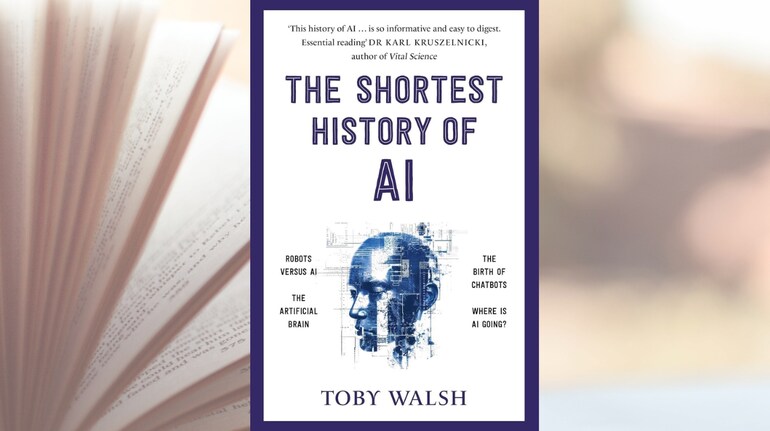
Excerpted with permission from the publisher The Shortest History of AI, Toby Walsh, published by Picador India.
******
THE END OF WORK
One pressing risk is the impact that AI will have on work. Sensational headlines regularly warn of technological unemployment and make dire predictions such as that AI might put half of us out of work. As ever, the reality is likely to be far more nuanced.
One of the earliest, most detailed studies in this area came out in September 2013 from the Oxford Martin School at the University of Oxford. A report summarising this research predicted that 47 per cent of jobs in the United States were under threat of automation. Similar studies have since reached broadly similar conclusions for other countries. Now, there’s a lot to disagree with in the Oxford report. But even if you agree with its findings, there are many reasons why you cannot conclude that half of us will be unemployed.
First, the Oxford report merely estimated the number of jobs that are susceptible to automation. Some of these jobs won’t be automated in practice for economical, societal, technical and other reasons. For example, we can pretty much automate the job of an airline pilot today. Indeed, most of the time, a computer is flying your plane. But society is likely to continue to demand the reassurance of having a pilot on board, even if they are just reading on their iPad most of the time. As a second example, the Oxford report gives a 94 per cent chance that the job of repairing bicycles can be automated. But it is likely to be very expensive and difficult to automate this job, and therefore uneconomical to do so. And I’ve yet to meet a roboticist who is trying to build a bicycle repair robot.
Second, we also need to consider all the new jobs that technology will create. For example, we don’t employ huge numbers of people setting movable type anymore. But we do employ many more people in related digital roles – making web pages, for example. Of course, if you are a printer and your job is replaced by a machine, it helps if you’re suitably educated so you can reposition yourself in one of these new industries.
Third, some of these jobs will only be partially automated, and automation will in fact enhance our ability to do the job. For example, the Oxford report gives a 63 per cent chance of the role of a geoscientist being automated. However, automation is likely to permit geoscientists to do more geoscience. Indeed, the US Department of Labor actually predicts that the next decade will see a 10 per cent increase in the number of geoscientists as we seek to make more of the planet’s diminishing resources.
Fourth, we also need to consider how the working week will change over the next few decades. Most countries in the developed world have seen the number of hours worked per week decrease significantly since the start of the Industrial Revolution. In the United States, the average working week has declined from around 60 hours to just 33. Other developed countries are even lower. German workers only work 26 hours per week. If these trends continue, we may need to create more jobs to replace those lost hours.
People forget that the weekend was an invention of the Industrial Revolution. Workers demanded to have Sunday off to go to church, and then to have Saturday off to rest. But, for reasons I’ve never understood, we stopped asking for more. There are, however, a number of studies on four-day working weeks being conducted around the world. Invariably these studies demonstrate that people are just as productive in four days of work as five – so we can pay them as much – and that people are happier. Who would have imagined?
Fifth, we need to consider changing demographics. Most developed countries have ageing populations: more of us are retired, supported by fewer and fewer people of working age. The improved productivity that AI brings may be needed just to keep our economies afloat and the retired in pensions.
It’s hard, then, to predict with any certainty how many of us will really be unemployed due to AI, but it is unlikely to be half the population. Society in its current form will break down well before we get to 50 per cent unemployment. AI is nevertheless going to have a huge impact on work, and we need to start planning for and mitigating against this disruption today.
Finally, while jobs may be displaced, there’s plenty of work done today that we don’t yet properly recognise and reward – for example, time spent looking after the elderly, the young, people with disabilities. This is work – largely done by women – that we could perhaps afford to pay for in a future where AI is providing significant productivity gains. Now that would be a fine future!
FUTURE CHALLENGES
The future of work isn’t the only issue we need to worry about today. There are many other impacts that AI will have. A powerful technology like artificial intelligence is a double-edged sword. Along with the many benefits – perhaps none more important than the transformation of medicine and education – come many risks.
In August 2023, the Science, Innovation and Technology Committee of the UK House of Commons did a good job identifying some of the most important challenges posed by AI.
▶ The Bias challenge. AI may create or perpetuate biases that society finds unacceptable.
▶ The Privacy challenge. AI may identify individuals or provide personal information about them beyond what the public expects.
▶ The Misrepresentation challenge. AI may generate content that misrepresents someone’s behaviour, opinions or character, as well as about important issues like the climate or political parties.
▶ The Access to Data challenge. The most powerful AI systems require access to very large datasets, which are held by a few organisations.
▶ The Access to Compute challenge. The most powerful AI requires access to significant amounts of computation, available to only to a few organisations.
▶ The Black Box challenge. AI models often cannot explain why they produce a particular result.
▶ The Open-Source challenge. Making AI code openly available may promote transparency and innovation but may enable bad actors to commit harm. On the other hand, making code proprietary may prevent this but may concentrate market power.
▶ The Intellectual Property and Copyright challenge. Large AI models are often trained on copyrighted content without the consent of owners or their compensation. It remains uncertain then who owns the outputs.
▶ The Liability challenge. If AI models are used by third parties and cause harm, we must establish who bears any liability.
▶ The Employment challenge. As I’ve discussed, AI will disrupt the jobs that people do and that are available to be done. We must manage this disruption carefully.
▶ The International Coordination challenge. AI is being developed around the world, so any governance frameworks to regulate it require international cooperation.
▶ The Existential challenge. AI might pose a threat to the human species itself.
This is a pretty worrying list of challenges. And it’s not even exhaustive; I can think of several other challenges that AI poses. There’s the Environmental challenge of large AI models producing CO2 and consuming cooling water, as well as the Democratic challenge posed by AI being used to influence voters and upset elections around the world. And indeed, most of these “future challenges” are in fact also present challenges. For example, multiple class-action suits about intellectual property and copyright are underway in the US against companies like OpenAI. Can technology companies use vast amounts of copyrighted material to train large language models without consent or compensation? Is it fair use to do so?
It’s impossible to say how such legal cases will play out. Previous lawsuits that might help set precedents have gone both ways. In 2013, Google won a class-action suit brought by the American Authors Guild that recognised the scanning and summarisation of millions of texts by Google Books as fair use. The US Supreme Court upheld this ruling in April 2016. On the other hand, Napster ceased operations in 2001 after losing multiple lawsuits about copyright infringement, despite identifying and blocking 99.4 per cent of infringing material.
One thing is clear: the road ahead will be bumpy.
hen people ask me if I’m optimistic or pessimistic about the challenges that AI poses, I say that I’m both. I’m optimistic that AI will ultimately bring great benefits. But in the short term, I’m pessimistic. Sadly, our children are set to inherit a worse world than the one we were born into, due to a raft of problems, some of which are caused by AI, such as technological unemployment and distrust in the very institutions that we now need most.
The next decade or two will be challenging. Technologies like AI could help us tackle many of these problems. But to profit from AI, we will need to learn from history. Social media, for example, should have been a wake-up call for how technology can disrupt our lives. We are now about to supercharge this disruption with AI. We had better learn then from the lessons of the past.
Perhaps this book isn’t a bad place to start?
**********
Toby Walsh, The Shortest History of AI, Picador India, 2025. Pb. Pp.216
In The Shortest History of AI, Toby Walsh takes us through the journey behind AI’s ‘overnight success’ to show how its recent skyrocketing popularity has been decades in the making. AI has been a part of our lives for centuries – from the first mechanical computer in 1837 to today’s chatbots, robots and self-driving cars.
But how did machines meant to follow simple instructions, read and do math become smart enough to write Shakespeare-style poetry, beat world champions at chess, and offer viable solutions to humanity’s problems? What lies in store for AI? Is it going to graduate to take over more complex jobs? If so, what might happen to our work, society, governance, healthcare – and life as we know it?
This brief history slices through the wild claims, myths and speculated threats to explain AI technology, its challenges, capabilities and how it is likely to shape the world in the future.
The chapter from where this book extract has been taken is a balanced view of the future of human work in the age of AI. While Walsh addresses the very real fears of many, he also points out the opportunities that lie ahead.
Coincidentally, this prime preoccupation of human work being done at a quicker speed by computers has been mentioned by Douglas Adams in his bestselling book The Hitchhiker’s Guide to the Galaxy. It was first published in 1979 by Pan Books, an imprint of Pan Macmillan Books. Nearly fifty years ago, this story made its first appearance. Yet, here we are in 2025, grappling with these very same problems in the real world. Not “many many millions of years” ago.
In chapter 25, Adams writes about a super computer that is sentient. It is conversing with the two programmers, Lunkwill and Fook, who switch it on, when they are disturbed by two angry philosophers, Majikthise and Vroomfondel. Here is a snippet from the chapter that is truly illuminating given the book extract from Tom Walsh’s book. Context matters.
Many many millions of years ago a race of hyper-intelligent pan-dimensional beings (whose physical manifestation in their own pan-dimensional universe is not so dissimilar to our own)…built themselves a stupendous super-computer which was so amazingly intelligent that even before its data banks had been connected up it had started from I think therefore I am and got as far deducing the existence of rice pudding and income tax before anyone managed to turn it off.
It was the size of a small city. ….On the day of the Great On-Turning two soberly dressed programmers with briefcases arrived and were shown discreetly into the office. They were aware that this day would represent their entire race in its greatest moment….
…
The subtlest of hums indicated that the massive computer was now in total active mode. After a pause it spoke to them in a voice rich, resonant and deep.
It said: ‘What is this great task for which I, Deep Thought, the second greatest computer in the Universe of Time and Space, have been called into existence?”….
A sudden commotion ….the door flew open and two angry men wearing the same coarse faded-blue robes and belts of the Cruxwan University burst into the room, thrusting aside the ineffectual flunkies who tried to bar their way.
…
‘We are quite definitely here as representatives of the Amalgamated Union of Philosphers, Sages, Luminaries and Other Thinking Persons, and we want this machine off, and want it off now!’
‘What’s the problem?’ said Lunkwill.
‘I’ll tell you what the problem is, mate,’ said Majikthise, ‘demarcation, that’s the problem!’
‘We demand,’ yelled Vroomfondel, ‘that demarcation may or may not be the problem!’
‘You just let the machines get on with the adding up,’ warned Majikthise, ‘and we’ll take care of the eternal verities, thank you very much. You want to check your legal position you do, mate. Under law the Quest for Ultimate Truth is quite clearly the inalienable prerogative of your working thinkers. Any bloody machine goes and actually finds it and we’re straight out of a job, aren’t we? I mean what’s the use of our sitting up half the night arguing that there may or may not be a God if this machine only goes and gives you his bleeding phone number the next morning?’
Both the books mentioned here have been published by Pan Macmillan.
Toby Walsh is one of the world’s leading researchers in Artificial Intelligence. He is a Professor of Artificial Intelligence at the University of New South Wales and Chief Scientist at its new AI institute, UNSW.ai. Walsh has been profiled by the New York Times and is the author of four previous books about AI for general readers, including Machines Behaving Badly and Faking It: Artificial Intelligence in a Human World. The winner of multiple prestigious awards, including the Humboldt Prize and the Celestino Eureka Prize for Promoting Understanding of Science, his X account was voted in the top ten to follow to keep abreast of developments in AI.
Discover the latest Business News, Sensex, and Nifty updates. Obtain Personal Finance insights, tax queries, and expert opinions on Moneycontrol or download the Moneycontrol App to stay updated!
Find the best of Al News in one place, specially curated for you every weekend.
Stay on top of the latest tech trends and biggest startup news.




