




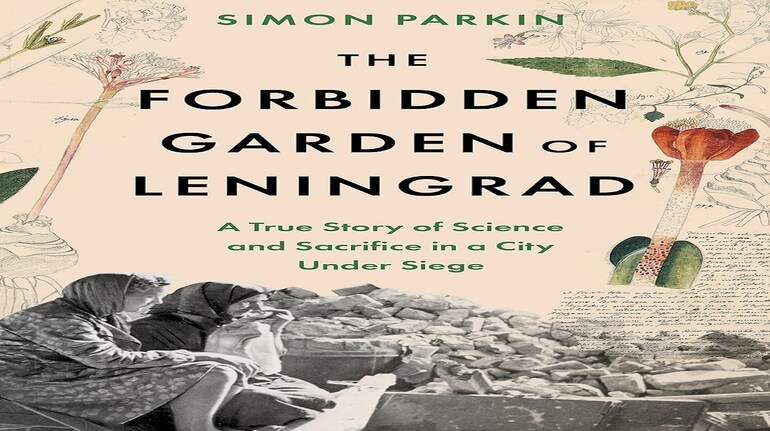
Excerpted with permission from The Forbidden Garden of Leningrad: A True Story of Science and Sacrifice in a City under Siege by Simon Parkin, published by Sceptre/Hachette India
An Explorer Vanishes
UKRAINE, AUGUST 1940
i.
On 6 August 1940, as sunlight knifed through the clouds overhead, Nikolai Vavilov and some of his colleagues gathered outside a youth hostel in the town of Chernivtsi in south-western Ukraine. On the far side of the continent, Adolf Hitler’s troops had overrun France and were poised to invade Britain, where aerial dogfights busied the skies above the home counties. The botanists spared little thought to the foreigners’ war this morning, however. The atmosphere was one of high-spirited adventure, a mood set by the group’s eminent and ebullient fifty-two-year-old leader.
Few things thrilled Vavilov so much as an expedition to an unfa- miliar region. He was a natural pioneer. ‘If you have ten rubles in your pocket: travel,’ he often urged his friends. His instinctive excitement today was compounded by a sense of mission: a quest to find and collect new varieties of plant to be returned to the seed bank, which during the past twenty years had become renowned throughout the world. These trips were to Vavilov as panning for gold is to prospectors. Each day the same thrilling proposition: what blank spaces in the collection might be filled by sundown?
Soon after he and his young team had arrived in the city now known as Leningrad, two decades earlier, Vavilov had secured new, larger premises, a three-storey nineteenth-century tsarist palace grand enough to house the world’s first seed bank. Designed by the architect Ivan Yefimov, it was enviably placed at 42 and 44 Herzen Street, just off St Isaac’s Square in the centre of the city. From this base Vavilov and his staff began to travel the world seeking rare seeds, tubers, roots, and bulbs to bring to the seed bank to be sorted, catalogued, and stored.
The mission was urgent. Everywhere conflict, natural disaster, and the destruction of habitat threatened to make certain types of plant extinct. Once destroyed, these specimens and their unique characteristics would be irretrievably lost; no amount of genetic tinkering could bring them back. The extinction of unexamined plant varieties could mean the loss of world-changing medicines, or supercrops that could enable communities and nations to protect themselves against famine.
The idea of a seed bank was novel, and the long-term value of a repository of genetic plant material yet to be fully understood. Some viewed Vavilov’s project as an eccentric waste of time and money. Undeterred, Vavilov and his team had, within a decade of their arrival, made great gains in their mission, replacing the initial collection that had been eaten by their predecessors during the Revolution years, and substantially adding to it. By 1933, the bota- nists had collected at least 148,000 live seeds and tubers, their work motivated by the repetitious waves of famine in Russia, which provided a clear and harrowing link between the theoretical scien- tific work and its practical ambition to establish food security.
The seed bank had become world-famous. As a journalist for The Times of London wrote that same year, it was a ‘living museum . . . unrivalled in completeness by any other collection in the world’. Scientists had started to refer to the project simply as ‘the world collection of plants’. The Plant Institute became a match- less library of the planet’s flora that contained enough latent life to – once planted, grown, and harvested – feed every citizen within Leningrad, the Soviet Union, and elsewhere besides.
By the time he arrived in Ukraine, Vavilov had led one hundred and fifteen excursions into sixty-four countries and countless cities, from Ethiopia to Kazakhstan, Tokyo to Los Angeles, the Sierra Madre to the Silk Road. Today’s trip to the Carpathian Mountains was closer to home than many of Vavilov’s more exotic sojourns, but no less rich with potential. He believed that several thousand years ago, early explorers had carried with them wheat plants from north-east Africa to Europe. Perhaps, he reasoned, descendants of the plants that once fed the people of Egypt and Babylon during the time of the first pharaohs had survived somewhere within the mountain range. Any ancient wheat plants that had endured centu- ries of cold air in the northern steppes could be ideal candidates for Vavilov’s current mission: to breed supercrops able to withstand inhospitable climes in the northern regions of the Soviet Union.
Outside the hostel, Vavilov readied his empty backpack, which he hoped to fill with seeds and specimens before nightfall.
ii.
Experience had not dulled Vavilov’s childlike sense of wonder. As his friend the eminent English biologist Professor Cyril Darlington once put it: ‘Wherever he went, Vavilov took sunshine and courage.’ He was charismatic and magnetic, described by the American Nobel Laureate Hermann Müller as ‘more life-loving, life-giving and life- building than anyone else I have ever known’. Nevertheless, the past twelve months had been trying. International fame and status had pushed Vavilov unwillingly into the shadow world of Stalin-era politics. Stress had reduced his health. One colleague noted that the ‘old sparkle’ had left the botanist’s eyes, along with his ‘usual slightly ironic cheerfulness’. The doorman at the Plant Institute noticed how he became short of breath whenever he climbed the building’s grand staircase. ‘It’s my heart, my dear fellow,’ Vavilov confided.
Counter to his genial mien, Vavilov had become increasingly prone to fits of rage, which burned out quickly, leaving him feeling awkward and embarrassed. ‘The brakes are getting worn down,’ he muttered to his staff, by way of apology. By the time he reached Chernivsti, Vavilov had amassed a collection and, with houses in Moscow, Leningrad, and Pushkin, a life that was the envy of bota- nists around the world. Yet it was partly the jealousy of his peers that had needled at Vavilov’s health and led him on several occasions to attempt to resign from his position as director of the seed bank. To be free from his sniping enemies for a few days, doing the work he loved, gave him more pleasure than he had experienced in some time, an infectious lightness of spirit that had spread throughout the group, on this warm, promising morning.
It helped that Vavilov was among the people he loved: botanists and scientists he had known, in many cases, since they were his own students. Vavilov attracted faithful devotees. In conversation, he offered the full and flattering beam of his attention. His ‘bright, intelligent eyes’ made even the most fleeting of encounters unfor- gettable. At the Plant Institute he had collected a staff of keen, dedicated individuals, each one as committed to their leader as they were to his vision. ‘He reminds me very much of Mozart,’ Gavriil Zaitsev, director of one of the Plant Institute’s large experimental stations in Central Asia, wrote to his wife. ‘He is very companion- able and straightforward, in spite of his worldliness.’
Vavilov’s pride at the seed bank was braided through with the affection he felt for his colleagues, whom he referred to as the ‘kings and queens’ of their various specialities. Unlike Stalin and his followers, Vavilov took no interest in a person’s background, whether they came from ‘pure’ peasant stock or a more well-heeled background. After all, the circumstances of one’s birth were random. Instead, he examined a person’s character and sought to nurture shoots of talent. In 1ç31 he expressed his admiration for the reports written by a colleague who ran the Institute’s Polar field station, urging his former student to commit more of his thoughts and observations to paper.
You’re such a dummy for not writing more. You have just the right style, and you know a fair amount, too. You must write, you must put your ideas into words, you must break through the ice . . . You should spend three hours a day writing, just as you eat and drink every day . . . Soon they’ll be watching you from both the North Pole and the South Pole.
Few of Vavilov’s crew were so dedicated as Vadim Lekhnovich, a plant taxonomist who, thirteen years earlier, had found in the Institute both a vocation and – when he met his colleague Olga Voskresenskaya – a partner and wife. Vavilov had sought out Lekhnovich, a young man with a bushy beard who was serving on the city council at the time. On their first meeting he urged Lekhnovich to study potatoes, describing them as ‘only second to bread’ in importance to humankind. Lekhnovich agreed and joined Vavilov’s team as a trainee, quickly working his way from labora- tory assistant to his current role of senior researcher, in which he had become first an expert in the Jerusalem artichoke and then in potatoes.
For the trip to Ukraine, Lekhnovich had been happy to share a room with Vavilov. Like most of his colleagues, he viewed the seed bank’s director as a kind of swashbuckling saint. That morning Lekhnovich had awoken to find his boss seated at a writing desk by the door, scribbling notes for the day ahead. A polyglot who read the eighteenth-century botanist Carl Linnaeus in the original Latin, Vavilov possessed seemingly inexhaustible energies. On expe- ditions he slept for only a few hours at night and routinely worked eighteen-hour days. He had, as one colleague wrote, ‘a mind that never slept and a body which for its capacity for enduring physical hardships can seldom have been matched’. ‘Life is short,’ he often said. ‘One must hurry.’ But Lekhnovich had detected a new sense of urgency to his leader’s demeanour on this trip, the agitation of a person worried that he might not have enough time to achieve his remaining ambitions.
For the day’s expedition Vavilov planned to travel with the head of the Land Department in the lead car. The group would drive the hundred or so miles into the Carpathian Mountains, near the village of Putyla. But even with three vehicles there was not enough room to take everybody who wanted to accompany Vavilov. Some of the Institute staff would have to stay behind to make room for local guests. Lekhnovich was one of the fortunate ones. He would accompany an associate professor from a local university in one of the other two vehicles, ‘an old car with worn tyres’ belonging to the People’s Commissar of Agriculture of Ukraine.
As those left behind waved them off, the convoy departed. The cars began to wend their way through the foothills. The journey would normally take three hours, but Lekhnovich knew that, with Vavilov in the lead, it could easily take much longer. While driving through unfamiliar terrain the seed bank’s founder would press his nose to the window and survey the plants, crops, and trees in the fields that lined the roads. Often, he would order the driver to stop the car, take a cutting from a nearby plant, and place it in a small, damp cloth bag. In this mode of specimen-gathering, there was little chance to keep to schedule.
Before long Lekhnovich felt the car tip and wobble. His driver slowed to a stop, while the other cars in the convoy rolled on. The driver stepped out, checked the vehicle, then opened the door to report to his passengers that the car had sustained several punctures, probably made by horseshoe nails in the dust. There was nothing to be done: the group would have to turn back.
As the car rattled along the road, Lekhnovich spied another black sedan travelling towards them at speed, kicking up clouds of dust. As the vehicle approached, he counted four men inside. The man in the passenger seat signalled to Lekhnovich’s driver to stop. The cars pulled alongside each other.‘Where is Academician Vavilov?’ the stranger demanded through an open window.
Lekhnovich answered straightforwardly. He laid out the expedi- tion’s planned route, then asked why they wanted to know.‘He has taken with him from Moscow some important docu- ments concerning the export of grain that are urgently needed,’ the man explained. Then the mysterious car roared off. The encounter did not strike Lekhnovich as unusual or parlous. If anything, it showed the Plant Institute’s work was considered suffi- ciently important for Moscow to dispatch delegates to collect Vavilov’s documents – an encouraging sign. Back at the hostel, Lekhnovich retreated to his room and waited for Vavilov to return from the mountain, not sensing the stirring of a betrayal.
iii.
Vavilov’s natural fervour for plant-hunting, which kept him digging through the long, hot hours, was not merely theoretical. It was rooted in a desire to reap tangible, hunger-defeating benefits from his work, partly inspired by the close memory of generational poverty in his own family. His grandfather had been one in a lengthy line of muzhiki – Russian peasants – but Vavilov’s father had worked his way from errand boy to manager of a merchant’s store to become a factory owner. In this way Vavilov’s father, who was bright but self-taught, raised the family out of serfdom into a posi- tion of relative comfort and wealth that facilitated his children’s educational prospects and instilled in each of them a scrambling drive for success.
The Vavilov children were each drawn to science. One of Vavilov’s sisters became a doctor, the other a bacteriologist, and his younger brother a physicist. Vavilov’s inquisitiveness about the natural world drew him to biology. In 1çoz he joined the Timiryazev Academy of Agriculture in Moscow. (Also known as the Petrovsky Agricultural Institute, and the Moscow Agricultural Institute.) He developed the capacity for arduous work at the academy, where lectures began on 15 September and continued, without break or holiday, until 15 July the following year. This period of intense study was followed by two months of practical work on either farms or experimental stations – a gruelling timetable.
Even at this early stage Vavilov’s interest in plant genetics was rooted in the practical. He drafted his undergraduate thesis on the destructive impact of slugs on food crops in the fields surrounding Moscow. He developed a longing to see his theoretical work produce material benefits. He learned that Russian farmers reaped the poorest harvests anywhere in Europe, less than half the yield of grain per acre than their French equivalents, and almost a third of that harvested by the Germans.
Vavilov knew that around half the harvest depended on the quantity of fertiliser used to feed the crop, and a quarter on the method of cultivation. The final quarter, however, depended on the quality of the seed grain. The young biologist perceived an opportunity: if he could improve the varieties of grain – higher yielding, better adapted, and more resistant – it might be possible for Russian farmers to produce harvests that rivalled those of their foreign counterparts.
iv.
In 1913 Vavilov visited England to study alongside the pioneering geneticists Rowland Biffen at Cambridge University, and William Bateson at the John Innes Institute in London. Vavilov worked out of Charles Darwin’s personal library, surrounded by the dust and correspondence of scientific history. Bateson, who had coined the term ‘genetics’ just eight years earlier, had a profound influence on Vavilov’s thinking, particularly the idea that potentially valuable wild varieties of wheat, rye, barley, and other crops had been over- looked by farmers in bygone centuries. Bateson believed it was possible that these snubbed plants might carry invaluable genetic qualities that, according to Gregor Mendel’s theory that plants – like people – inherit qualities from parentage rather than circumstance, could be bred into today’s crops.
Captivated by Bateson’s theory, Vavilov became a botanical treasure-hunter. He mounted a series of expeditions to collect and catalogue ancient, domesticated varieties of wheat, barley, pea, lentils, and other crops known as ‘landraces’. He also sought their wild relatives which, he reasoned, might prove useful in his experiments to breed supercrops. ‘In order to guide our breeding work scientifi- cally . . . we must go to the oldest agricultural countries, where the keys to the understanding of evolution are hidden,’ he said.
In 1906 Vavilov mounted his first major expedition to northern Iran to study cereals. Five years later he visited the United States, then in 1923 he collected a thousand plant samples in Mongolia. The next year he became the first European to lead a caravan across Afghanistan. In 1916 he visited first the Mediterranean, then Italy, followed by the Middle East, and onward to Western China, Japan, Taiwan, Korea, Cuba, Yucatán, Peru, Bolivia, Argentina, Uruguay, Trinidad, and Puerto Rico.
Vavilov’s face became bronzed with experience. He felt the hot breeze of the Afghan valleys, the buzzing humidity of the Brazilian rainforest, the dry, oppressive heat of the Ethiopian plains. Despite his growing reputation, Vavilov took a humble, open-hearted approach on his travels. When he arrived in a new region, he would attempt to learn the local language and approach peasants not as his inferiors, but as colleagues from whom he could learn why particular seeds had been chosen as suitable for their regions and climes.
Vavilov was motivated by scientific curiosity, not profiteering. In this spirit, the specimens he collected were freely given and respect- fully taken, or purchased with expedition funds. He made the effort to learn local dialects; Iranian landowners, known as dehqans, were delighted when he talked to them about early farming practices in impeccable Persian. He would send seeds, spikes, and the stones of exotic fruit by post to Leningrad. While touring the Amazonian riverbanks he collected butterflies with monstrous and intricately patterned wings, which he carefully packaged up and sent home alongside packets of seeds. And even as he passed into middle age he approached problems ‘in a spirit of youthful inquiry and opti- mism’. He always included his staff in his adventures, sending postcards to the seed bank describing the plant varieties he had seen. Vavilov’s pioneering work, combined with his eagerness to collab- orate with international researchers (he often spoke of the Institute’s need to be ‘on the globe’, a term he coined to emphasise the benefits of a strong international reputation), eventually garnered him a slew of prestigious awards. In Britain he was an elected member of the Royal Society of London, the Royal Society of Edinburgh, and an honorary member of the Linnean and Horticultural Societies, and of the British Association of Biologists. In the United States he became a member of the New York Geographical Society and an honorary member of the American Botanical Society. He was awarded honourable associations and honorary doctorates in Germany, India, Czechoslovakia, and Bulgaria. In 1932 the British geneticist and Vavilov’s colleague at Cambridge Rowland Biffen declared that under Vavilov’s direction the Soviet Union had become the world leader in plant breeding, providing an instructive example of how countries might protect their populations from famine and starvation.
By 1934, Vavilov had established more than four hundred research institutes and numerous stations around the Soviet Union. His journal, the Bulletin of Applied Botany, Genetics and Plant Breeding, had become a leading international publication in its field. Where other Soviet scientists subscribed to journals, Vavilov often obtained papers first-hand from the authors whom he called friends. A charismatic, sought-after lecturer, he had indisputably become the most famous and influential biologist-explorer in the world. A rangy, tireless seeker of knowledge and truth, his accomplishments embodied the essence of the scientific spirit.
v.
Not everyone was enamoured of Vavilov and his theories, however. One of his former pupils, a peasant horticulturalist named Trofim Denisovich Lysenko, followed Jean-Baptiste Lamarck’s early- nineteenth-century theory that organisms could acquire traits in their lifetimes from their environments. These qualities would then be passed down to the next generation. There was no need for genetic engineering or seed banks, which, Lysenko argued, repre- sented a waste of time and resources: one simply had to train plants to meet one’s goals, a theory he named vernalisation.
Lysenko’s outlier theory resonated with the country’s leader, Stalin, who approved of the idea that plants, like workers, could be transformed by an act of political will. Stalin also liked that, unlike Vavilov, Lysenko came from peasant stock, and that his theories did not rely on academic laboratory work. Better still, at a time when millions of Russians and Ukrainians were perishing from starvation caused, in part, by poor crop yields, Lysenko prom- ised Stalin that he could meet the demand for improved crop varieties within three years, seven fewer than Vavilov estimated his work required to produce results.
Stalin was under pressure to undo the effects of the three-year- long terror-famine his policies induced in 1932. So when, at a 1935 conference, Lysenko delivered a speech in which he vilified the scientific elite and promised quick-fix solutions to the problems of Soviet food production and distribution, his message resounded. Before the speech was even finished, the Soviet leader rose from his seat and shouted: ‘Bravo, Comrade Lysenko, bravo!’(At another conference where both Lysenko and Vavilov were due to speak, Stalin praised Lysenko’s presentation, then left the room when Vavilov stood to speak.)
Vavilov followed Lysenko’s work closely but suspected his emerging rival had manipulated the results of his experiments to support his ideas. Vavilov’s students ridiculed Lysenko’s apparent ability to ‘produce a camel from a cotton seed, and a baobab tree from a hen’s egg’. Nonetheless, propelled by the winds of Stalin’s favour, Lysenko sailed past his former teacher through the ranks of the Soviet hierarchy.
Vavilov had begun to experience powerful opposition in the late twenties as part of the so-called Cultural Revolution, Stalin’s attacks on the intellectual elite designed to suppress those who might threaten his regime with dissenting views. Lysenko’s arrival on the political-historical stage hastened the schism. The seed bank was increasingly viewed as a wasteful drain on the state without tangible benefit. ‘Practical farming has not been made easier because this [seed collection] is stored in the institute’s cupboards,’ said Vyacheslav Molotov, the formal head of the government. Others dismissed Vavilov’s expeditions as little more than expensive luxury tourist trips. ‘In order to assemble 300,000 specimens for his collec- tion of world plant resources, the Institute of Plant Breeding had to organise dozens of excursions to every part of the Old and New Worlds and spend millions on them,’ wrote one critic at the time. ‘And what benefit did plant breeding derive from that? Not a thing.’ It was Vavilov, however, whose reputation prevailed internation- ally. His expeditions were covered by Western journalists, and, on his travels, he befriended dignitaries and world leaders. It was Vavilov whose achievements the New York Times celebrated in its pages. One English biologist wrote of his Russian counterpart: ‘His unsleeping mind, his untiring body, his ambitious plans, even his flamboyant showmanship, are all Napoleonic in character.’ In Stalinist Russia, to be acclaimed by so many international writers and intellectuals could soon become a problem.
Vavilov suspected that his close ties to Western science had brought him under the surveillance of the Soviet security services. In letters written to his American friend Harry Harlan, he began to use coded language to signal danger. All around him science seemed ever more deeply politicised. He faced criticism for hiring staff to work at the seed bank regardless of their social background and Party affiliation. His mentor, William Bateson, was dismissed by Lysenko’s collaborator, Isaak Prezent, as a ‘fascist’ and ‘racist’ – scandalous accusations designed to tarnish Vavilov’s reputation by association.
The collection of seeds, too, soon came under attack. In October 1937 Pravda published an editorial that claimed ‘[Vavilov’s] expedi- tions have absorbed huge amounts of people’s money. We must declare that practical value of the collection did not justify the expenses.’ One of his close friends, Dr Anaida Atabekova, was fired from her post at the Timiryazev Academy for conducting ‘seditious’ research – namely, the study of the effect of X-rays on plant matter. As Stalin began to imprison intellectuals on charges of being ‘enemies of the state’, banishing them to labour camps to be ‘re-educated’ in accordance with Communist principles, Vavilov wondered for how long he could lead the Plant Institute in such an oppressive climate.
Dedication to his research made Vavilov incautious. He disre- garded the political sensitivities of his international collaborations. Even after the Molotov–Ribbentrop Pact of August 1ç3ç, an agree- ment that made Britain an enemy of the Soviet Union, Vavilov continued to collaborate with British geneticists. A few months before he travelled to Ukraine, he approved a plan by the biologist Cyril Darlington to translate the seed bank’s latest volume on genetics into English. The flurry of correspondence between Leningrad and London swelled Vavilov’s file kept by the People’s Commissariat for Internal Affairs, the NKVD.
Vavilov knew his actions were provocative. In a sense of height- ened paranoia, he began to call home every time he departed one place and arrived at a new one. But his conviction that discipline, not politics, should inform research and scientific collaboration did not waver. At a March 1939 staff meeting he delivered a speech that signalled his willingness to cleave to the first principles of scientific inquiry, no matter the cost: ‘We shall go to the pyre,’ he said. ‘We shall burn. But we shall not retreat from our convictions.’
Later that year, while Vavilov was away on a scientific expedition, Lysenko replaced the twenty-seven senior scientists who served on the Plant Institute’s scientific council with his own followers. When Vavilov returned he offered his resignation, saying it was ‘impossible for me to continue as leader of the Institute’. The request was rejected. If Vavilov was to lose his job at the seed bank, it would not be his decision to make.
vi.
It was dark when Vadim Lekhnovich and his colleague, Professor Fatikh Bakhteyev, returned to the hostel after taking dinner in town. The men were unconcerned; their leader would often return late from a seed-collecting excursion. Lekhnovich approached the doorman on the gate and asked whether he had seen Vavilov. Yes, he replied: the botanist had returned a little while earlier. But as he was unloading the car another vehicle containing a group of men had pulled up and demanded he accompany them for an urgent phone call with Moscow. Vavilov departed in such a hurry, the doorman said, that he had left his rucksack on the pavement.
Lekhnovich and Bakhteyev took the bag from the doorman and returned to their rooms to await Vavilov’s return. The botanists emptied the sack of samples their leader had collected that day, and checked each specimen for damage. Among the plants they removed was a sample of grain they did not recognise. Could this be one of the original wheat plants brought to Europe from Egypt four or five thousand years ago? At around midnight there was a rap on the door. Two young men entered the room. One gave Lekhnovich a note written and signed in Vavilov’s unmistakable hand.
In view of my sudden recall to Moscow, hand over all my things to the bearer of this note. 6.8.40. 23:15 hours. N. Vavilov. Vavilov was already at the airport, the stranger explained, awaiting a plane to Moscow. The botanists hurriedly gathered his belongings, discussing what he might need for the unexpected trip, and what they should keep and return to Leningrad. Growing impatient, the strangers insisted that Vavilov needed everything; nothing was to be left behind.
With the bags packed, the botanists carried Vavilov’s luggage outside to a waiting vehicle. A third man occupied the driver’s seat. Lekhnovich realised there would not be room for both him and Bakhteyev to accompany the cases to the airport. Lekhnovich volun- teered to stay behind. His colleague walked around to the side of the car, and moved to open the door. ‘Is it worth your while going?’ asked the stranger from Moscow, sharply.
‘You must be joking?’ Bakhteyev replied. At least one member of the expedition needed to meet with Vavilov before he departed. How else would they know what they were supposed to do for the remainder of the trip? As Bakhteyev placed his hand on the door handle, the stranger landed a sharp blow to his head. The botanist fell backwards away from the car and landed heavily on the ground. Before he could recover, the car doors slammed in quick succession, and the vehicle carrying Vavilov’s bags and officers Kobstev and Koslov, agents of the NKVD, accelerated away into the night.
Simon Parkin The Forbidden Garden of Leningrad: A True Story of Science and Sacrifice in a City under Siege Sceptre, Hachette India, 2024. Pb. Pp.384
In the summer of 1941, German troops surrounded the Russian city of Leningrad — now St Petersburg — and began the longest blockade in recorded history. By the most conservative estimates, the siege would claim the lives of three-quarters of a million people. Most died of starvation.
At the centre of the embattled city stood a converted palace that housed the greatest living plant library ever amassed - the world's first seed bank. After attempts to evacuate the collection failed, and as supplies dwindled, the scientists responsible faced a terrible decision: should they distribute the specimens to the starving population, or preserve them in the hope that they held the key to ending global famine?
Drawing on previously unseen sources, The Forbidden Garden tells the remarkable and moving story of the botanists who remained at the Plant Institute during the darkest days of the siege, risking their lives in the name of science.
Simon Parkin is an award-winning British author and journalist.
His work has been featured in 'The Best American Nonrequired Reading'. He is a finalist in the Foreign Press Association Media Awards and recipient of two awards from the Society of Professional Journalists (SPJ). His second nonfiction book, ‘A Game of Birds and Wolves’, was shortlisted for The Mountbatten Prize.
He lives in West Sussex, England.
Discover the latest Business News, Sensex, and Nifty updates. Obtain Personal Finance insights, tax queries, and expert opinions on Moneycontrol or download the Moneycontrol App to stay updated!
Find the best of Al News in one place, specially curated for you every weekend.
Stay on top of the latest tech trends and biggest startup news.




