






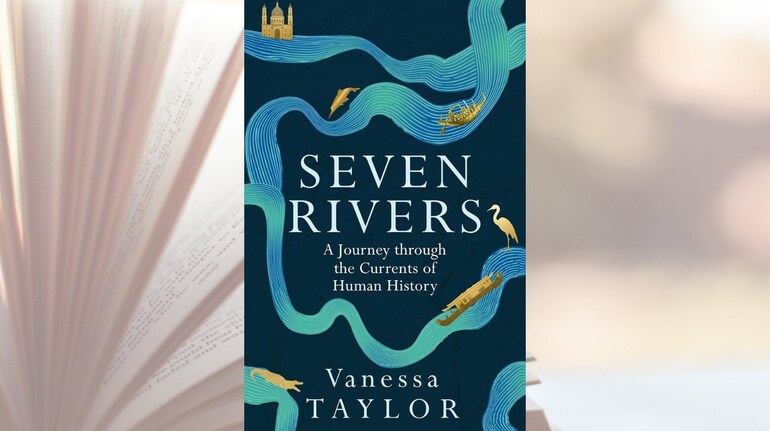
Excerpted with permission from the publisher Seven Rivers: A Journey Through the Currents of Human History Vanessa Taylor, published by Orion Publishing Group/ Hachette India.
***
The Danube River was woven into the histories of two great Central European empires across six centuries from the 1300s to the 1900s. Upstream were the Habsburgs, a wildly successful ruling family who had begun their dynastic life at the Habsburg Castle in Switzerland’s upper Rhine River basin in the ninth century. They ended up with two family wings from the 1500s. There were the Spanish Habsburgs, a great beast that incorporated among other places the Low Countries on the North Sea coast and the Spanish America. And there were the Austro-Hungarian Habsburgs who married and fought their way to the crowns of Central Europe.
Their Habsburg Empire and the Holy Roman Empire – an ambiguous, high-status Roman Catholic territory dating back to King Charlemagne – both radiated out from Vienna on the left bank of the middle Danube for many centuries. When Hungary (and, with it, Croatia) demanded autonomy in 1867, Austria-Hungary became the so-called Dual Monarchy; two semi-detached royal houses separated along the Leitha tributary, with Austria in the driving seat.
The Ottomans had already begun their move on the lower Danube by the time they captured the Roman Empire’s eastern capital at Byzantium (Constantinople) on the Black Sea in 1453. Early Ottoman fortresses were built on the right-bank cities of Silistria and Ruse in the late 1300s, in today’s Bulgaria. The Balkan regions – what would later become Serbia and Bosnia- Herzegovina – were partially secured by the mid-fifteenth century, and the two fertile territories on the lower Danube’s left bank: Wallachia and Moldavia. It was Suleyman the Magnificent who led the Ottomans deep into Central Europe. The personable Suleyman was known for his fine ways. Foreign ambassadors standing before the Sultan’s throne at the Sublime Porte couldn’t help but be distracted by the seat beside him, occupied by a golden helmet, Venetian-made, encrusted with diamonds, rubies, pearls, turquoise and emerald and topped with technicolor plumage. Just a few years after his father’s Ottoman conquest of the Nile, Suleyman took Belgrade (Serbia) at the Danube-Sava confluence on the right bank: ‘the key to all Central Europe’. The miraculous capacity of the Ottomans at this time to exploit any weakness was described by the sixteenth-century Habsburg ambassador, Ogier Ghiselin de Busbecq, like ‘mighty rivers, swollen with rain, which, if they can trickle through at any point in the banks, spread through the breach and cause infinite destruction’. The next to fall were Hungarian cities, including Buda facing Pest across the Danube: a massive blow at the heart of Habsburg Central Europe.
Ottoman westward advances stalled at the gates of Vienna in 1529 and again in 1683, but they remained embedded in the middle Danube – especially on its southern shore – and the two empires had to share the Danube. But their approach to it was strikingly different.
At Budapest, the Ottomans rebuilt the city to their own liking, installing mosques and baths at the ancient geothermal springs. On Buda’s hilly right bank, Ottoman officials lowered themselves into pools of warm sulphurous liquid all year round, even when the water outside slowed to a halt in the ice-bound Danube. The small-scale holy war rumbling away on this part of the river is suggested by a map of Buda made for the Flemish-German atlas Civitates Orbis Terrarum (1617). This bird’s-eye view shows the walled cities of Buda and Pest linked across the Danube by a pontoon bridge of boats. Rising above Buda is a mosque. Formerly the Church of the Holy Virgin, this was now a site of ‘Mohammedan abominations’ according to the map’s commentary. In the foreground above Pest a finely dressed Pasha, in a cobalt-blue turban bigger than the matching blue domes of the mosques, speaks with a subordinate, his temple pierced by feathers, an animal-skin cape slung over his shoulder and a sabre in his belt. The subordinate is a Deli, we are told – the Ottoman bodyguards known for acts of mad daring and loyalty – or as the map’s cartouche put it ‘a barbaric tribe among the Turks’. Beyond Buda’s fortified walls vineyards climb lush hills to the west; and on the right-hand side of the map, the river flows upstream round an orderly pastoral scene on Margaret Island. Cannon fire from fortresses on the walls of Buda suggest a city under threat – the main reason why the wealth of Egypt was needed to cross-subsidise this hard-to-defend city.
The balance of power on the Danube River was altered by the Habsburgs’ formation of new alliances in the late 1600s, in the form of the so-called ‘Holy League’, comprised of the Habsburgs, Venice and Russia, among others. Together the League defeated Ottoman forces at Budapest in the 1680s and pushed their stronghold downstream on the river, transforming the world of the middle Danube. In the centuries that followed, the Austrian state put a significant amount of investment into the river. From the 1820s and 1830s, commercial operations linked riverside cities as steamboats puttered between Vienna and Pest (left bank), taking in the majestic Danube Bend at 10 to 12 miles an hour downstream; half the speed for the return journey against the current. By the 1820s steamboats were churning up rivers all over the world, gobbling trees and later coal as transport entered the carbon age: part of a wide tourist network that included the steamboats with enslaved crews plying the rivers of the Mississippi basin. Travel tips were published for international audiences. As an 1833 Pocket Book for Conversation put it: Travelling in steamboats is very agreeable . . . particularly so for parties of pleasure, on large rivers such as the Rhine, the Danube, the Loire, the Thames, the Delaware, the Ohio, &c.’ Passengers could sleep comfortably, lounge in cabins with carpeted floors, write letters home, dress for dinner before full-length mirrors. Ladies’ cabins were thoughtfully ‘below deck as being the most retired place’.
**********
Vanessa Taylor, Seven Rivers: A Journey Through the Currents of Human History, Orion Publishing Group/ Hachette India, 2025. Pb. Pp.319
Rivers are the great natural arteries that run through our lives. We have navigated them, dammed them and worshipped at them. From the ancient ecosystems of Egypt to the sinking cities of Shanghai and London, what we do with our rivers tells us about who has power and what we value. Now, when a passion for wild swimming is flourishing but the Amazon is on fire and some of our major river systems are dying, it has never been clearer that rivers are intertwined with humanity at our best and our worst.Seven Rivers is story of the Nile, Danube, Niger, Mississippi, Ganges, Yangtze and the Thames. It is a story of imperial frontiers, alluvial gold, kidnappings, slavery, anticolonialism and creation myths. It is about those who've lived and died on these rivers and their endless capacity for invention: their lotus pools and hanging gardens, their gigantic canal systems and elaborate fishing rituals, their absolute powers and their sly rebellions. At its heart are the empire-builders of the Chinese dynasties, Romans and Hindus and their river gods, the Habsburgs and Ottomans, Mughal emperors, the people of the Niger from Mali's golden age to today, struggles of life and death on the Mississippi, and the dethroning of the British on the rivers of their unruly imperial subjects.This is the story of us, in seven rivers.
Vanessa Taylor is a historian of rivers, water and environmental history at the University of Greenwich. She has published extensively, written for BBC History Magazine and appeared on Channel 4, and is one of the foremost experts on the history of the river Thames. She was raised in the watersheds of the Mersey, Thames, Los Angeles and Stour rivers, and now lives in London.
Discover the latest Business News, Sensex, and Nifty updates. Obtain Personal Finance insights, tax queries, and expert opinions on Moneycontrol or download the Moneycontrol App to stay updated!
Find the best of Al News in one place, specially curated for you every weekend.
Stay on top of the latest tech trends and biggest startup news.




