






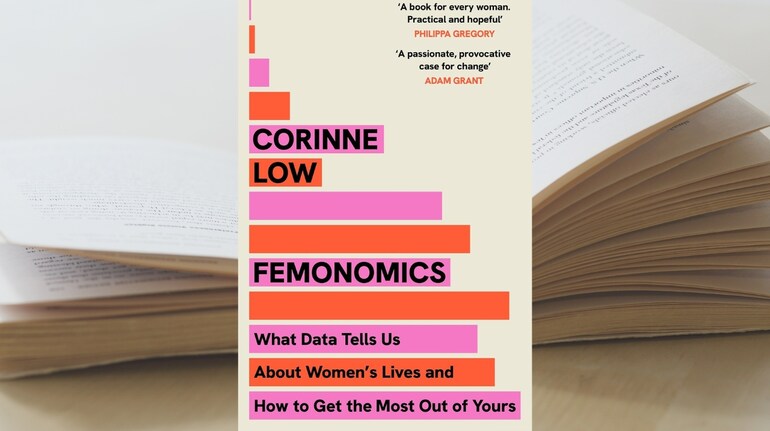
Excerpted with permission from the publisher Femonomics: The Life-Changing, Data-Driven Guide to Making Better Choices at Home and at Work, Corinne Low, published by Hodder Press, an imprint of Hachette India.
**************
Close your eyes and imagine what a moment of bliss looks like for you. The aroma of garlic as it sizzles in a pan as you cook a special recipe with a treasured family member. Cuddling up under a fuzzy blanket and watching a great movie. Finally catching a glimpse of a beautiful waterfall after a long hike. The sensation of sand beneath your toes, or the taste of an ice-cold beer shared with a friend or partner. Your dog’s wet nose on your cheek. Dressing your infant after a bath and kissing their perfect-smelling head. Witnessing your teenager’s pride in achieving something they’ve worked hard for.
Now make visible to yourself the invisible labor behind that joy. Too often, when we think about maximizing our utility, we think about the work we do that generates income. But the time invested in crafting the moments I just described—and being able to experience them—is just as valuable to your utility as the money used to purchase the material things in those pictures. Which is why, before diving into how to plan your career, we’re going to reflect a bit on exactly what role it plays in our lives, and the limits of what money can buy. The two resources we use to create utility are time and effort. We want to maximize these precious, limited resources in a way that is going to bring us as much joy and meaning as possible over a lifetime. A common mistake people make is investing all their resources in one form of maximization: improving their careers to make as much money as possible. But money can only pull certain levers in our utility function—those driven by material goods. And trying to make as much of it as possible decreases another key input into our utility functions: time, to spend with loved ones, enjoy the world around us, rest, or engage in pursuits that give us a sense of purpose.
In economic terms, your career and the income you make from it affect what economists call your budget constraint: the amount of money you have to buy and invest in everything that creates utility for you, such as where you live, your kids’ school, restaurant meals, and nice vacations. But working also reduces your time for leisure and home production, which are two direct ways of creating utility. Time invested in leisure and home production produces real and immediate economic value. Money, on the other hand, is an indirect route to utility, in that it lets you buy things to increase your utility. Your utility function is entirely unique to you. But the belief that more money, in and of itself, will directly produce greater joy and utility is a trap for all of us living in modern capitalist societies.
I encourage you to think about maximizing your resources this way: there are trade-offs that have an exact value for you that only you will know—being able to wear nice clothes versus
having a tidy home; paying for private school versus having time to play with your kids after school; helping your parents with bills versus traveling to visit them, and so on. But what we cannot lose sight of in the pursuit of these values is that your time is just as important as the money and security you’ll achieve in your career. I want a life for you filled with special memories, learning and discovery, and delicious restorative sleep. And for you to make that magic for yourself, to reclaim your joy, you have to get out of the trap of comparing achievements, of only maximizing resources that lead to financial gain, and focus on your utility in all its quirky, individual glory.
If you are a mother, or want to become a mother, this means that part of your career planning may involve not just considerations of earning potential but also considerations about which companies have the best maternity leave or insurance policies for IVF, which jobs allow you flexibility to be the mom you want to be while earning a respectable paycheck, and which jobs reimburse for care costs or provide on-site childcare. Because mothers tend to have higher investment in their kids than fathers, my vision of female liberation is not necessarily one in which no gender wage gap exists. I see in the data that, in fact, many women want to spend time at home with their children.
When women have more financial resources, they often choose to provide more of their own childcare. That means caregiving for our kids is what economists call a luxury good—something you buy more of when you have more money. I’ll never forget the moment during the 2012 presidential race when Mitt Romney said that when he was governor in Massachusetts, it cost more money to subsidize day care for low-income moms than to provide them with cash assistance to stay home, but his administration chose the day care option so that these women could “have the dignity of work.” Wait a minute, I thought. Wasn’t Anne Romney a stay-at-home mom to five boys? Oh, so only poor women needed to have “the dignity of work”—got it.
Economists normally associate labor with disutility. Not only does work time cut into leisure time, but often work itself is, well, work. So when economists create models, they typically write them in a way where people’s goal is to work as little as possible. But suddenly when we’re talking about women, we get weird about it. We act as though work is some kind of end in itself. That closing the gender wage gap is the goal, rather than closing the gender happiness gap. I think a lot about the fact that Western feminism seems to define female empowerment as “freedom to work” but that if you asked a woman in a developing country who had to work in a backbreaking job just to buy food while leaving her child behind what female empowerment meant, she might be more likely to say, “Freedom from work.” I want a society where women from all socioeconomic means can spend the time they want caring for their own children—or, if they don’t have or want to have children, spent that time with art or leisure or volunteer work in their communities.
More broadly, I want us to recognize the value of utility produced at home. Of cooking healthful food, creating livable spaces, and completing all the godforsaken paperwork. Of ensuring the next generation of responsible, compassionate citizens. That does not mean we need to have women sweeping the floors and washing the dishes at twice the rate men do—recognizing the value of these activities means recognizing their value for the whole household, and seeing them as valid, respectable, and necessary activities for all human beings to function optimally. To recognize that value but still treat the activities themselves as “women’s work” not only holds back women’s careers, it also squeezes out women’s leisure time, as they find themselves doing both full-time work and the “second shift” at home. It shouldn’t be a radical proposition that women, too, deserve to play sports, read books, and pursue artistic fulfillment.
What I’m saying is, let’s stop romanticizing work. Instead, let’s see it as a tool to help us reach our ultimate goal: maximizing utility. How is it a tool? Well, work can do something amazing: it converts your time and effort into money, which can be exchanged for other things that other people are better at making than you are! Jobs give us an ATM that we can put time and effort into, and get money out of.
So write this down: A job is a technology for converting time into money. That’s it. Once you consider your job through this framework, it’s incredibly clarifying and freeing. I’m not suggesting you can’t also love your job—we’ll get there in a minute. But if we were independently wealthy and didn’t need to work, I suspect that most of us would invest time and effort in some of the pursuits I referenced earlier—art, leisure, family and friends, making a difference in the world. So let’s talk about how to get as much out of that time-to-money conversion as possible, while keeping your sanity and maximizing the other things you value, too.
**********
Corinne Low, Femonomics: The Life-Changing, Data-Driven Guide to Making Better Choices at Home and at Work, Hodder Press, an imprint of Hachette India, 2026. Pb. Pp. 288
For women today, the promise of “having it all” is an ever-elusive carrot. Faced with unsustainable demands in every sphere, we are certainly doing it all—but at a steep cost. Research shows that biologically, culturally, and economically, we are on uneven playing ground, and one that drains us of our happiness. But that same data can empower us to make choices that will reclaim our time, our energy, and even our joy.
In Femonomics, Wharton professor and economist Dr. Corinne Low unpacks the hidden factors that influence women’s decision-making, and how the unintended consequences of these choices alter the course of our lives. From when and whether to get married and (or) have children to what type of career to pursue, whether to obtain an advanced degree to where to live.
In Femonomics, Dr. Low explodes the myths about what makes women successful and happy such as:
For too long, women have been expected to accept labour-intensive solutions to systemic problems—optimize, lean in, work harder. But Dr. Low isn’t suggesting women need to do more. Femonomics blends personal experience, research, and analysis to illuminate the complex decisions women face, and offers an evidence-based framework for creating a better, happier life. Consider it the essential economics textbook for life as a woman—but hopefully, a little more fun. Corinne Low is an Associate Professor of Business Economics and Public Policy at the Wharton School. Her research focuses on the economics of gender and discrimination and has been published in top journals such as the American Economic Review, Quarterly Journal of Economics, and Journal of Political Economy. She was named one of Poets and Quants 40 MBA Professors under 40 in 2024. Her first book is Femonomics: The Life-Changing, Data-Driven Guide to Making Better Choices at Home and at Work (2025, Hachette India). In America, the book was published with the title Having it All.
Corinne and her work have also been featured by major popular media outlets, including Forbes, Vanity Fair, The LA Times, and NPR. Corinne is the co-creator of the Incentivized Resume Rating method for measuring hiring discrimination, and regularly speaks to and works with firms looking to improve their hiring and retention practices. She has spoken to and advised firms like Google, IFM Investors, Uber, Activision Blizzard, and Amazon Web Services, in addition to teaching in Wharton’s Executive Education programs. She has given talks to top academic institutions like Harvard University, Stanford University, and Oxford, as well as to organizations like the New York Federal Reserve, Brookings, and the US Department of Labor.
She received her Ph.D. in Economics from Columbia University, her B.S. in Economics and Public Policy from Duke University, and formerly worked for McKinsey and Company. Outside of work, she is the co-founder and volunteer executive director for Open Hearts Initiative, a New York City based non-profit that aims to combat the homelessness crisis through pro-housing neighbourhood organizing.
Discover the latest Business News, Sensex, and Nifty updates. Obtain Personal Finance insights, tax queries, and expert opinions on Moneycontrol or download the Moneycontrol App to stay updated!
Find the best of Al News in one place, specially curated for you every weekend.
Stay on top of the latest tech trends and biggest startup news.




