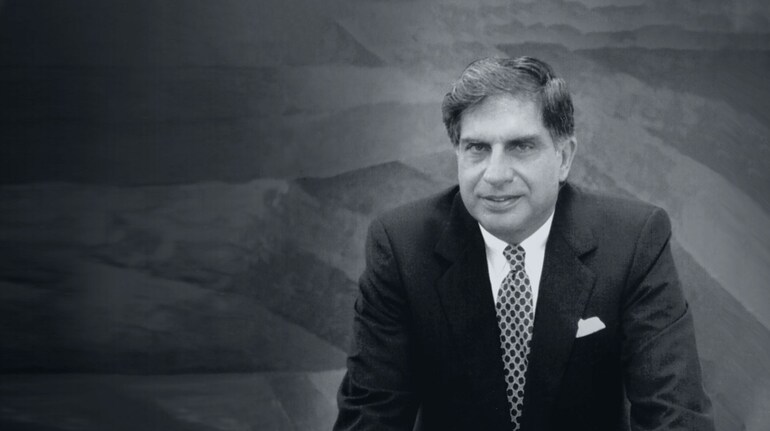
When industrialist Ratan Tata passed away in October 2024 at 86 years, there was a barrage of tributes for him. People recalled not just his business ventures but also his philanthropy and exemplary lifestyle. Tata took over the reins of the hotels-to-cars conglomerate from JRD Tata in 1991, at the cusp of economic liberalization in India. Over the next two decades, he led the group through some difficult periods, including the 26/11 Mumbai terror attack and the global financial crisis of 2008-09.
Harish Bhat, author and ex-chairman of the board at Tata Coffee Ltd who joined the Tata Group straight out of business school in 1987, remembers meeting Tata on "multiple occasions" over his decades-long service with group companies -- including as brand-custodian from 2016 to 2023. "I have never reported directly to Ratan Tata during my career. But I have had the privilege of meeting him on multiple occasions," Bhat says in an email interaction. "In each of these meetings, he was very courteous and graceful. He would invite me to sit down, listen intently to what I had to say, and then provide me his views or advice. His eyes were sharp, he spoke thoughtfully, slowly and clearly. I think he chose his words carefully. This is how I will always remember him."
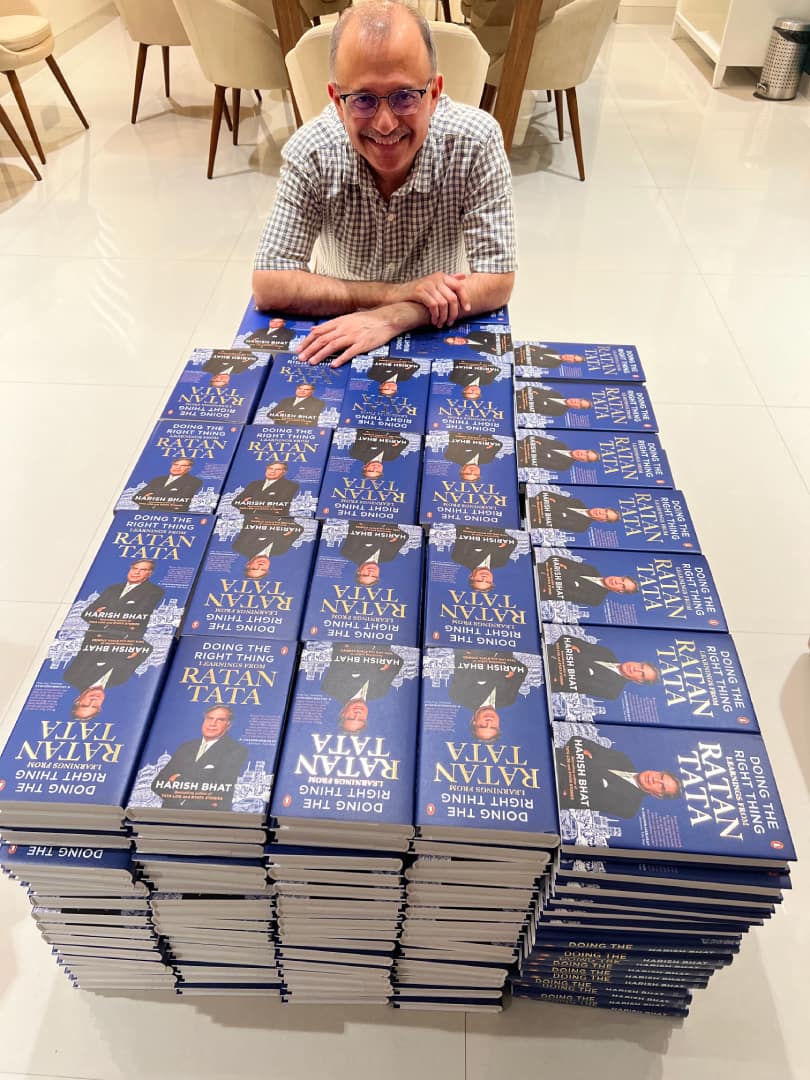 Author Harish Bhat
Bhat's latest book, 'Doing the Right Thing: Learnings from Ratan Tata', which released in November 2025, looks back at the life and career of the former chairman and managing director of the Tata Group to cull learnings for the present day. Edited excerpts from an email interview with Bhat:
Ratan Tata took over Tata Group when the country was at the cusp of liberalisation. He was also at the helm during the global financial crisis. What lessons can we learn from him to weather wide-ranging and systemic change? Especially now, at a time when newer technologies are again threatening / promising to upend the world of work as we know it?Indeed, Ratan Tata took over as Chairman of Tata Sons in 1991, the very same year in which (then) Finance Minister Manmohan Singh presented his landmark "liberalisation" budget. Ratan Tata quickly grasped the significance of that budget, and its possible impact on the Tata Group. Therefore, he invested a lot of his time and energy in ensuring that the Group became ready for a very different future.
He introduced the "Tata Business Excellence Model" across the Group, to ensure that each Tata company developed a mindset of excellence. He urged leaders of the Group to develop a global mindset and to benchmark their respective businesses with the best in the world. He pioneered pathbreaking initiatives, such as the development of India's first indigenous passenger car, to build a belief that we can make the impossible possible, if we have strong conviction in what we are doing. This was a bold move, particularly because of the significant risks involved. And yet he went ahead and made it happen.
I think these lessons from Ratan Tata are equally valid today: Prepare your organisation to be future-ready, relentlessly benchmark yourself with the global best-in-class, be prepared to take bold steps to make the impossible possible.
You have spoken about Ratan Tata urging Companies of the Group to develop a global mindset. Could you share an example?Yes, of course. Let me share an illustration from my own career in the Tata group. I served as Chief Operating Officer of the Watches business of Titan for six years, from 2006 to 2012. Titan was already a strong market leader in India at that time, and a consistently profitable business. But, during this period, we began comparing our growth and financial metrics with the Swatch group of Switzerland, which we saw as a global benchmark at that time. The questions we then began grappling with were: When can we reach and exceed the Swatch group, on our profitability - specifically, our profit before taxes (PBT) as a percentage of revenues? When can we beat them on product innovation?
Questions like this led us to undertake internal exercises in Titan relating to areas such as design and innovation, manufacturing and sourcing, marketing and retailing. Our focus was - what could we learn from the Swatch group and other reputed global brands in each of these areas? These exercises made the Titan watches business even more competitive, robust and future-ready. Such questions were being asked not just in Titan, but across many Tata businesses - one of the key reasons for this was that Ratan Tata had pushed all of us to work with a global mindset.
A very important learning from Ratan Tata's life is to lead a life of integrity. In my understanding, there are two elements of integrity - first, being honest. And second, consistent adherence to some moral principles that are very important to you. For Ratan Tata, some moral principles were all important - such as being ethical in all his actions, of being caring and compassionate, of treating people with dignity and respect, of meeting every commitment he made. He was determined to abide by these principles in all his decisions and actions.
For instance, in this book, I have narrated a story of an interaction between Ratan Tata and B. Muthuraman, who was at that time the Managing Director of Tata Steel. They held different views on a proposed business deal, and this interaction was about reaching a resolution on this specific matter. However, something very unusual happened during this conversation, which had nothing to do with this particular business transaction, but which illustrated Ratan Tata's spontaneous respect and care for his colleague.
Similarly, in this book, I ask readers, what moral principles are important to each of us? How do we practice these moral principles consistently in our own lives? I use real-life stories from Ratan Tata's life to inspire readers to think about what principles we will prioritise in our own lives. Each of us may have a different set of such moral principles that are very important to us, which is completely fine. But being self-aware of what our core moral principles are, and then adhering to them consistently, that is what makes us authentic leaders and good human beings.
You write about how Ratan Tata loved architecture, and studied it even though his family opposed this. Did architecture continue to be a passion for him in later years, and did it help him in business at any point?People who have worked closely with Ratan Tata in Tata Motors speak about his keen eye for aesthetics and design, which perhaps partly flowed from his passion for architecture. Whether it was the design of the Tata Indica or the Tata Nano, Ratan Tata took keen personal interest in working alongside his engineering teams and developing the broad design directions for these breakthrough vehicles. In this book, I narrate an interesting story of how Ratan Tata brought an architect's eye to even ensuring that the most appropriate and durable stone was used for building the Tata Medical Centre at Kolkata.
At a broader level, I think architecture is about visualising the grand picture of the cathedral, as well as providing guidance on every structural aspect wherever required until the building has been constructed fully. I believe that Ratan Tata brought this critical dual capability to his complex role as Chairman of the Tata Group. His vision set the broad direction and powered the growth of the Group, and he was also there to provide guidance and support to individual Companies whenever required. He may not have pursued architecture as a career, but undoubtedly he was the master architect of the Tata group throughout his long stint as Chairman.
What prompted you to publish this book on Ratan Tata, a little over a year after he passed away?When Ratan Tata passed away in October 2024, I was struck by the fact that millions of people across India felt a deep sense of personal loss, even if they had not known him personally at all. I kept thinking - why did this happen? Why was Ratan Tata not just respected, but so universally admired and loved? Was it because he was a very successful industrialist, or was it because of his admirable philanthropy? Was it because of his humility, grace and elegance?
Eventually, as I reflected on his life and career, and spoke to senior colleagues who have worked closely with him, I came to the realisation that one key reason was Ratan Tata's desire to always "do the right thing" in his life and career. That quality endeared him to so many of us. As a writer with deep interest in leadership and business history, I wanted to explore this aspect in greater detail. Very importantly, I wanted to distill what "doing the right thing" really means, and how we can take forward these learnings in our own lives. This is the seed from which this book has taken birth.
What is the most important aspect of Ratan Tata's personality that struck you during the research and writing of this book?What stood out for me while working on this book was Ratan Tata's care and compassion for the people he worked with and also for people he did not know. He was forever willing to help people and causes. His compassion went beyond human beings - his love for stray dogs and animals is legendary. Whether it was his response to the 26/11 terror attacks in Mumbai, or his personal visit to spend time with an ailing retired employee, or the role he played in the creation of the Small Animal Hospital by the Tata Trusts - all these instances and many, many more highlight how empathy was such an integral part of Ratan Tata's personality. Business leaders are generally known to be tough and demanding people, and it is rare to come across a leader like Ratan Tata, who was also instinctively so caring and compassionate at the same time.
When Ratan Tata passed away on October 9, 2024, a lot of the tributes centred around his frugal lifestyle and philanthropic ventures. What would you say the current generation can learn from him in this regard?Ratan Tata lived a simple life, despite being Chairman of India's largest industrial enterprise. He championed the Tata ethos of contributing to nation building and giving back to the community. He immersed himself completely in his role as custodian of the Tata group. I think each of these aspects of his life holds clear lessons for our young generation. A simple lifestyle enables us to focus our entire energies on the higher purpose for which we work and live. Giving back to the nation and the community through whatever we do, both within and outside our professional roles, provides us a unique sense of fulfilment.

Discover the latest Business News, Sensex, and Nifty updates. Obtain Personal Finance insights, tax queries, and expert opinions on Moneycontrol or download the Moneycontrol App to stay updated!
Find the best of Al News in one place, specially curated for you every weekend.
Stay on top of the latest tech trends and biggest startup news.