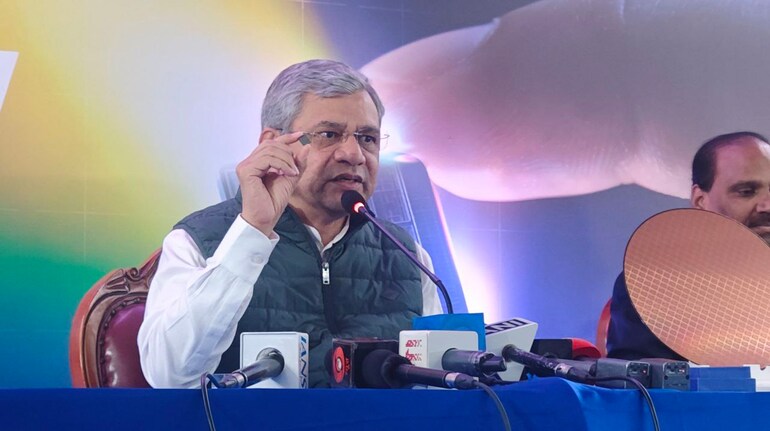
Union minister Ashwini Vaishnaw on February 7 said Qualcomm’s successful 2-nanometre chip tape-out reflects India’s transition to end-to-end chip design, marking a shift from back-end engineering work to full lifecycle involvement in advanced semiconductor development.
Vaishnaw was speaking at an event hosted by Qualcomm Technologies, where the company announced the tape-out of its 2-nm chip through its India engineering centres in Bengaluru, Chennai, and Hyderabad.
“Gone are those days when most of the development, the back office development work was being done here, and now the entire right from customer product definition to designing the final silicon, getting it taped out and getting it validated, that entire thing is being done here in India,” he said in Bengaluru.
He added that the milestone shows that work spanning customer product definition, silicon design, tape-out, and validation is now being carried out in India.
The minister further added that the development places India among a growing group of countries contributing to cutting-edge chip design and highlights the country’s expanding role in the global semiconductor ecosystem.
He said that advanced nodes such as 2 nm involve extreme complexity, with chips packing tens of billions of transistors, and require deep design capability across hardware and software.
Vaishnaw said the achievement is in line with the government’s broader semiconductor roadmap, which focuses on building capabilities step by step.
Also, read: Two companies planning AI server manufacturing units amid data centre push: IT minister Vaishnaw
Path from 28 nm to 7 nm under Semicon 2.0
Vaishnaw said that the next step would be 7 nm manufacturing under the upcoming Semiconductor Mission 2.0.
“We have defined the path to 7 nanometres very clearly. We have learned from countries like Japan, South Korea, and Taiwan on how to move from legacy nodes to advanced nodes,” Vaishnaw said.
“We started with 28 nanometres, very well understanding that this is a very important node because more than 75 percent of the chips used in automotive, telecom, power management, and industrial applications use 28 nanometres to 180 nanometres,” he said.
20,000 GPUs to be added under AI mission
Meanwhile, Vaishnaw said India is also scaling up its AI compute infrastructure alongside its semiconductor push.
“So far, we have 38,000 GPUs as part of the common compute. Very soon we should be adding about 20,000 more GPUs,” he said, adding that the expansion would continue under the next phase of the AI mission.


Discover the latest Business News, Sensex, and Nifty updates. Obtain Personal Finance insights, tax queries, and expert opinions on Moneycontrol or download the Moneycontrol App to stay updated!
Find the best of Al News in one place, specially curated for you every weekend.
Stay on top of the latest tech trends and biggest startup news.