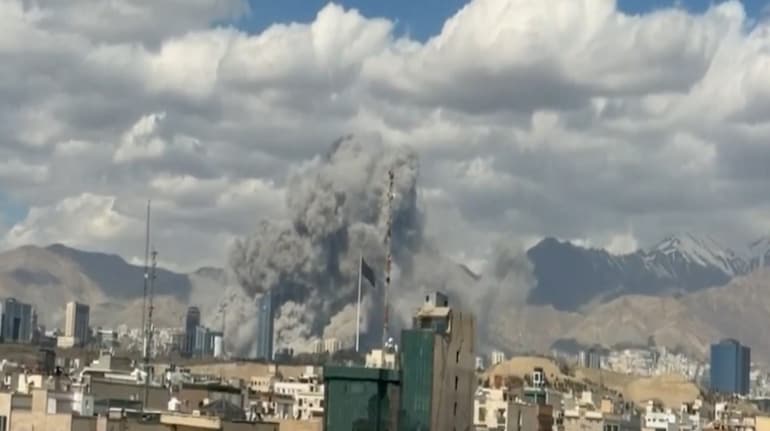

Israel’s strikes on about 30 Iranian fuel depots on Saturday went far beyond what the United States expected when Israel notified Washington in advance, marking the first significant disagreement between the two allies since the war began eight days ago, according to a US official, an Israeli official and a source with knowledge who spoke to Axios.
The Israeli air force strikes triggered large fires in Tehran, with flames visible for miles and heavy smoke spreading across parts of the capital, according to reporting by Axios.
US officials surprised by scale of strikes
Israeli and US officials told Axios that the Israel Defense Forces (IDF) notified the US military ahead of the attacks.
However, a US official told Axios the US military was surprised by how wide-ranging the strikes were.
“We don't think it was a good idea,” a senior US official told Axios.
An Israeli official told Axios that the US message to Israel after the strikes was “WTF”.
The White House and the IDF did not comment, according to Axios.
Israel says fuel depots linked to military supply
In a statement, the Israel Defense Forces (IDF) said the targeted fuel depots were used by the Iranian government to supply fuel to various consumers, including military units.
“The fuel depots are used by the Iranian regime to supply fuel to different consumers including its military organs,” the IDF said in its statement.
An Israeli military official told Axios that part of the purpose of the strikes was to signal to Iran to stop targeting Israeli civilian infrastructure.
US concerned about broader consequences
US officials expressed concern that attacks on infrastructure used by ordinary Iranians could have strategic consequences.
According to Axios, US officials worry that such strikes could rally Iranian society behind the government and contribute to higher oil prices.
While the depots that were struck are not oil production facilities, US officials told Axios that the images of burning fuel depots could unsettle oil markets and push energy prices higher.
“The president doesn't like the attack. He wants to save the oil. He doesn't want to burn it. And it reminds people of higher gas prices,” a Trump adviser told Axios.
Iran warns of retaliation targeting energy infrastructure
Iranian officials warned that continued strikes on oil and fuel infrastructure could lead to retaliation.
The spokesman for Iran’s Khatam al-Anbiya headquarters, which oversees military operations, said Tehran could respond with similar attacks across the region if strikes on Iranian oil infrastructure continue.
He added that Iran had not yet targeted regional fuel and energy infrastructure but warned that if such attacks occur, oil prices could rise to $200 per barrel.
Iranian parliament speaker Mohammad Bagher Ghalibaf also warned that Tehran would retaliate “without delay” if infrastructure attacks continue.
Disagreement expected to be discussed by senior officials
A US official told Axios that the disagreement between Washington and Tel Aviv over the scope of the strikes is expected to be discussed at senior political levels between the two governments.
The conflict between Israel and Iran has now entered its eighth day, with military exchanges expanding across the region and increasing concerns about global energy supplies.
The Strait of Hormuz, a key shipping route for global oil trade, has become a focal point for energy market concerns during the conflict.
Discover the latest Business News, Sensex, and Nifty updates. Obtain Personal Finance insights, tax queries, and expert opinions on Moneycontrol or download the Moneycontrol App to stay updated!




Find the best of Al News in one place, specially curated for you every weekend.
Stay on top of the latest tech trends and biggest startup news.