
Three weeks after the first US-Israeli strikes on Iran, the conflict is still widening across the Gulf, oil markets remain on edge, and no side appears ready to define a real endpoint
The war that began on 28 February with a massive joint US–Israeli strike campaign was supposed to look decisive. Instead, it has entered a third week with no agreed diplomatic off-ramp, continued missile and drone attacks, and growing signs that the conflict may last much longer than early messaging from Washington suggested.
That is now the central question hanging over the war: when does this end?
So far, the answer is getting harder, not easier, to give.
Early signals from Washington suggested a short campaign. But that assumption has collided with three stubborn realities. Iran, despite heavy losses, is still able to retaliate and impose economic pain, especially through pressure on shipping. Israel has made clear it will keep striking until it decides to stop. And US allies remain reluctant to turn the crisis into a broader multinational maritime mission to reopen the Strait of Hormuz.
By 17 March, Reuters reported there was 'no end in sight'. Iran had renewed attacks on the UAE, launched missiles at Israel overnight, and the US embassy compound in Baghdad came under a heavy drone-and-rocket attack that Iraqi security sources described as the most intense since the war began.
At the heart of the conflict now is not just the air war, but the sea.
Do Not Forget | Trump demanded Iran’s ‘unconditional surrender’ when war entered the second week
Despite severe damage from US and Israeli air and naval strikes, Iran has still managed to impose costs through the Strait of Hormuz. The waterway remains largely closed to most tanker traffic. That has kept crude above $100, rattled currencies, and pushed the war out of the military domain and deep into the global economy.
How the war reached this point
The best way to understand why the conflict is still grinding on is to look at how the timeline evolved, and how the rhetoric of leaders increasingly drifted away from the reality on the ground.
February 28: The war begins with shock and speed
The conflict opened with a major US–Israeli strike campaign across Iran under the operation dubbed “Epic Fury”. Iranian state media reported that Supreme Leader Ali Khamenei had been killed. Tehran’s retaliation came quickly.
Iran fired missiles toward Israel, targeted countries hosting US bases, and warned that the Strait of Hormuz had been shut.
That set the tone for the war’s first big shift. What began as an air campaign quickly turned into a battle over maritime choke points and global energy flows.
March 1: The Gulf is dragged in
By the next day, the conflict had already spilt into Gulf cities and infrastructure.
Do Not Miss | Gulf states didn’t seek war with Iran, now many want Trump to finish what it started; here's why
Iranian missiles aimed at major aviation hubs in Dubai and Doha, as well as explosions in Abu Dhabi.
March 2: Washington hints at a timeline, but leaves itself room
At a Pentagon briefing, Pete Hegseth argued that the president could cite timelines like 'four weeks, two weeks, six weeks', implying that the war had a rough horizon but not a fixed one. That flexibility would become a pattern.
March 4–5: The campaign deepens, and officials start admitting it will take time
By 4 March, Hegseth said US and Israeli forces would have 'complete control of Iranian skies' in under a week. But in the same breath he also said: 'we are only four days into this' and 'we will take all the time we need.'
A day later, at CENTCOM headquarters, Brad Cooper said ballistic missile attacks had fallen 90 percent and drone attacks 83 percent from day one. He described intensified action against Iran’s navy, including an Iranian 'drone carrier ship'. But he also said the next phase, systematically dismantling Iran’s missile production,' is going to take some time.'
March 7–8: The war’s civilian and environmental toll grows
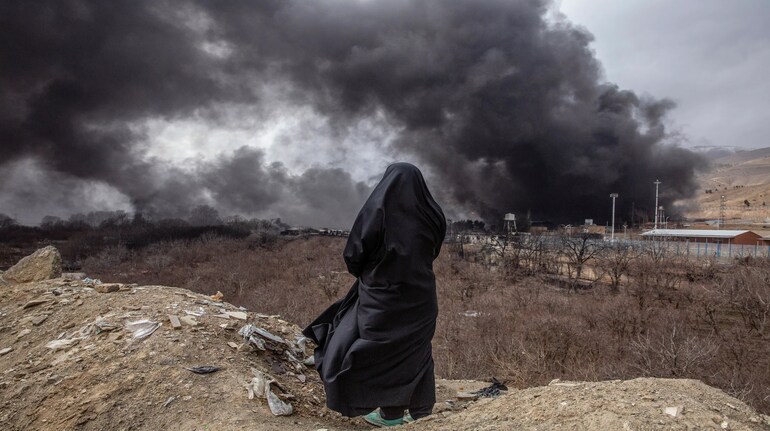
Israeli strikes on fuel depots and refineries around Tehran on the night of 7–8 March. Residents were warned to remain indoors. Concerns emerged over toxic fallout, acid rain and broader health impacts.
March 10: Allies begin openly questioning the endgame
Reuters reported Friedrich Merz saying there was 'clearly no joint plan' to end the war. That was one of the clearest signs yet that allies were beginning to worry not just about escalation, but about the absence of a political roadmap.
The same day, Israeli foreign minister Gideon Saar said the war would continue until Israel and the US decide it is time to stop. He offered no timeline.
March 11–12: The war becomes an oil and market story
By the second week, the war’s economic effects had become impossible to ignore.
Reuters reported that the Trump administration had privately assessed the first six days of war cost at $11.3 billion, with expectations that funding needs would rise sharply.
Reuters reported the dollar pressing toward 2026 highs as oil surged and investors began pricing in the risk of prolonged Hormuz disruption.
March 13: Washington’s internal split becomes visible
By mid-March, Reuters described a clear divide inside Washington.
Some advisers wanted to define victory narrowly, signal that the operation was nearing completion, and shift to sanctions, deterrence and negotiations. Others wanted to continue the pressure.
March 15–16: Predictions of a short war collide with facts on the ground
Trump was pressing other countries to help secure Hormuz, while US Energy Secretary Chris Wright said the conflict would end 'in the next few weeks'.
Iran’s foreign minister Abbas Araqchi rejected the idea of talks and said Iran was ready to defend itself 'for as long as it takes'.
Washington was still trying to put the war inside a manageable timeline. Tehran was signalling it was prepared for a long fight.
March 17: Week three begins with more escalation, not less
By 17 March, any idea that the conflict was naturally burning out had fallen apart.
Reuters reported fresh Iranian attacks on the UAE, another hit in Fujairah, temporary airspace closures, and a death in Abu Dhabi from debris of an intercepted missile. It also reported a heavy drone-and-rocket attack on the US embassy in Baghdad.
At the same time, Reuters said Israel was planning for 'at least three more weeks of war'.
So when can the war end? Here are the main possibilities
At this point, there is no single visible exit ramp. But a few scenarios stand out.
A US-declared 'mission accomplished' moment
One possibility is that Washington declares core military objectives met and shifts to sanctions, deterrence and negotiations.
Reuters has reported discussions around exactly such an endgame. Politically, it would allow the White House to say it delivered a major blow without being pulled into a much longer conflict.
But this route becomes believable only if maritime conditions improve and oil cools enough to support the claim. If Hormuz remains effectively shut and Iran keeps striking, a victory declaration will look premature.
A longer air-and-naval campaign
This is increasingly plausible.
By mid-March, official language had shifted from the shock of the opening strikes to the more methodical task of destroying production capacity and sustaining pressure. The 16 March fact sheet cited more than 7,000 strikes, 6,500-plus combat flights, and over 100 Iranian vessels damaged or destroyed.
Reuters’ report that Israel is preparing for at least three more weeks of war strengthens the case that the operational timeline is now stretching into April.
A more dangerous fight over Hormuz
If Hormuz remains mostly shut and allies still refuse to join a naval coalition, pressure will grow for more direct action against the tools Iran is using, coastal launch systems, mine-laying assets, drones, missiles and command nodes.
That could improve shipping conditions. It could also drive a sharper escalation.
This is why the maritime front is so dangerous. It is both the key to market stability and the part of the war most likely to broaden the conflict.
A messy de-escalation without a clean peace
This may be the most realistic version of 'ending' in the near term.
In such a scenario, strikes could gradually reduce in intensity, shipping could partially resume, and backchannel diplomacy could begin without a formal settlement. Public rhetoric would stay hardline even as both sides quietly ease the pace.
It would not look like peace. It would look like exhaustion.
A broader regional spillover that delays any real end
The final possibility is the bleakest: the war widens further through militias, proxy attacks and secondary fronts.
Baghdad is already seeing a sharper attack pattern. The UAE has repeatedly come under pressure. Iraqi oil assets and Gulf energy infrastructure are increasingly part of the strategic picture. If those secondary theatres keep heating up, the war may not end so much as mutate.
One thing is becoming clearer: Iran is not collapsing quickly
One of the biggest gaps between early expectations and present reality is the absence of any clear sign of regime collapse.
The Washington Post reported US intelligence assessments suggesting the IRGC is consolidating power and that the regime remains intact and hardline even after decapitation strikes. The Critical Threats Project has assessed that Mojtaba Khamenei’s inner circle is dominated by long-standing IRGC commanders, suggesting further hardening rather than compromise.
That matters because wars sold as short often rely on an assumption that the adversary will fracture quickly. So far, the evidence points the other way.
Iran may be damaged, but it still appears capable of enduring and retaliating.

Discover the latest Business News, Sensex, and Nifty updates. Obtain Personal Finance insights, tax queries, and expert opinions on Moneycontrol or download the Moneycontrol App to stay updated!
Find the best of Al News in one place, specially curated for you every weekend.
Stay on top of the latest tech trends and biggest startup news.