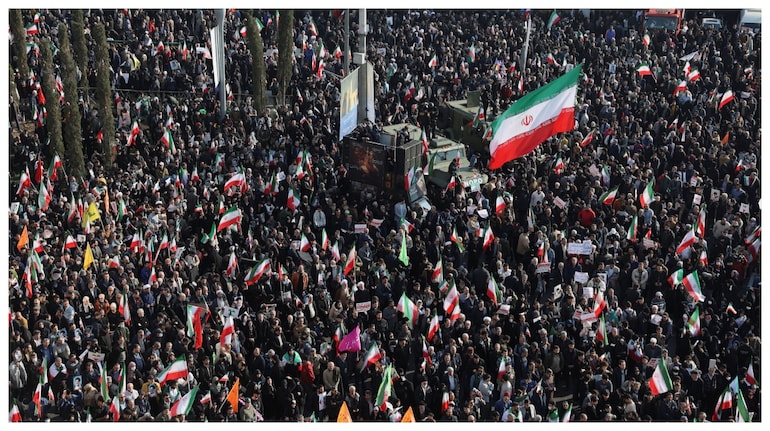

After a week of the largest nationwide protests Iran has seen in years, the streets have fallen quiet again. In Tehran, residents describe an atmosphere closer to a forced holiday shutdown than a return to normal life. Shops close early, people keep their heads down and security forces remain visible.
The calm has been imposed, not restored. The Islamic Republic has relied on its familiar tools of repression to smother demonstrations that erupted last week, but the forces that brought people onto the streets have not disappeared. As the regime prepares to mark the anniversary of the 1979 revolution next month, it is confronting one of the most precarious moments of its existence, CNN reported.
How the protests erupted
What began as economic unrest in Tehran’s bazaars quickly evolved into a nationwide challenge to the state. Within days, crowds across multiple cities were openly calling for the fall of the regime. Some chants went further than in previous protest cycles, including calls for the return of Reza Pahlavi, the exiled son of Iran’s last shah.
The speed and scale of the response from the authorities reflected a leadership unwilling to concede ground. Iran’s security forces, already weakened by last summer’s conflict with Israel and the United States, moved decisively to crush dissent. A sweeping internet shutdown cut off most communication with the outside world, making it difficult to verify the full extent of the crackdown. US-based Human Rights Activists News Agency has reported nearly 3,000 deaths, figures that cannot be independently confirmed.
Will the US intervene
For weeks, Donald Trump warned that the United States could strike Iran if violence against protesters continued. That threat appeared to recede late last week when Trump said he had been told the killing had stopped. Regional governments including Qatar, Oman, Saudi Arabia and Egypt also urged Washington to avoid military action, warning that a new war would destabilise the region and damage global energy markets.
Those efforts seem to have bought time, not certainty. US military movements in the region continue, and analysts caution that tensions with Iran have not been resolved. Israel’s long-running confrontation with Tehran, in particular, is largely separate from Iran’s internal unrest and could flare again regardless of events on the streets.
Is diplomacy still possible
If talks between Washington and Tehran resume, they will do so on very uneven ground. Iran’s nuclear infrastructure was badly damaged in US strikes last year, and much of the regional network it once relied on to project power has been weakened or dismantled. While Iran still holds a significant stockpile of enriched uranium, its bargaining position is far weaker than in past negotiations.
Any renewed diplomacy is also likely to go beyond the nuclear file. The US would press Iran on its missile programme and its support for groups such as Hamas, Hezbollah and allied militias across the region. These have long been treated by Tehran as red lines. Conceding on them would be seen internally as surrender rather than compromise.
Still, Iran’s leadership has accepted painful deals before. At the end of the Iran–Iraq war in 1988, Ayatollah Ruhollah Khomeini agreed to a ceasefire he likened to “drinking from a poisoned chalice”. Survival may once again push the regime towards decisions it would otherwise resist.
A broken social contract
Many analysts argue that the deeper problem facing the Islamic Republic is no longer diplomatic or military but domestic. The repeated use of lethal force against protesters has, in their view, permanently damaged the social contract between the state and society.
Previous protest waves, including those in 2022, produced limited concessions, such as looser enforcement of hijab rules. This time, the violence has been far more intense, leaving little space for reconciliation. For many Iranians, incremental reform no longer feels credible.
At the same time, meaningful change from below remains extraordinarily difficult. Iran’s security and intelligence apparatus has spent decades dismantling organised opposition. Prominent reformist figures and human rights activists have been jailed or silenced, hollowing out internal alternatives to the current system.
No clear opposition path
Outside Iran, opposition forces remain fragmented. Reza Pahlavi has re-emerged as a prominent voice, presenting himself as a transitional figure rather than a future ruler. But after more than four decades in exile, he has struggled to unite Iran’s diverse political currents or articulate a credible path to change without foreign intervention. Many Iranians view him as divisive, not unifying.
There is also anxiety about what might follow a sudden collapse of the regime. Iran’s ethnic and regional diversity, combined with separatist movements in some areas, raises the risk that upheaval could lead to fragmentation rather than renewal.
What comes next
For now, the state has regained control of the streets. But history offers little comfort to Iran’s leaders. The 1979 revolution itself followed months of protests that surged and ebbed before finally toppling the shah.
Most analysts believe this will not be the last round of unrest. A line has been crossed, and the grievances driving discontent remain unresolved. Whether the next chapter is shaped by diplomacy, repression or renewed revolt will depend on choices made in Tehran and Washington alike.
Discover the latest Business News, Sensex, and Nifty updates. Obtain Personal Finance insights, tax queries, and expert opinions on Moneycontrol or download the Moneycontrol App to stay updated!
Find the best of Al News in one place, specially curated for you every weekend.
Stay on top of the latest tech trends and biggest startup news.