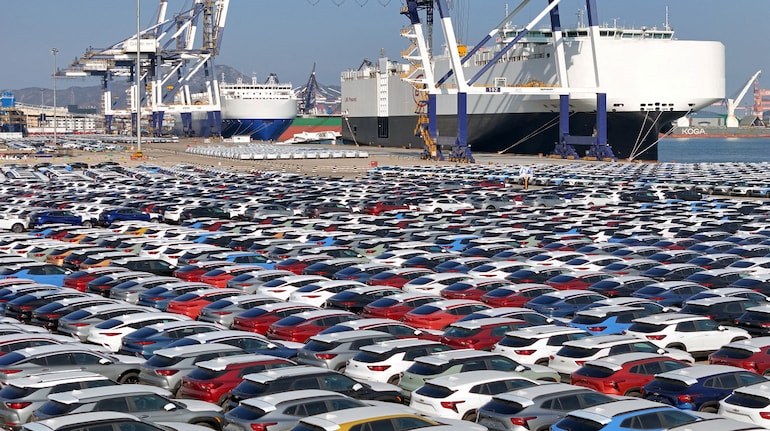
Global car manufacturers are rolling out a major comeback bid at China's biggest car show this week in Shanghai in an attempt to regain market share in the world's largest car market. Veteran players such as Volkswagen, Toyota, Mercedes-Benz, and BMW are launching new electric vehicles (EVs) full of software and intelligence features designed specifically for Chinese consumers, in a bold shift to a "China for China" strategy. With local brands such as BYD and Geely leading the EV charge, foreign carmakers are scrambling fast—or else they'll be left behind, the Financial Times reported.
From dominance to disruption
Western automakers once controlled over 60% of the Chinese market. Now, their market share has fallen to 31% during the first two months of 2025, with local brands surpassing them. In reaction, Mercedes and other firms are launching EVs such as the CLA model with China-designed operating systems and sophisticated autonomous functionality. BMW's Neue Klasse will also be produced locally with inputs from Chinese tech titans Alibaba and Huawei. This strategic turnover is a bigger industry pattern: foreign car manufacturers now look towards Chinese partners for not only distribution but also co-development and innovation.
Power to localised R&D and design
Toyota and Audi are depending heavily on joint ventures to reclaim Chinese customers. Audi is launching a China-specific sub-brand in partnership with SAIC, dispensing with its four-ring signature logo, and displaying 18 models at the event. Toyota, having a fairly solid market position, is remaking its strategy by delegating product development to domestic teams and granting its Chinese arm complete decision-making powers. It aims to produce cars for Chinese consumers by Chinese brains, reversing the previous decades when Chinese companies copied Western ones.
Global brands rethink their roles
Mazda's EZ-6 electric sedan relies on architecture supplied by Chinese ally Changan, and Toyota's bZ3X SUV has more than 40% of its components shared with GAC's Aion V. These cars represent a broader pattern of shared platforms and reverse innovation, where local engineering and design are the priorities.
Lexus, Toyota's luxury brand, is still controlled more tightly by the Japanese, but even it is growing production in Shanghai through a wholly owned battery and EV plant—one of only three foreign-owned factories in China.
Confronting a new era
Automakers admit that they might never recapture their past supremacy, but they are hardly done yet. As tensions between Beijing and Washington escalate, restoring a resilient presence in China has become a strategic necessity. The next chapter of global auto behemoths in China will depend on their capacity to localize, innovate, and shift with unprecedented velocity within one of the most competitive EV markets globally.
Discover the latest Business News, Sensex, and Nifty updates. Obtain Personal Finance insights, tax queries, and expert opinions on Moneycontrol or download the Moneycontrol App to stay updated!
Find the best of Al News in one place, specially curated for you every weekend.
Stay on top of the latest tech trends and biggest startup news.