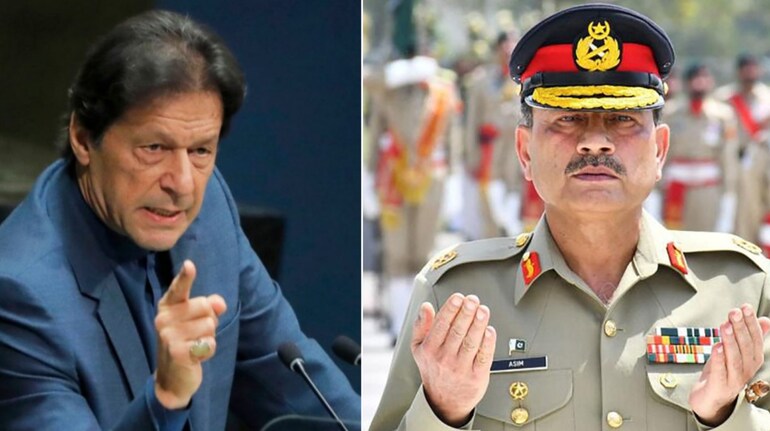
The longstanding rivalry between Pakistan’s newly appointed Chief of Defence Forces (CDF) Field Marshal Asim Munir and former Prime Minister Imran Khan dates back to 2019.
At that time, then-Lieutenant General Munir was removed as Inter-Services Intelligence (ISI) chief within eight months of taking charge under Khan’s government, despite being handpicked by Army Chief Gen Qamar Javed Bajwa.
Also read: Pakistan Army calls Imran Khan ‘mentally ill’, labels his narrative a security threat
Now, Pakistan has handed unprecedented authority to Munir, making him the country’s first-ever CDF while he continues as Chief of Army Staff (COAS). This structural change consolidates control of Pakistan’s army, navy, air force, and strategic decision-making under one leader known for a hard-line stance.
Munir’s elevation presents a direct challenge to Khan, who is currently serving a 10-year sentence in Adiala Jail for “selling state secrets” in the Toshakhana case. Historically, Khan’s political influence relied partly on military support or neutrality, but with Munir consolidating power, Khan’s ability to confront the establishment is further weakened.
Must read: Pakistan parrots China's claim on Arunachal Pradesh again, challenges India’s sovereignty stance
The personal animosity between the two is evident. Munir’s removal from the ISI in 2019 was a rare rebuke under Khan’s government, and since then, Khan has publicly criticised both Munir and the military establishment.
The new power dynamic also threatens Khan’s ability to communicate from prison. Speaking at a press conference in Rawalpindi on Friday, DG ISPR Lieutenant General Ahmed Sharif Chaudhry questioned Khan’s political messaging from jail, asking, “Which law is it under which a prisoner meets people and crafts a narrative against the state and the armed forces of Pakistan?”
Analysts suggest that Khan’s supporters may view Munir’s rise as a direct threat to their political interests, potentially complicating the former premier’s standing and further tightening the military’s grip over Pakistan’s political and security apparatus.
What lies ahead for PTI?
Pakistan Tehreek-e-Insaf (PTI), the political party founded by former Prime Minister Imran Khan on April 25, 1996, in Lahore, was banned in May 2023. The ban followed escalating political tensions after Khan’s ouster in April 2022 and a crackdown on the party amid protests and alleged anti-state activities.
The Election Commission of Pakistan (ECP) barred PTI from participating in elections and suspended its operations, citing constitutional violations and alleged attempts to destabilize the government.
Khyber Pakhtunkhwa (KP) remains the only province under PTI’s governance, where ongoing political unrest coincides with a renewed rise in militancy, putting additional pressure on the Shehbaz Sharif government and the military establishment.
Discover the latest Business News, Sensex, and Nifty updates. Obtain Personal Finance insights, tax queries, and expert opinions on Moneycontrol or download the Moneycontrol App to stay updated!
Find the best of Al News in one place, specially curated for you every weekend.
Stay on top of the latest tech trends and biggest startup news.