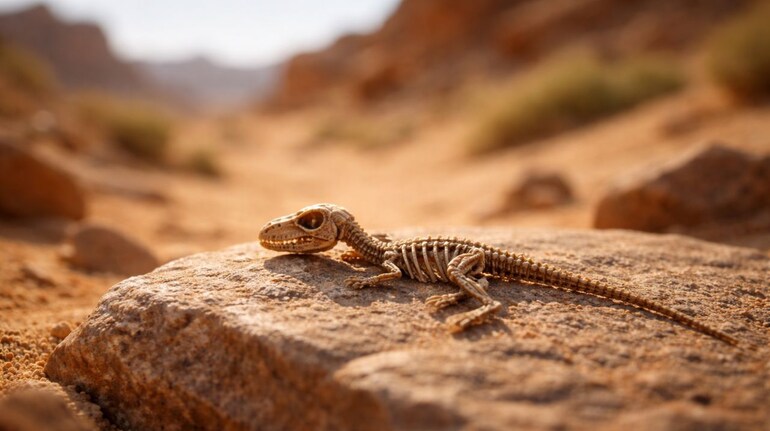

A discovery in Mongolia’s Gobi Desert is drawing attention for its sheer scale or rather, its lack of it. Scientists have uncovered a nearly complete fossil skeleton measuring just about one centimetre, making it one of the tiniest vertebrate fossils ever found from the age of dinosaurs.
At first glance, the fossil almost doesn’t look real. It’s so small it can sit between two fingers, yet you can clearly make out a skull, a spine and even tiny limbs. The level of detail is surprising for something this size, which tells scientists it has been preserved unusually well over millions of years.
What really stands out, though, is how old it is. Researchers estimate it dates back around 75 to 100 million years, placing it in the Late Cretaceous period, when dinosaurs were still around. We tend to picture that era in terms of massive creatures, but finds like this are a reminder that there was an entire world of much smaller animals too. The problem is, they rarely get preserved this clearly, so we don’t come across them as often.
There’s still some uncertainty about exactly what this fossil represents. It could be a very small reptile, or it might be a juvenile, essentially a young individual of a larger species. Scientists will need to study it more closely to pin that down. Either way, it adds to our understanding of the kind of biodiversity that existed alongside dinosaurs, especially at the smaller end of the spectrum.
The Gobi Desert has a long track record when it comes to fossil discoveries. It has given us everything from dinosaur eggs to full skeletons, and even evidence of behaviours like nesting. This find shifts attention away from the usual focus on large prehistoric animals. It’s a reminder that the dinosaur era wasn’t just about massive animals. There were plenty of tiny, fragile creatures around too, but we don’t see them as often simply because they don’t preserve as easily.
The fact that this one survived in such detail likely comes down to where it was found. Dry, undisturbed conditions can slow down decay and protect even very delicate remains, which seems to be the case here.
It also points to how much we’re still piecing together. Big dinosaurs tend to get most of the attention, but smaller animals were just as much a part of these ecosystems.
In the end, this fossil might be tiny, but it adds another piece to the puzzle of what life looked like millions of years ago.
Discover the latest Business News, Sensex, and Nifty updates. Obtain Personal Finance insights, tax queries, and expert opinions on Moneycontrol or download the Moneycontrol App to stay updated!
Find the best of Al News in one place, specially curated for you every weekend.
Stay on top of the latest tech trends and biggest startup news.