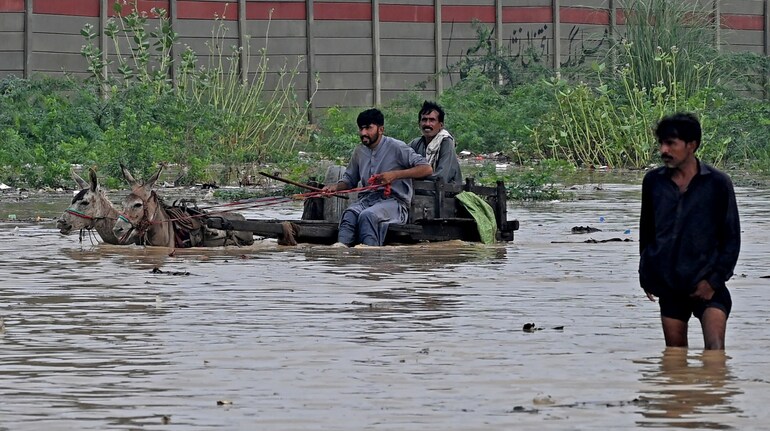
Some of the world’s most populated and thriving cities are at risk of disappearing underwater. A new scientific study warns that coastal megacities built on river deltas, including Shanghai, Dhaka and Karachi, are on track to face catastrophic flooding that could wipe them off the map.
According to the research published in the journal One Earth, these cities are sinking at the same time that sea levels are rising. Scientists say this deadly combination is as destructive as a nuclear disaster if governments fail to act now.
The study argues that many cities depend heavily on sea walls and embankments, but these structures are no longer enough. Climate change has sharply raised the threat from storms and surging sea levels. Experts warn that if a strong storm hits, protective walls could fail suddenly, allowing seawater to rush in and trap millions of people.
What is the ‘polder effect’?
Researchers describe this potential disaster as the “polder effect.” Unlike regular floods, where water eventually drains away, sinking delta cities behave like deep bowls. When a barrier breaks during a storm, seawater floods in but cannot flow out naturally. The floodwater remains trapped until huge pumps remove it, which can take weeks or even months.
Professor Robert Nichols of the University of East Anglia says the destructive power of this effect is widely misunderstood. He explains that the risk is greatly underestimated because people assume these walls will always protect them.
Which cities are most vulnerable?
The study looked at 40 major cities built on river deltas, home to nearly 300 million people. The highest risk locations are in China, Southeast Asia, and South Asia. Cities facing the greatest threat include Shanghai, Ningbo and Guangzhou in China, Yangon in Myanmar, Dhaka in Bangladesh, and Karachi in Pakistan. The analysis also names New Orleans in the United States as a major risk zone after it suffered deadly flooding during Hurricane Katrina.
Researchers created a digital simulation for Shanghai using data from the ten most severe storms in the past fifty years. The projection was alarming. Co-author Min Zhang said the flooded area during a major storm “could increase by 80 per cent” by the year 2100. He warned that the model shows the city could be almost completely submerged under worst-case conditions.
Why walls will not save these cities
Flood risk comes from many forces working together, including ocean tides, storm surges, heavy rain, waves and river flows. The most severe disasters happen when several of these occur at once. Professor Nichols warns that the danger is increasing because the land beneath these cities is sinking. He says that building higher sea walls is becoming more risky and more expensive, adding that if one of them fails, the result “would be unimaginable.”
What must be done now
Scientists say governments must adopt a layered protection approach. Solutions include creating wetlands and mangrove belts as natural barriers, redesigning urban areas to absorb water like “sponge cities,” and in the most dangerous areas, moving people and development away from vulnerable zones.
Researchers conclude that if cities do not change their protection strategies today, future generations may only read about these coastal giants in history books.
Discover the latest Business News, Sensex, and Nifty updates. Obtain Personal Finance insights, tax queries, and expert opinions on Moneycontrol or download the Moneycontrol App to stay updated!
Find the best of Al News in one place, specially curated for you every weekend.
Stay on top of the latest tech trends and biggest startup news.