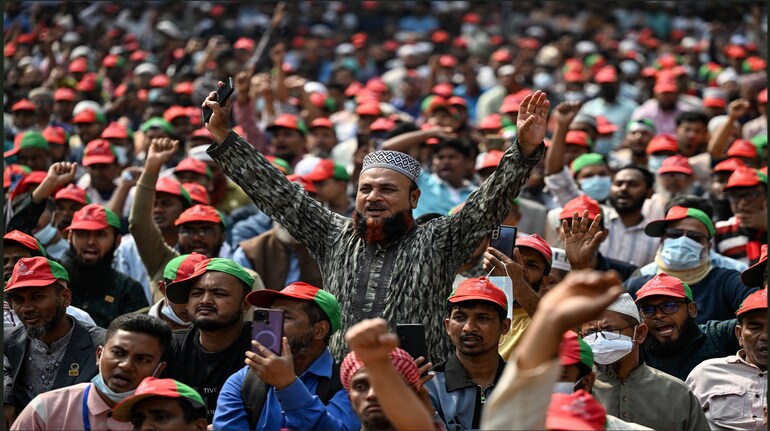
With just 72 hours left for Bangladesh’s high-stakes 13th Parliamentary Election scheduled for February 12, fresh violence has erupted, highlighting the fragile political climate during one of the country’s most consequential transitions in decades.
More than 40 people, including women, were injured late on Friday night in clashes between workers of the Bangladesh Nationalist Party (BNP) and Jamaat-e-Islami. The violence reportedly broke out after accusations of cash distribution at a Jamaat programme escalated into street confrontations. The incident occurred days before polling and hours before campaigning is set to end on February 10 at 7.30 am.
Following the ouster of Sheikh Hasina in August 2024, Bangladesh is preparing for elections without the Awami League, which has been barred from contesting. The development has fundamentally reshaped the political contest ahead of voting.
BNP steps up campaign
Despite sporadic violence, preparations are in full swing at the BNP’s Nayapaltan headquarters in Dhaka. Visitors continue to stream into the party office, purchasing memorabilia from a small ground-floor store.
Badges featuring the BNP’s symbol, “dhaaner sheesh” (sheaf of paddy), remain popular, alongside posters of Begum Khaleda Zia, Ziaur Rahman, Tarique Rahman and his family, as well as books and T-shirts.
The building’s exterior and nearby roads are lined with banners and hoardings of Khaleda Zia and Tarique Rahman. Painters and electricians were seen working to freshen up the premises ahead of the February 12 election, in which the BNP is widely expected to return to power after two decades.
Scenes at Awami League’s deserted party office
A stark contrast is visible at the Awami League’s party office, just about two kilometres away in Gulistan. Founded in 1949 by the country’s “Founding Father,” the Awami League, once Bangladesh’s dominant political force, now finds its headquarters abandoned following a ban on its activities after the ouster of former Prime Minister Sheikh Hasina.
The imposing building stands deserted, with an overpowering stench of urine and only a few destitute men seen wandering around the premises. Area is now being used as a parking space for tempos belonging to local flower suppliers, according to India Express report.
“It has become a toilet and a storage place for the local shops,” said a local Awami League supporter, who did not wish to be identified.
BNP manifesto and minority outreach
The BNP, led by Tarique Rahman, is campaigning on a platform that promises a “new political culture oriented towards the future, opposite to politics of revenge and retribution,” according to its manifesto.
Party leaders say the focus is on unity and nation-building beyond governance. “Although the Hindu minority population is small, our pujas have increased manifold. What does that tell you, that the Hindu minority community is free to celebrate their festivals and there is no targeting of minorities,” said senior BNP leader Goyeshwar Chandra Roy.
A BNP supporter echoed calls for stability, saying, “We want to live peacefully, in a stable Bangladesh.”
‘Flood’ of disinformation
Authorities have flagged a surge in online misinformation ahead of the polls, including the use of AI-generated images and coordinated campaigns. Interim leader and Nobel Peace Prize winner Muhammad Yunus said in January that there had been a “flood of misinformation surrounding the elections” while seeking assistance from UN rights chief Volker Turk.
“It is coming from both foreign media and local sources,” Yunus said. Much of the misinformation revolves around claims of attacks on minorities, particularly Hindus, who make up around 10 percent of Bangladesh’s population.
According to police data released in January, only 12 percent of the 645 reported incidents involving minority groups in 2025 were found to have sectarian motives.
Influence of Gen Z and electoral dynamics
The BNP is contesting 292 of the 300 parliamentary seats and is widely seen as the frontrunner. Party chief Tarique Rahman told Reuters that the BNP was confident of winning “enough to form a government”.
However, the Jamaat-e-Islami-led alliance is emerging as a significant challenger. A newly formed party driven largely by Gen Z activists under 30 has aligned with Jamaat after struggling to convert street protests against Hasina into electoral gains.
Discover the latest Business News, Sensex, and Nifty updates. Obtain Personal Finance insights, tax queries, and expert opinions on Moneycontrol or download the Moneycontrol App to stay updated!
Find the best of Al News in one place, specially curated for you every weekend.
Stay on top of the latest tech trends and biggest startup news.