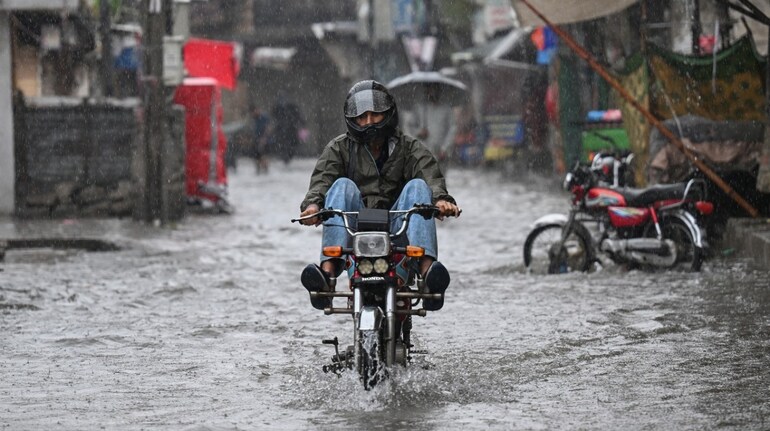
Heavy monsoon rains have once again plunged Pakistan into crisis, with the country’s disaster management agency confirming that 54 people died in the past 24 hours alone, taking the death toll from rain-related incidents to around 180 since the season began in late June.
This year’s monsoon, marked by torrential downpours and rising river levels, has wreaked havoc especially in Punjab province, where houses collapsed and cities like Rawalpindi witnessed flash floods. In scenes that have become grimly familiar, boats were used to rescue stranded villagers, including women and children waving shawls from rooftops and screaming for help.
“Children were screaming for help, and women stood on rooftops, waving their shawls and begging to be rescued,” Tariq Mehbood Bhatti, a farmer in Ladian village, told AFP.
While seasonal rains are essential for agriculture across South Asia, in Pakistan they often spiral into large-scale disasters. But why is the country so prone to flooding, and why are these floods so deadly year after year?
Geography, climate and poor planning
High climate vulnerability: Despite contributing only 0.5% to global greenhouse gas emissions, Pakistan is one of the most climate-vulnerable countries in the world. Its Biennial Transparency Report to the United Nations Framework Convention on Climate Change (UNFCCC) bluntly states:
“Pakistan has been ranked as the most climate-vulnerable country globally in 2025, bearing immense social and economic costs from recurring climate-induced disasters…”
The numbers reflect this grim reality. Pakistanis are reportedly over a dozen times more likely to die from climate-related disasters than people elsewhere.
Extreme weather and glacial melting: Pakistan’s climate is defined by two extreme systems: heatwaves and droughts, and monsoon rains. The latter delivers 70–80% of the annual rainfall between June and September.
In 2024, the country witnessed an alarming spike in temperatures in Gilgit-Baltistan, a region home to more than 13,000 glaciers, including some of the world’s largest. Often dubbed the "Third Pole", Gilgit-Baltistan has experienced temperatures above 48°C, despite being 1,200 metres above sea level, according to the Pakistan Meteorological Department.
These extreme temperatures are accelerating glacial melt, increasing the risk of Glacial Lake Outburst Floods (GLOFs – an unpredictable and devastating form of flooding.
Urban mismanagement and inaction: Pakistan’s flooding problem is not just a natural one; it’s political and structural. A large share of the urban population lives in unregulated settlements, or “katchi abadis”. The UN Habitat’s 2023 report states that over 50% of Pakistan’s urban dwellers live in such informal housing, which is more susceptible to collapse and flooding.
Despite suffering catastrophic floods in 2022, which killed 1,700 people and displaced around 30 million, experts say no substantial policy reform has followed.
“I cannot think of a single policy reform that the government has taken after the 2022 floods, despite all the tall claims made by the ministers and other officials,” said Ali Tauqeer Sheikh, a climate expert based in Islamabad, in an interview with Al Jazeera.
“Internal-focused driven reforms to enhance the preparedness of communities in vulnerable areas is completely missing... We are a reform-averse society, and we don’t want to undertake any change that is substantial in nature, and this attitude only perpetuates vulnerabilities.”
“Given the rise in temperatures and anthropogenic climate change, the fragile ecosystem in Gilgit Baltistan is facing imminent flash flooding and risk of Glacial Lake Outburst Flood (GLOF),” said Zakir Hussein, director general of Gilgit Baltistan’s disaster management authority, to Al Jazeera.
The human cost: Since the start of this year’s monsoon season on June 26, around 180 people have died—70 of them children, and more than 500 injured, as per the National Disaster Management Authority (NDMA).
“In the last 24 hours, 54 people were killed and 227 injured across Pakistan, with the majority of fatalities reported from Punjab,” the NDMA spokeswoman told AFP, noting that most deaths were caused by collapsed houses, flash floods, and electrocution.
The financial toll is equally severe. The 2022 floods caused an estimated $30 billion in damage -- $14.8 billion to property and infrastructure and the rest as a loss to Pakistan’s GDP.
Global responsibility and financial inequity: In 2023, UN Secretary-General Antonio Guterres said that Pakistan is: “Doubly victimised by climate change as well as a morally bankrupt global financial system,” and called on wealthier nations to assist in Pakistan’s recovery, arguing that they have a “moral obligation.”
Discover the latest Business News, Sensex, and Nifty updates. Obtain Personal Finance insights, tax queries, and expert opinions on Moneycontrol or download the Moneycontrol App to stay updated!





Find the best of Al News in one place, specially curated for you every weekend.
Stay on top of the latest tech trends and biggest startup news.