
Iran’s Supreme Leader Ayatollah Ali Khamenei was killed in a major attack on Iran launched by Israel and the United States, throwing the future of the Islamic Republic into doubt and sharply raising the risk of regional instability.
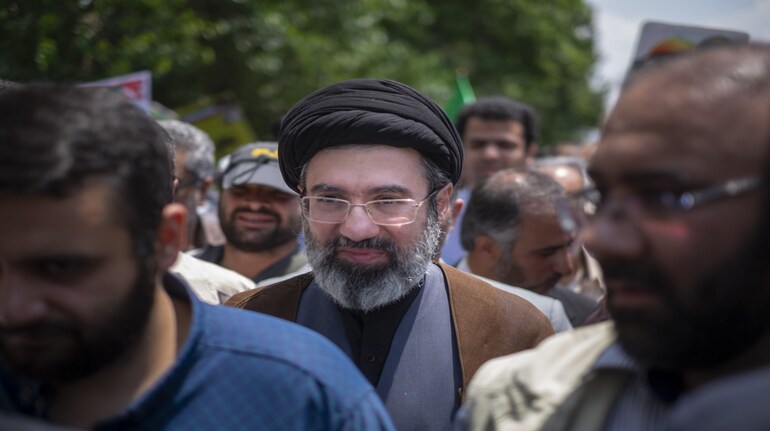
Within hours, attention shifted to a man long seen as a powerful but shadowy figure inside Tehran’s power structure: his second-eldest son, Mojtaba Khamenei. Several reports now claim he is being named Iran’s new Supreme Leader, a move that, if confirmed, would reshape both Iran’s domestic politics and its relationship with the West.
And as Mojtaba steps into the glare of global scrutiny, a year-long investigation by Bloomberg News offers rare insight into the financial network allegedly tied to him, a network stretching from Tehran to London, Dubai, Frankfurt and beyond.
From behind-the-scenes powerbroker to centre stage
Mojtaba Khamenei, 56, has for years been described by analysts as a key behind-the-scenes player in Iran’s political system, with close ties to the Islamic Revolutionary Guard Corps (IRGC). He has largely avoided public visibility, even as debate intensified over who would eventually succeed his 86-year-old father.
According to Bloomberg, citing people familiar with the matter and the assessment of a leading Western intelligence agency, Mojtaba oversees, directly or through proxies, a sprawling investment network that channels funds into Western markets despite US sanctions imposed on him in 2019.
Bloomberg reported that while assets are not held in his own name, the younger Khamenei has been directly involved in deals dating back at least to 2011. The network, according to people cited by Bloomberg, spans Persian Gulf shipping, Swiss bank accounts and British luxury property worth more than £100 million.
None of the documents reviewed by Bloomberg lists Mojtaba Khamenei as the direct owner of the assets.
Billionaire’s Row and beyond
One of the most striking elements of Bloomberg’s investigation centres on London’s The Bishops Avenue — often called “Billionaire’s Row.” Behind hedges and blacked-out gates sit luxury homes whose ultimate ownership, through layers of shell companies, traces back to the network described by Bloomberg as linked to Mojtaba Khamenei.
Bloomberg reported that one property alone cost £33.7 million when purchased in 2014. The broader web includes prime London real estate, a villa in what is dubbed the “Beverly Hills of Dubai,” upscale hotels in Frankfurt and Mallorca, and previously held assets in Toronto and Paris.
Funds for these purchases, Bloomberg reported, were routed through accounts in the UK, Switzerland, Liechtenstein and the UAE. According to people cited in the report, the money primarily originated from Iranian oil sales, a trade increasingly pushed into opaque channels due to sanctions.
The role of Ali Ansari
Central to Bloomberg’s findings is Iranian businessman Ali Ansari, described by British authorities last year as a “corrupt Iranian banker and businessman” and sanctioned by the UK for allegedly financially supporting the IRGC. Ansari is not under sanctions in the US or EU.
According to Bloomberg, many overseas purchases were made in Ansari’s name or through companies where he is listed as beneficial owner, including firms registered in Saint Kitts and Nevis and the Isle of Man.
Farzin Nadimi, a senior fellow at The Washington Institute for Near East Policy, told Bloomberg: “When you analyze his financial network, Ali Ansari is the main account holder for him.”
Ansari, through his lawyer, told Bloomberg he “strongly denies” any financial or personal relationship with Mojtaba Khamenei and intends to challenge UK sanctions.
Sanctions, succession and scrutiny
The timing of these revelations matters more than ever.
Iran enters this leadership transition at one of its most fragile moments since Ali Khamenei assumed power in 1989. Its economy has been battered by sanctions, protests have erupted over corruption and mismanagement, and its regional proxies have been weakened in the wake of the Gaza conflict. Tensions have further escalated after the latest US-Israel strikes.
Bloomberg’s investigation underscores how, despite one of the toughest sanctions regimes in modern history, Iranian elites allegedly moved capital abroad using front companies, offshore jurisdictions and weaknesses in global beneficial ownership systems.
Ben Cowdock of Transparency International UK told Bloomberg that Britain’s property market “should not serve as a safe deposit box for cronies who finance repressive regimes.”
Frankfurt’s deputy mayor, Nargess Eskandari-Grunberg, told Bloomberg that companies and associates of those in power “must be sanctioned,” accusing Iran’s leadership of abusing financial systems.
At home, critics of the regime have long targeted the so-called 'aghazadeh,' a term used for children of elites accused of benefiting from political connections. Internationally, Western governments may reassess enforcement gaps in sanctions regimes if the allegations around offshore assets gain further traction.
For now, what was once a shadow narrative confined to intelligence assessments and investigative reporting has collided with a seismic geopolitical event.
Discover the latest Business News, Sensex, and Nifty updates. Obtain Personal Finance insights, tax queries, and expert opinions on Moneycontrol or download the Moneycontrol App to stay updated!
Find the best of Al News in one place, specially curated for you every weekend.
Stay on top of the latest tech trends and biggest startup news.