






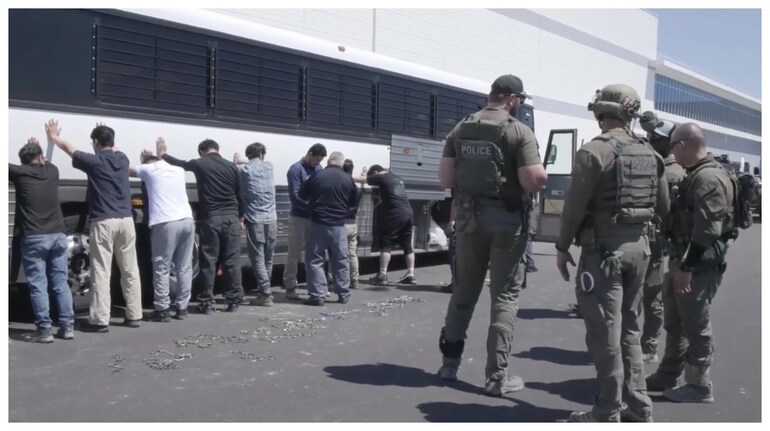
A massive deportation raid at a planned Hyundai-LG battery plant in Georgia rocked US-South Korea relations and underscored cross-purposes within the Trump administration. Federal officials deported around 500 workers, the overwhelming majority South Korean nationals, in what government officials termed the largest single-site Homeland Security enforcement operation to date. The raids threaten to make challenging a project that is central to both US manufacturing ambitions and South Korea's global investment policy, the New York Times reported.
The raid and its magnitude
The raid was conducted Thursday at an incomplete electric car battery plant in Ellabell, just outside Savannah. The $12.6 billion facility is intended to serve as a flagship of South Korean investment in US clean energy production, with thousands of American jobs to follow. Instead, production has stalled as federal authorities took hundreds of employees away who were alleged to reside or work in the United States illegally. Most were subcontractors, though 47 of its own employees were confirmed by LG Energy Solution as being arrested.
South Korea's swift reaction
Seoul reacted in shock, calling in senior officials for an emergency meeting and dispatching diplomats from Atlanta and Washington to the site. South Korea's foreign ministry asserted that the rights of its citizens and firms should be protected in US enforcement actions. The two governments concluded by Sunday to free the South Korean workers in detention and arrange their return home. Nonetheless, the raid was criticized vigorously in the South Korean press, with threats of worsening mistrust between allies already struggling with contentious tariff negotiations.
Trump's rival agendas
The raid underscored the conflict of Trump's dual priorities: expanding US manufacturing capacity while increasing immigration enforcement. Georgia officials welcomed them in turn, attracting billions of Korean investment while working with federal authorities on immigration raids. Pressed as to whether he worried about undermining his own economic objectives, Trump brushed the question aside, declaring the workers "came through illegally" and enforcement agencies were simply doing their job.
Corporate reaction and ambiguity
Neither Hyundai nor LG replied directly to the probe but both pledged to prioritize safety for workers. LG instructed its US employees to remain indoors or return to South Korea and suspended business travel to the country. Both firms have begun reviews of subcontractor practices, citing concerns that lower-level contractors maybe avoided labour laws. The episode is questioning whether companies can keep up with Washington's demands for rapid factory construction while complying with tougher immigration laws.
Wider implications
South Korean investment in US factories has surged on subsidies for electric vehicles and semiconductors. Hyundai has pledged $21 billion between 2028 and 2025 alone, while Seoul pledged to invest $350 billion in US projects in July under a draft tariff deal. But raids like Thursday's undermine investor confidence. Thursday's incident also illustrates the irony of Trump's immigration and economic policy: a search for foreign money and jobs undercut by enforcement efforts that destabilize exactly the projects being promoted.
The Hyundai-LG raid has unsettled domestic communities, investors, and foreign governments. For Washington, it demonstrates the difficulty of balancing tough immigration enforcement with the need to attract strategic industrial investment. For Seoul, it serves as a reminder that its alliance with America, as profound as it is, can be disturbed by domestic American politics. The workers will likely soon return home, but diplomatic and economic repercussions will take far longer to mend.
Discover the latest Business News, Sensex, and Nifty updates. Obtain Personal Finance insights, tax queries, and expert opinions on Moneycontrol or download the Moneycontrol App to stay updated!
Find the best of Al News in one place, specially curated for you every weekend.
Stay on top of the latest tech trends and biggest startup news.









