




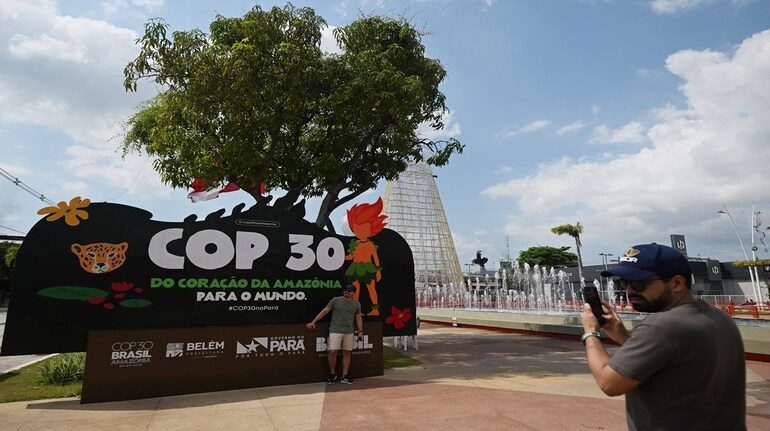
As COP30 formally opens in Belém in the Amazon on Monday, the world’s attention turns from promises to proof. The leaders’ summit last week, meant to set the tone and provide momentum, instead revealed how divided the global response still is, especially on who will pay for climate action and how soon.
About 50 countries joined the two-day meeting hosted by Brazil’s president Luiz Inácio Lula da Silva, with leaders from France and Germany in attendance. Yet, the absence of top-tier representation from the US, China and India signalled a faltering political will as the planet’s physical distress grows harder to ignore.
Nature provided its own warning. Barely hours after the summit ended, a powerful tornado ripped through southern Brazil’s Paraná state, killing at least six people and leaving more than a thousand homeless. For a host nation seeking to spotlight implementation and delivery, it was a stark reminder that climate extremes are no longer future risks; they are unfolding in real time.
Brazil has cast COP30 as an implementation summit that is aimed at transforming pledges into action. India has called it an adaptation COP, arguing that resilience must stand on equal footing with mitigation. The two priorities are not competing. Both reflect the same demand of measurable progress backed by finance that actually flows.
Who pays and how
This is where the world remains stuck. The new collective quantified goal on climate finance, meant to replace the missed 100 billion-a-year target, is the main agenda item in Belém. The UNFCCC’s roadmap report outlines how contributions could be structured and tracked, but it offers no clarity on who pays or how the gaps will be bridged.
India’s own figures reveal the scale of that challenge. Its nationally determined contribution estimates that the country will require “at least USD 2.5 trillion (at 2014–15 prices) between now and 2030” to meet its climate goals. A government estimate later pegged adaptation costs alone at ₹56.68 trillion (roughly USD 648 billion) by 2030. These are not abstract targets. They represent the cost of protecting millions from intensifying floods, droughts and heatwaves.
Globally, the picture is no less daunting. The UN Environment Programme’ has warned that developing countries need five to 10 times more money than they receive. Only one-quarter of current flows go to adaptation, and most arrive as loans. Even these numbers may be overstated due to weak reporting and double-counting, the UN agency on climate change said.
“We are hurtling towards climate disaster, yet the world remains trapped in the fossil fuel age,” was the blunt assessment of UN Secretary-General António Guterres at the leaders’ meet. “Promises are easy, delivery is what counts,” he later warned. “People are losing faith because the gap between words and action keeps growing.”
Lula used the moment to launch the Tropical Forests Forever initiative, a fund rewarding countries that keep their forests intact. “It is not enough to talk about conserving nature,” he said. “We must make it economically viable.” The move underscored Brazil’s dual role as a host seeking leadership, and a nation confronting deepening climate risks at home. More than 92% percent of its municipalities have suffered at least one climate-related disaster in the past decade.
Gulf between rhetoric and resources
Still, the meeting ended without major new pledges. The gulf between rhetoric and resources remains wide. Most developing nations insist that the new finance goal must reflect actual needs and be delivered as grants or concessional funding, not loans that add to debt. They also want adaptation and mitigation treated as equal imperatives. Implementation must serve both survival and transition, they insist.
For India, the opening week of COP30 will test how far that demand can go. It will push for predictable, accessible funding linked to national priorities and supported by transparent accounting. India has also argued that counting private investment as public finance undermines trust, an issue expected to dominate closed-door discussions.
Brazil faces its own balancing act. Hosting the summit in the Amazon gives it symbolic authority, but also exposes the contradictions of climate politics. Deforestation has fallen under Lula’s government, yet droughts, floods and forest fires continue to intensify. Turning climate ambition into measurable delivery at home will be as important for Brazil as achieving it abroad.
Europe’s leaders arrived in Belém with cautious optimism but few specifics. The US, China and India’s lower-level representation at the leaders’ summit has left a leadership vacuum. Negotiators admit that agreement on a new finance framework by the close of COP30 could be unlikely. A broad outline may emerge, but numbers and mechanisms could be kicked down the road once again.
That uncertainty shadows the talks that start Monday. Without a credible breakthrough, developing nations warn that climate diplomacy risks losing legitimacy. The trust gap between promises made and money delivered is now the defining fault line of the process.
The tornado in southern Brazil served as a vivid reminder of what is at stake. Climate change is no longer a future threat to debate, but a present reality to fund. As delegates and negotiators take their seats in Belém, the task before them is clear. They will have bridge the divide between ambition and delivery, or risk losing what remains of public faith in the process itself.
Discover the latest Business News, Sensex, and Nifty updates. Obtain Personal Finance insights, tax queries, and expert opinions on Moneycontrol or download the Moneycontrol App to stay updated!
Find the best of Al News in one place, specially curated for you every weekend.
Stay on top of the latest tech trends and biggest startup news.