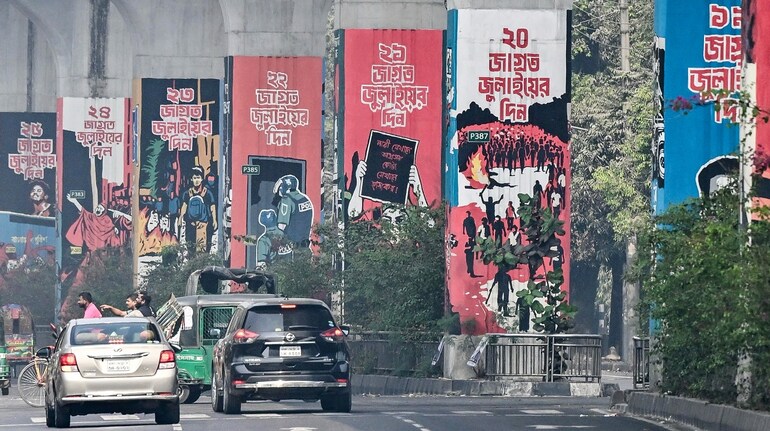

On February 12, more than 127 million Bangladeshis will head to the polls in what is being described as the country’s first genuinely competitive national election in more than a decade. The vote comes 18 months after mass student-led protests forced former prime minister Sheikh Hasina to flee the country, ending her long and dominant rule. Since then, Bangladesh has been governed by an interim administration led by Nobel laureate Muhammad Yunus, tasked with restoring political normalcy and credibility to the electoral process.
For India, the stakes are high. What emerges from Dhaka will not just shape Bangladesh’s domestic future but also determine the trajectory of India’s security, border stability, and regional influence in eastern South Asia.
As Michael Kugelman, senior fellow for South Asia at the Atlantic Council, told Al Jazeera, “India is hoping that this upcoming election will produce a government that is willing to engage with India and will not be influenced by the types of actors that India feels threaten its interests.”
The main contenders for prime minister
This election is being fought without the participation of the Awami League, which has been barred from contesting. In its absence, the contest has narrowed to three broad political forces.
The strongest traditional player is the Bangladesh Nationalist Party, led by Tarique Rahman, the son of former prime minister Khaleda Zia. Rahman is contesting the election from exile but remains the party’s central figure and decision-maker.
Opposing the BNP is a coalition led by Jamaat-e-Islami, which has aligned with the newly formed Nationalist Citizen Party. The NCP is driven largely by Gen Z activists who emerged from the protest movement that toppled Hasina.
The interim government under Yunus is not contesting the polls but has played a key role in shaping the transition.
Why Tarique Rahman has an edge
Despite being physically absent from Bangladesh, Tarique Rahman enters the election with several advantages. The BNP retains a nationwide organisational network that far exceeds that of newer political formations. Years of repression under the Hasina government have also generated sympathy for the party among voters who view the BNP as the most credible alternative.
Reuters has reported that Rahman has successfully repositioned himself as a reformist figure, promising institutional change and political reconciliation while avoiding overtly confrontational rhetoric. His ability to unite anti-Hasina sentiment under one banner gives the BNP a decisive edge in a fragmented opposition landscape.
At the same time, the Jamaat-led alliance lacks broad national appeal, while the NCP, despite its youthful energy, remains untested and organisationally weak.
What each outcome would mean for India
For New Delhi, the absence of Sheikh Hasina is a strategic setback. Her government maintained exceptionally close ties with India across security cooperation, trade, transit access, and counterterrorism. Under Hasina, Dhaka cracked down on insurgent groups targeting India’s northeast and actively cooperated on border management.
India has nonetheless begun cautiously engaging the BNP. Prime Minister Narendra Modi sent a condolence letter following Khaleda Zia’s death last December. External Affairs Minister S Jaishankar also attended Zia’s funeral and met Tarique Rahman.
However, rapprochement remains difficult. As the Institute of South Asian Studies in Singapore noted, “The BNP’s rhetoric frequently depicted Indian initiatives as hegemonic and unequal, opposing transit arrangements and highlighting unresolved disputes over water and trade.”
During Khaleda Zia’s tenure, Bangladesh reportedly provided sanctuary and logistical support to insurgent groups such as ULFA and NSCN(IM), a legacy that continues to shape Indian scepticism.
A Jamaat-influenced government would raise even deeper concerns. The party has a long history of anti-India rhetoric and close ideological and political ties with Pakistan, making it the least preferred outcome for New Delhi.
Security concerns and crimes against Hindus
India is also closely watching Bangladesh’s internal stability, particularly incidents of violence against the Hindu minority. In recent years, there have been repeated reports of attacks on Hindu homes, temples, and businesses during periods of political unrest. New Delhi views minority protection as both a humanitarian issue and a barometer of political radicalisation in Bangladesh.
A weakened or ideologically driven government could exacerbate these tensions, potentially triggering migration pressures and social instability along the nearly 4,000 km India-Bangladesh border.
India is especially alert to any shift that could affect security in the northeast or undermine cooperation near the Siliguri Corridor, the narrow land bridge connecting the region to mainland India.
China and Pakistan factor into India’s calculus
Beyond domestic politics, India is concerned about Dhaka’s growing engagement with China and Pakistan. Beijing has stepped up investments, defence cooperation, and infrastructure diplomacy, including a reported drone manufacturing facility near Bangladesh’s border with India and involvement in Teesta river water management projects.
Bangladesh has also begun resetting ties with Pakistan, restoring air and sea links and expanding defence cooperation. Dhaka is reportedly considering the procurement of JF-17 fighter aircraft jointly produced by China and Pakistan.
As The Indian Express observed, “Who emerges dominant will do more than just form a government. It will influence how Bangladesh navigates its ties.”
Why New Delhi is watching closely
For India, Bangladesh’s election is not just about leadership change. It is about whether Dhaka remains a stable, cooperative neighbour or becomes another arena for strategic competition involving China and Pakistan.
While New Delhi has prepared to work with whichever government emerges, the results will determine how difficult that engagement becomes. The ballot in Bangladesh, therefore, is being watched just as closely in New Delhi as it is in Dhaka.
Discover the latest Business News, Sensex, and Nifty updates. Obtain Personal Finance insights, tax queries, and expert opinions on Moneycontrol or download the Moneycontrol App to stay updated!
Find the best of Al News in one place, specially curated for you every weekend.
Stay on top of the latest tech trends and biggest startup news.