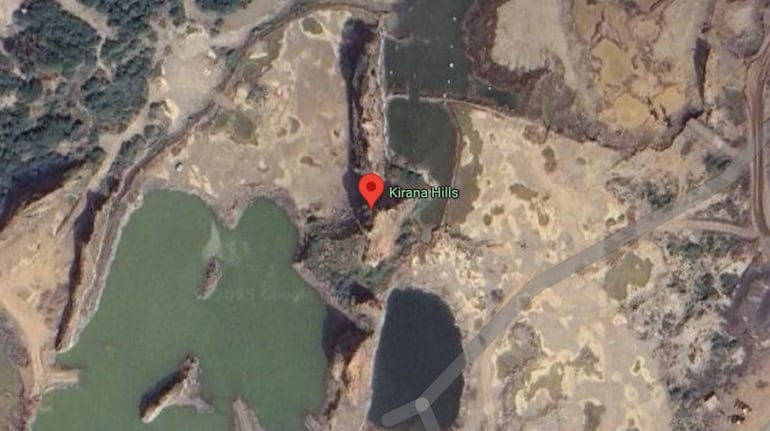
The Indian Air Force has categorically denied claims that it targeted Pakistan’s Kirana Hills—an alleged nuclear weapons storage site—in its recent retaliatory strikes. “We have not hit Kirana Hills, whatever is there,” said Indian Air Force’s Director General of Air Operations Air Marshal AK Bharti while responding to media queries.
However, the very mention of Kirana Hills in the context of the recent India-Pakistan conflict has reignited interest in one of Pakistan’s most secretive military facilities, often likened to America’s infamous Area 51. Long suspected to be central to Pakistan’s nuclear weapons program, the site remains a closely guarded location under the control of the Pakistan Air Force.
Notably, the retaliatory strikes by Indian Armed Forces on Pakistan’s air bases, amid incursion attempts by Islamabad through missiles and drones – on the intervening night of May 9 and 10 – were followed by Pakistan’s DGMO reaching out to his Indian counterpart the next day, which subsequently led to the announcement of ceasefire.
What are Kirana Hills?
Located in Pakistan's Punjab province near the city of Sargodha, the Kirana Hills – often called Black Mountains because of its brownish terrain – are a range of low-lying rocky outcrops spanning roughly 12 km. The terrain is rugged and isolated—ideal for covert military testing and infrastructure. Beginning in the early 1980s, the area was developed for military use, including the establishment of bunkers and underground facilities.
The Pakistan Air Force integrated it into the Mushaf Airbase complex, allowing for added security and limited civilian access. Its obscurity and the restricted access surrounding it have fuelled decades of speculation and secrecy.
Notably, during the 1965 War, PAF Base Mushaf, Sargodha was a key target of Indian air strikes, resulting in the destruction of 10 Pakistani aircraft.
The Kirana Hills are said to have over 10 tunnels, which reports claim are used for storage of Pakistan’s nuclear warheads. Some unconfirmed reports also state that M-11 missiles, supplied by China, are believed to have been stored there.
A Site of Covert Nuclear Experiments?
Between 1983 and 1990, the Kirana Hills were reportedly used for 24 “cold tests” or subcritical nuclear experiments, conducted by the Pakistan Atomic Energy Commission (PAEC) under the supervision of Dr. Abdul Qadeer Khan, according to Nuclear Threat Initiative, a global think tank that documents nuclear programs worldwide.
These tests—collectively codenamed "Kirana-I"—were vital in helping Pakistan validate its nuclear warhead designs without crossing the nuclear threshold. Subcritical tests do not produce an actual explosion but use conventional explosives to simulate conditions of a nuclear detonation.
The remote nature of the Kirana Hills made it easier to avoid international scrutiny, especially from satellite surveillance and intelligence agencies from countries like the United States and India.
According to defence analysts, the success of these experiments directly contributed to Pakistan's ability to carry out its first nuclear test in the Chagai Hills in May 1998.
Strategic Relevance Today
While the Chagai Hills became globally known post-1998, the Kirana Hills remain a foundational chapter in Pakistan's nuclear journey. Today, the area is believed to house critical nuclear storage facilities and infrastructure vital for Pakistan’s second-strike capability—a concept central to nuclear deterrence.
However, due to the extreme secrecy surrounding the site, independent verification of its current capabilities remains limited. Defence experts often compare its function and secrecy to the US Air Force's Area 51 in Nevada.
Discover the latest Business News, Sensex, and Nifty updates. Obtain Personal Finance insights, tax queries, and expert opinions on Moneycontrol or download the Moneycontrol App to stay updated!

Find the best of Al News in one place, specially curated for you every weekend.
Stay on top of the latest tech trends and biggest startup news.