- My Alerts
- Go Ad-Free
-
My Account
















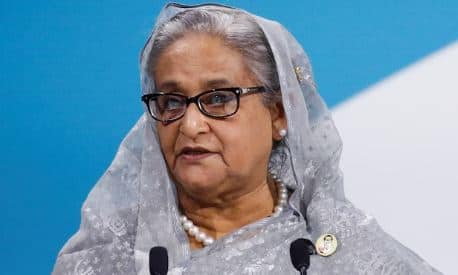
Sheikh Hasina
Sheikh Hasina (born September 28, 1947) is a seasoned Bangladeshi politician and the daughter of Bangladesh’s founding father, Sheikh Mujibur Rahman. She served as Prime Minister from 1996–2001 and
...Read more- Bangladesh’s Gen-Z battles to gain political ground after ousting Hasina
The student-led National Citizen Party faces entrenched rivals with deep networks and resources as polls approach in February
- Awami League calls Hasina sentencing ‘entirely predictable’, blames Yunus govt
The Awami League has rejected the corruption verdict against Sheikh Hasina and her family, accusing the interim government of weaponising the anti-graft body for political gain.
- Bangladesh court convicts ex-PM Sheikh Hasina and UK lawmaker niece Tulip Siddiq in land scam case
A Dhaka court sentenced prime minister Sheikh Hasina to five years and her UK MP niece Tulip Siddiq to two for corruption linked to the Purbachal New Town land project.
- Bangladesh court gives Sheikh Hasina 21-year jail term in three corruption cases
According to the court, the plot was allotted to Hasina “without any application and in a manner that exceeded the legally authorised jurisdiction.”
- Bangladesh says ‘situation different now’, awaits India’s response on Hasina extradition
Bangladesh’s interim government says it is expecting a formal response from New Delhi after renewing its request to extradite former PM Sheikh Hasina following her conviction by a special tribunal.
- 'Request being examined': MEA on Bangladesh's request to India for Sheikh Hasina's extradition
This comes three days after Bangladesh's interim government sent an "official letter" to India seeking the extradition of Hasina after a special tribunal sentenced her to death.
- Bangladesh turmoil: Awami League announces resistance marches over Sheikh Hasina’s death sentence
The Awami League described the tribunal’s judgment as “farcical,” claiming it had been “rejected with contempt” by the people and denounced the proceedings as a “mockery of a trial.”
- Bangladesh interim govt sends letter to India seeking Sheikh Hasina’s extradition
On Nov 17, the International Crimes Tribunal (ICT-BD) sentenced 78-year-old Hasina to death along with then home minister Asaduzzaman Khan Kamal on charges of committing “crimes against humanity” after their trial in absentia. Hasina is currently in India. Kamal is believed to be hiding in India.
- 'Yunus cannot touch my mother': Sheikh Hasina's son Sajeeb on her death sentence
Wazed accused Yunus of damaging the country, alleging that he is turning Bangladesh into a failed state and an Islamist terrorist state.
- Flawed trial, political pressure, no defence: Why Sheikh Hasina’s death sentence stands on shaky legal ground
Legal experts now argue that the court had no authority to try Hasina for crimes allegedly committed in 2024. Its jurisdiction, they say, does not extend beyond the 1971 war.
- Sajeeb Wazed slams Bangladesh interim govt after Hasina’s death sentence: 'A political coup'
Bangladesh’s International Crimes Tribunal-1, on Monday, sentenced the ousted prime minister to death for her alleged role in the violence and mass killings during the July-August 2024 uprising.
- ‘Eternally grateful to PM Modi’: Sheikh Hasina's son says India saved her during Bangladesh crisis
Wazed said New Delhi’s quick response had allowed Hasina to escape imminent danger as unrest escalated in August 2024.
- 'Never received threat but US attitude has changed': Ex-Bangladesh PM Sheikh Hasina's son on Western pressure
Speaking about the new US government under President Donald Trump, Sheikh Hasina's son said with this, the situation is completely different and that there is a distinct change in outlook of Washington towards Dhaka.
- Sheikh Hasina’s death sentence raises the big question: What’s ‘international’ about Bangladesh’s ICT?
Behind the facade of the word “international” lies a court that is deeply domestic, politically controlled, and structurally isolated from the global justice system it seeks to imitate.
- The conspiracy that claimed Sheikh Hasina’s family: Why her parents and siblings were killed on August 15, 1975?
The August 1975 coup plunged the young nation into years of political turmoil and set off a cycle of military interventions that lasted for decades.
- Inside Bangladesh’s ICT: A tribunal branded international but built for domestic power
Bangladesh’s International Crimes Tribunal, despite its name, functions entirely as a domestic court. Operating under national laws, it faces criticism for political influence, limited safeguards, selective prosecutions and lacking genuine international legitimacy.
- Why India may reject Sheikh Hasina’s extradition: Analyst points to political exemption clause in treaty
Bangladesh’s interim government, led by Chief Adviser Muhammad Yunus, has formally asked India to hand over Hasina, calling it a “legal obligation under the extradition treaty.”
- Sheikh Hasina’s family in turmoil: Where are her children now and why is WHO probing her daughter Saima?
For the Hasina family, this period marks yet another cycle of exile, separation, and uncertainty -- a story that has repeated itself across generations in Bangladesh’s turbulent political history.
- Media gag, shutdowns, police crackdown: What's happening in Bangladesh after Sheikh Hasina's death verdict?
The ruling has set off widespread protests, clashes, and a nationwide shutdown, while authorities have issued strict warnings to the media and tightened security in major cities.
- Sheikh Hasina’s death sentence and Dhaka’s extradition demand: What options does India have now?
Soon after the verdict, Bangladesh’s ministries of home and foreign affairs issued statements urging India to send Hasina and Khan back immediately.



