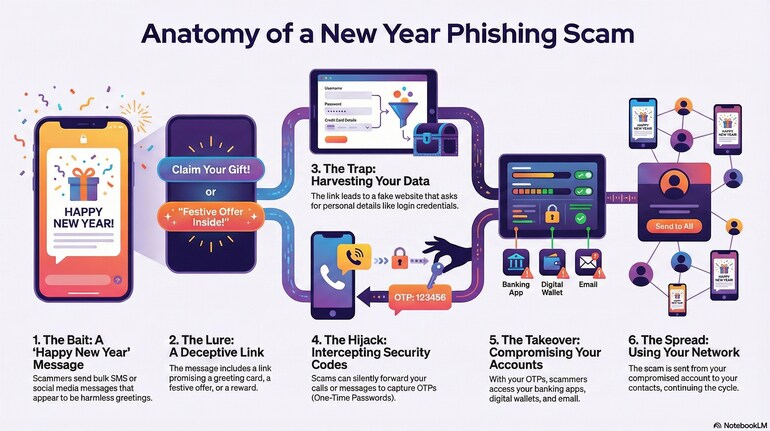

With only a few hours left before 2025 begins, celebrations are underway as people connect with friends and family, both in person and online. Alongside genuine New Year greetings shared over WhatsApp and other social media platforms, authorities have warned that fraudsters are using festive messages to target unsuspecting users. Police, cybersecurity agencies, and telecom experts have urged people to remain cautious of scam messages disguised as New Year wishes.What's the scam?
Well, as always, Fraudsters are using the festive wishes to dupe people. This time it the “Happy New Year” messages on SMS, WhatsApp, and social media platforms to lure users into clicking malicious links or sharing sensitive information.
So, how does the scam works?
Well, scammers take advantage of the festive wishes and the rule applies to the Happy New Year wishes too. Let's understand this step-by-step.
Step 1:
Scammers send bulk “Happy New Year” messages through SMS, WhatsApp, or social media platforms. These messages often look harmless and may appear to come from an unknown number or a hacked contact.
Step 2:
The message contains a link, attachment, or prompt claiming to show a greeting card, festive offer, cashback, or exclusive New Year reward. In some cases, users are asked to “verify” their number to view the message.
Step 3:
Once the user clicks the link, they are redirected to a fake website or asked to install an app. These pages are designed to look legitimate and may ask for personal details such as phone numbers, email IDs, or login credentials.
Step 4:
In advanced cases, the scam silently enables call or message forwarding at the network level. This allows scammers to receive incoming calls, SMS messages, or OTPs meant for the user without raising immediate suspicion.
Step 5:
With access to OTPs and messages, scammers attempt to take over banking apps, digital wallets, email accounts, or WhatsApp accounts linked to the phone number.
Step 6:
The compromised account is then used to forward similar New Year scam messages to the victim’s contacts, allowing the scam to spread further through trusted networks.
What happens when you forward them
Receiving such message is a risk in itself. However, if you also forward them, then you are become a part of the chain and helping spread the scam too buy helping scammers reach more people who can get trapped in to this scam.
Many users trust messages that appear to come from known contacts, making them more likely to click on links shared in group chats or personal conversations. This chain reaction increases the success rate of scams and puts more users at risk of financial fraud and identity theft.
Signs that a New Year message could be a scam
Unfamiliar links or shortened URLs
Messages that include unknown links, shortened URLs, or redirects to external websites should be treated with caution, especially when the sender is not verified.
Unexpected attachments or greeting cards
Scam messages often include attachments or links claiming to open a New Year greeting card or video. Legitimate wishes do not require downloads.
Urgent or action-oriented language
Phrases urging users to “click now,” “verify immediately,” or “claim before it expires” are common tactics used to create panic and reduce scrutiny.
Promises of rewards or gifts
Messages offering cash rewards, vouchers, or exclusive New Year deals are a strong red flag, particularly when no prior participation is involved.
Requests for personal information or OTPs
Any message asking for bank details, login credentials, or one-time passwords is fraudulent. Genuine greetings never require sensitive information.
Spelling errors or unusual formatting
Poor grammar, spelling mistakes, or odd formatting can indicate automated or poorly crafted scam campaigns.
Message appears out of character
If a New Year message from a known contact feels unusual or includes links they normally wouldn’t share, the account may be compromised.
Repeated forwarding in groups
Messages that appear multiple times across different groups or urge users to “forward to everyone” are commonly linked to scam chains.
What you need to stay protected
Users are advised not to click on suspicious links or reply to unknown senders. If a message appears to come from a known contact but seems unusual, it is safer to verify directly through a call or separate message. Personal information, banking details, and OTPs should never be shared.
Users can also check for suspicious call forwarding by dialing *#21# on their smartphone. If any unknown forwarding numbers appear, dialing ##002# disables all forwarding immediately.


Discover the latest Business News, Sensex, and Nifty updates. Obtain Personal Finance insights, tax queries, and expert opinions on Moneycontrol or download the Moneycontrol App to stay updated!
Find the best of Al News in one place, specially curated for you every weekend.
Stay on top of the latest tech trends and biggest startup news.