
The IT industry, already grappling with a slowdown in deal signings, could see more turbulence as US President Donald Trump's tariff war triggers fears of a recession in the US, the biggest market for Indian information technology firms.
The number of deals up for renewal has been declining. In 2023, 1,374 deals were up for renewal, which fell to 1,226 in 2024 and is expected to decline further in 2025, consulting firm Everest Group data accessed by Moneycontrol shows.
“The tariffs will probably not have a direct effect, but anything that suppresses business confidence or creates uncertainty usually means delayed spending decisions. Renewal cycles may get extended,” said Julian Herbert, Vice President, of Everest Group.
For instance, multinational wholesale firm Metro Group’s $700 million deal with Wipro, which ends this year, is among the major names with renewals due in 2025.
Instead of large multi-year contracts, some firms might opt for short-term extensions in case of contract expiry, say experts.
“Uncertainty in the business environment will impact renewal deals. Some clients will prioritise short term challenges and might delay big renewals till they see stability in the market,” said Pareekh Jain, founder and CEO of consulting firm EIIRTrend.
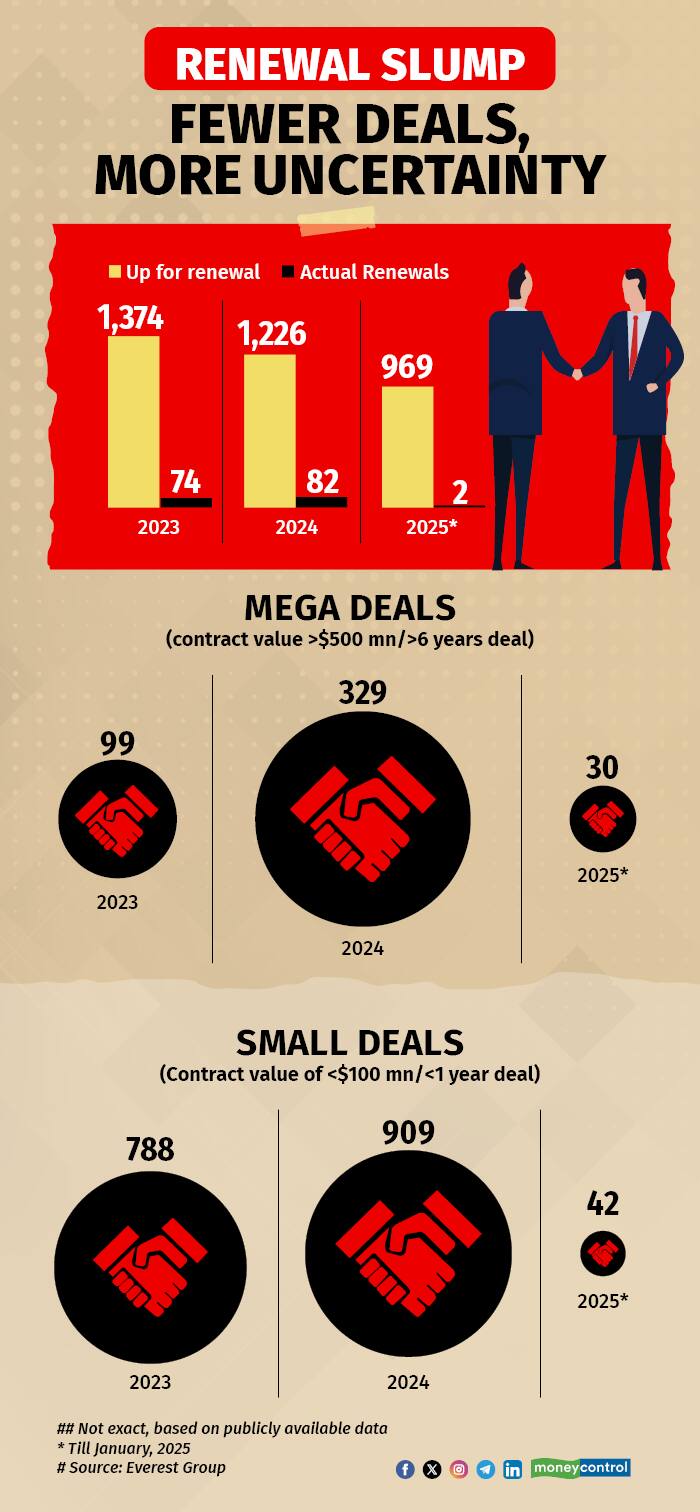
A caveat to these numbers is that they are broadly indicative. While this does not offer a complete view, it does offer insight into overall market trends.
Tell-tale signs are there, with investor concerns having grown over a potential economic slowdown after Trump didn’t rule out recession due to his trade tariffs, which are seeing a push back from US’ biggest trading partners.
The uncertainty has roiled the market at home and abroad. The tech-heavy Nasdaq and the broader S&P 500 in the United States have fallen to their lowest levels since September 2024.
At home, the Nifty IT index has dropped approximately 16 percent, so far, this year.
This doesn't bode well for India's $283 billion IT industry, which posted its strongest recovery in 18 months in Q3FY25 after enduring a multi-quarter slowdown.
Shorter contracts, shifting deal trends
Deal structures are evolving, with shorter-term contracts now dominating new signings. This allows businesses to adjust quickly if the partnership does not meet expectations or if a new technology, such as AI or cloud advancements, emerges mid-term.
Large IT deals, valued between $250 million and $500 million or spanning 3–6 years, saw a major shift. While 99 were signed in 2023, 329 were signed in 2024, and 31 have been signed by January 2025.
Smaller deals, valued below $100 million or lasting less than a year, continue to dominate. While 788 of these deals were signed in 2023, a little over 900 were inked in 2024 and 42 signed in January 2025.
“Large deals in Q4 2024 declined by 57 percent compared to Q4 2023, with a reduction in $1 billion-plus and $500 million-plus contracts,” said Gaurav Karnaney, senior manager, Everest Group. In contrast, deals below $50 million formed the bulk of the market.
On January 13, India’s largest software exporter Tata Consultancy Services chief executive officer and managing director K Krithivasan told Moneycontrol that the company found that the December quarter was the first time in a while that the deal cycle decreased by a few weeks.
Peers, such as HCLTech and Wipro, agreed.
On January 17, after delivering better-than-expected Q3 earnings, Wipro's chief financial officer Aparna Iyer said the company was seeing a strong momentum for small and medium-sized deals.
"Quantum of small and medium-sized deals improved significantly in Q3 quarter and thereby, our annual contract value (ACV) increased drastically after several quarters," Iyer said in the post-earnings call.
Also read: AI can reduce project completion timelines, will drive smaller deals: HCLTech CEO C Vijayakumar
Impact on workforce
As deal sizes shrink, companies are also adjusting execution models.
Attrition rates in IT services inched up to 14-15 percent in recent quarters. Subcontracting trends and staffing strategies are also under scanner as firms wade through the shifting contract structures.
With fewer mega deals in the pipeline and a cautious approach to renewals, IT firms will need to recalibrate strategies to sustain growth in an increasingly volatile business environment.
Renewals in the US could take longer due to policy uncertainty, said Piyush Pandey, SVP - Institutional Equity Research (Lead Analyst) at broking firm Centrum, adding that businesses might delay major commitments until market conditions stabilise.


Discover the latest Business News, Sensex, and Nifty updates. Obtain Personal Finance insights, tax queries, and expert opinions on Moneycontrol or download the Moneycontrol App to stay updated!
Find the best of Al News in one place, specially curated for you every weekend.
Stay on top of the latest tech trends and biggest startup news.