




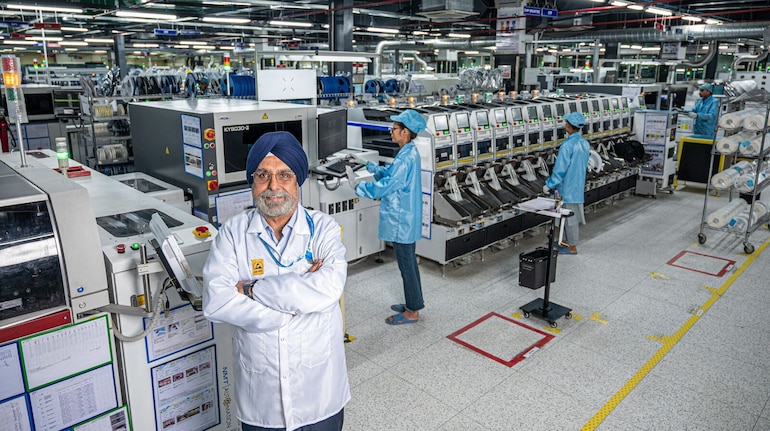
Electronics manufacturer Syrma SGS is lining up a major push into printed circuit board (PCB) manufacturing, holding talks with German, Japanese and Taiwanese companies looking to diversify away from China for their incremental demand. The company’s upcoming PCB facilities have triggered interest from global firms in automation, automotive and energy hardware, signalling one of India’s strongest early cases of import substitution in high-value components.
Managing director Jasbir Singh Gujral told Moneycontrol that global OEMs are actively seeking Indian partners as supply-chain rebalancing accelerates. The shift aligns with the Centre’s ECMS 2.0 incentives, which are expected to catalyse large-scale domestic component manufacturing.
Gujral said that cumulative investments of Rs 7,000–10,000 crore across new PCB facilities under ECMS 2.0 could help substitute 25–30% of India’s Rs 40,000-crore annual PCB import bill in the first phase.
“Whenever we present to potential OEMs and EMS customers and mention that we are diversifying into PCBs, interest spikes. I’ve had detailed conversations with one of India’s largest groups about indigenisation of inputs and the roadmap for localising raw materials. Global companies from Japan and Germany have expressed interest,” Gujral said.
Despite having its own EMS business, Syrma SGS will initially prioritise external customers — especially global and large Indian firms.
“Interest from industry is very strong. Companies are asking about product range and readiness dates. Globally, companies want to diversify their supply chains; until now, alternatives were limited. With strong central and state support, India can present credible alternatives,” he said.
The company’s PCB portfolio will cater to industrial, automotive, consumer, renewable energy, space, med-tech, power electronics and selective telecom applications.
“We won’t target mobile phones initially. Also, energy meters are a major opportunity — the government has to deploy around 50 million energy meters. Solar inverters and other mass applications also present large PCB demand,” Gujral added.
Syrma eventually plans to use these PCBs for its own EMS operations.
“…we can produce multi-layer PCBs for our own needs. However, our internal volumes may be relatively small, so we will prioritise external customers. But having the ability to source in-house adds flexibility and credibility; for very large volume orders we will supply ourselves.”
Five applications under ECMS 2.0
Under the ECMS 2.0 scheme, the company has filed five applications — including three for multi-layer PCBs, HDI PCBs and CCL (Copper Clad Laminate), and two others for camera modules and magnetic/mechanical components. It has already received approvals for a multi-layer PCB plant in Andhra Pradesh and a camera module facility in Pune.
“The multi-layer PCB is our first priority. In the first week of December, we will finalise construction start dates. This is a large factory of about 700,000 sq. ft. at Naidupeta. If construction starts now, we expect to complete construction and install machines by December next year, start trial production, and begin commercial production by April 2027,” he said.
The first-phase investment in multi-layer PCBs is $90 million, of which $40 million will be spent by December 2026.
“The funding will be a mix of debt and equity; around 25% will be invested by a collaborator. Andhra Pradesh government offers up to 50% capital subsidy for eligible investments; if we spend $40 million by the stipulated timeline, we will receive about $20 million back via an escrow mechanism,” he said.
Japanese tech tie-up for the Camera module unit
For its camera module unit, Syrma SGS is close to sealing a partnership with a Japanese company and plans Rs 250 crore investment over five years, targeting revenues of Rs 600–700 crore.
“It’s relatively small compared to PCB but is a high-technology segment. We are negotiating technology partnerships. A camera module ecosystem is largely in China, but original technology often comes from Japan, and Japan also has capabilities. For PCBs and camera modules, we prefer stable, non-Chinese partnerships where possible,” Gujral said.
Applications span mobile devices, laptops, surveillance systems, drones and automotive. “We are assessing which segments to prioritise. It will most likely be other than mobile — mobile is highly volume-driven and tightly integrated into OEM/ODM ecosystems,” he said.
Syrma SGS expects around 30% revenue growth this year and a double-digit EBITDA increase by FY28. “Our focus is more on EBITDA quality. Industrial, automotive and exports have done well — exports grew about 30% in the first six months and automotive around 25%. Industrial, automotive and consumer together account for 75–80% of our business; the remaining 20% includes med-tech, railways and miscellaneous verticals,” he said.
Gujral said that cumulative investments of Rs 7,000–10,000 crore across new PCB facilities under ECMS 2.0 could help substitute 25–30% of India’s Rs 40,000-crore annual PCB import bill in the first phase.
“Against an import-dependent market of nearly Rs 40,000 crore, these capacities are expected to substitute only about a quarter of the current inflows initially. Syrma SGS alone is investing about Rs 1,500 crore, with other players committing comparable amounts… as domestic firms scale, stabilise yields and win customer validation, additional capacity could gradually deepen India’s self-reliance,” he said.



Discover the latest Business News, Sensex, and Nifty updates. Obtain Personal Finance insights, tax queries, and expert opinions on Moneycontrol or download the Moneycontrol App to stay updated!
Find the best of Al News in one place, specially curated for you every weekend.
Stay on top of the latest tech trends and biggest startup news.