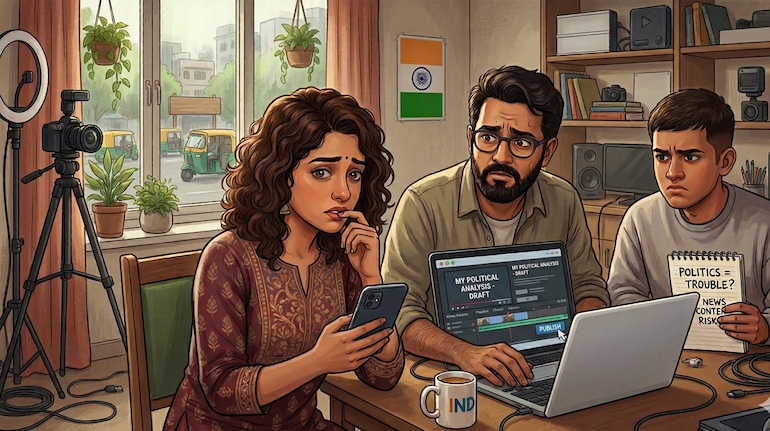

India's proposed amendments to the IT Rules—bringing user-generated 'news and current affairs content' under publisher-style oversight—could curb the reach of creator-led news, increase takedowns, and push influencers toward self-censorship or exit from the category altogether, industry stakeholders said.
At the heart of the concern is the broad scope of what constitutes “news and current affairs content.” Sakchi Jain, CA and financial educator, said the definition goes far beyond political commentary. “It is not just political creators. Anyone creating content on economic, social or cultural matters could be covered,” she said.
“A creator explaining a new tax rule, a finfluencer breaking down a budget announcement, someone sharing their take on an RBI policy—all of this could now be treated the same way as content from a registered news organisation,” she added.
Ritesh Ujjwal, Co-Founder, Kofluence estimates Rs 8,000-25,000 compliance cost for mid-tier influencers (1 –5 lakh followers) and a 5–15% revenue reduction in their monthly salaries ranging from Rs 1 to Rs 4 lakh.
A 3-8% revenue drop is expected for large influencers (5 lakh–over 5 million followers) earning Rs 5-over Rs 20 lakh a month with compliance cost ranging between Rs 30,000-Rs 1.5 lakh.
Ujjwal thinks micro creators in the news category are more likely to exit.
Compliance burden, blurred lines may drive exits
For creators, the lack of clarity on definitions and compliance thresholds could prove to be the biggest challenge.
Neel Gogia, co-founder of influencer marketing and talent management agency Iplix, said the ambiguity around roles could shrink the category. “Who qualifies as a publisher, and where does opinion end and ‘news dissemination’ begin? In today’s ecosystem, almost every creator is, in some way, a publisher,” he said.
“If compliance becomes complex or restrictive, you could see a sharp drop in the number of creators in this space, especially smaller or emerging ones. Many creators operate independently and may not have the resources or credentials to meet formal requirements,” he added.
Jain echoed this concern, pointing to the structural gap between institutions and individuals. “A news channel has lawyers, editors, and systems to handle compliance while a solo creator does not. That gap is where things get really complicated,” she said.
According to Danish Malik, the founder and CEO of the influencer marketing agency Boomlet, the responsibility on creators will increase significantly, especially around accuracy, verification, and accountability. "Influencers will need stronger fact-checking layers, clearer attribution, and a disciplined approach to content delivery."
Platforms, advertisers may add to pressure
Beyond legal implications, the amendments could trigger a cascading effect across platforms and advertisers, tightening the ecosystem around creators.
The impact would be immediate at an operational level, said Yasin Hamidani, director at Media Care Brand Solutions.
“Influencers dealing with news or politics may need stronger fact-checking, cleaner sourcing, and more careful wording, while platforms could become quicker to restrict, label, or remove borderline content. This may also affect brand deals, because advertisers are already more cautious around controversy-heavy creators,” he said.
A key clause in the draft makes platforms accountable for “news and current affairs content” shared by non-publishers, increasing the likelihood of stricter moderation. “That means political and news influencers may face closer scrutiny around takedowns, disclosures, and platform moderation, especially if platforms fear losing safe-harbour protection,” Hamidani added.
The pressure will be multi-layered, Anirudh Sridharan, co-founder of HashFame, said. “The real impact isn’t ‘ban risk’, it’s regulatory, platform and advertiser pressure stacking together.”
Raj Mishra, MD & CEO of Chtrbox, outlined three shifts: “Higher accountability: more caution around political and news content; Brand caution: advertisers will reassess associations; Professionalisation: more structure, documentation, and compliance.”
Creators turn risk-averse
Industry players believe the changes could fundamentally alter creator behaviour, especially among independent voices.
Hamidani said smaller creators are likely to retreat first. “The biggest risk is that smaller creators self-censor or exit because the compliance burden and platform uncertainty become too high for independent operations,” he said.
Jain described a broader chilling effect. “When the rules are vague and the consequences are serious, creators stop taking risks. They start avoiding topics that might be considered political or commentary on government policy. And the audience pays the price because they lose access to the kind of plain language explanations that independent creators do well,” she said.
She added that creators could face “content takedowns, reduced reach because platforms start pre-emptively flagging borderline content, and potential legal trouble.”
“For those of us in the financial content space, we are already operating under Securities and Exchange Board of India (SEBI) guidelines on what we can and cannot say about investments. Adding this on top means navigating two separate regulatory frameworks at the same time, with no clear guidance on where one ends and the other begins,” Jain said.
Also read: User-posted news on platforms may face publisher-like oversight under draft IT Rules
Core compliance obligations
Ujjwal said individual creators would need to register with a nodal authority. Operational burden would be 2 - 4 hours of administrative work weekly for a solo creator.
Creators would also need to appoint or outsource a Grievance Redressal Officer (GRO). He estimated a cost estimate of around Rs 2,000–5,000 per month for outsourced compliance and Rs 30,000–50,000 per month for dedicated staff for mid-tier creators.
He noted that time-bound response requirements typically is 36–72 hours which means monitoring grievance channels continuously which is unrealistic for solo creators and carries high risk of over-removal to avoid liability.
Fast-growing category at risk
The potential impact comes at a time when creator-led news consumption is rapidly rising in India.
Gogia noted that over the last few years, creators have increasingly moved into news and current affairs. “What’s worked for them is not just reporting news, but reacting to it—adding context, opinions, and personal takes. That’s what has helped them build credibility and audience trust,” he said.
Sridharan estimates that 6–12% of India’s 4.5 million creators—roughly 250,000 to 500,000—engage with news or political content in some form.
Jain pointed to shifting consumption trends. “The Reuters Institute’s 2025 Digital News Report found that 38% of Indians regularly get their news from creators and influencers on social media. That is actually more than the 34% who follow traditional news brands. Among people between 18 and 34, the number goes up to 41%,” she said.
“This is not a small or niche category anymore. For a very large section of younger Indians, independent creators are their primary source of news and information.”
Mishra added that “news and public affairs content is no longer owned by institutions—it’s now a creator-led ecosystem.”
Election cycles including 2019 and 2024 created sustained demand for political analysis, Ujjwal said.
"This segment is not fringe. It represents tens of thousands of creators generating meaningful economic value."
Shift to safer content likely
Going ahead, stakeholders expect a shift in the kind of content creators produce.
“The nature of what gets created will change,” Jain said. “Creators who have legal support will adapt and continue. Most independent creators do not have that. So what you will likely see is people quietly moving away from news and policy topics and shifting to safer, more entertainment-focused content.”
She warned that the most valuable voices could be the first to disappear. “The people willing to explain complex policies in simple language, ask questions that do not get asked elsewhere.”
“We saw something similar happen with SEBI regulations on financial content. The macro (creators with 100,000 to 1 million followers) finfluencer space saw a big exit after the crackdown. Regulatory uncertainty does not just push out bad actors. It pushes out everyone. And in a country where a significant chunk of people are already relying on creators for their daily news, that is a very real consequence,” she added.
Sridharan said even casual commentators could be affected. “Casual commentators will surely see a drop, including some meme pages,” he said.
Ultimately, the challenge will lie in balancing regulation with expression. As Gogia put it, “Platforms today enable freedom of expression, and opinion-sharing is a big part of that. Regulating it without stifling it will be the real challenge.”


Discover the latest Business News, Sensex, and Nifty updates. Obtain Personal Finance insights, tax queries, and expert opinions on Moneycontrol or download the Moneycontrol App to stay updated!
Find the best of Al News in one place, specially curated for you every weekend.
Stay on top of the latest tech trends and biggest startup news.