

Have you ever stepped outside on a bright summer afternoon and thought, “Wow, the Sun is really hot!” You can feel its warmth on your skin, see its dazzling light in the sky, and even watch shadows shrink beneath it.
The Sun is the brightest and hottest thing which is seen every day. But have you ever wondered why it is so hot? What makes it shine so powerfully from 150 million kilometres away? Here is a simple science behind why sun is so hot.
The Sun Is a Giant Ball of Fire
The Sun is not actually “on fire” like wood or paper burning. It is a huge glowing ball of gas, mostly made of hydrogen and helium. It is so big that about 1.3 million Earths could fit inside it. The Sun is incredibly hot because something amazing is happening deep inside it but due to a powerful process called nuclear fusion.
What Is Nuclear Fusion?
Deep in the centre (the core) of the Sun, it is unbelievably hot about 15 million degrees Celsius. At this temperature, tiny hydrogen particles are moving so fast that they smash into each other. When they crash together, they join to form helium.
This joining process is called nuclear fusion. When hydrogen turns into helium, a huge amount of energy is released. This energy becomes light, heat and a travel path through space. This is why the Sun shines and keeps our planet warm.
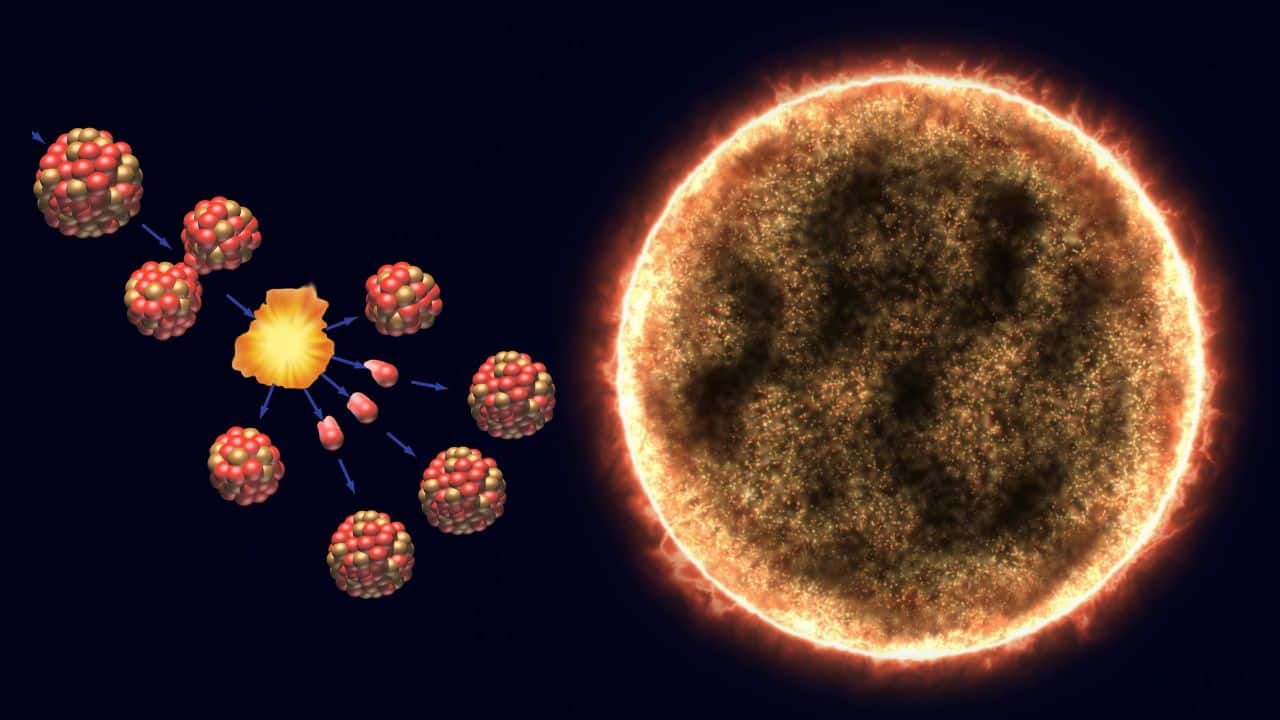 Nuclear fusion. (Image: Canva)
How Hot Is the Sun?
The Sun has different layers, and they are not all the same temperature. Its core is around 15 million°C. Sun's surface is about 5,500°C and its outer atmosphere known as corona is even hotter than the surface. Even though the surface is cooler than the core, it is still hot enough to melt almost anything on Earth instantly.
Why Don’t Humans Burn Up, if the Sun is so Hot?
If the Sun is so hot, why doesn’t Earth melt? Luckily, Earth is at just the right distance from the Sun. Not too close and not too far. Scientists call this the “Goldilocks zone”, where conditions are just right for life.
Earth's atmosphere also protects humans by blocking harmful radiation. Sun is important for Earth to survive. Without the Sun’s heat, Earth would be a frozen ball of ice which means no plants, no animals and no people.
 The Sun has been shining for about 4.6 billion years. (Image: Canva)
Will the Sun Stay Hot Forever?
The Sun has been shining for about 4.6 billion years, and it will continue to shine for another 5 billion years or so. One day, far in the future, it will run out of hydrogen fuel.
When that happens, it will change into a different type of star called a red giant. But this is not going to happen for billions of years, so not need to worry.
Discover the latest Business News, Sensex, and Nifty updates. Obtain Personal Finance insights, tax queries, and expert opinions on Moneycontrol or download the Moneycontrol App to stay updated!
Find the best of Al News in one place, specially curated for you every weekend.
Stay on top of the latest tech trends and biggest startup news.