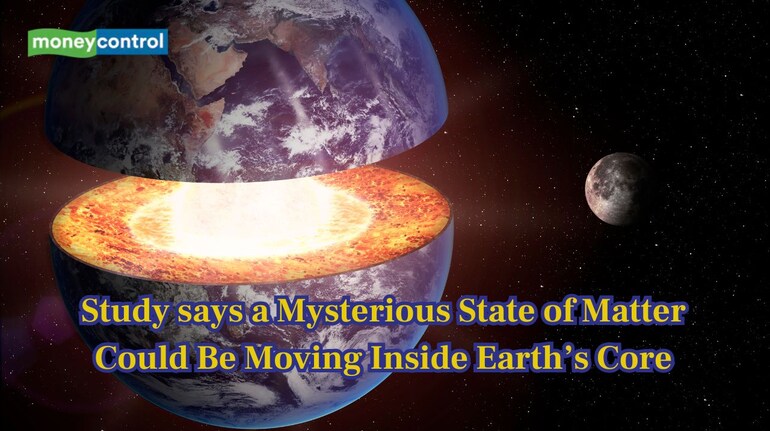

Earth’s deepest secret may finally be cracking. Scientists say the planet’s inner core is not fully solid. It may be flowing while staying solid at the same time. This discovery points to a rare and exotic state of matter. It is called superionic matter. This could change everything we know about Earth’s interior.
A Long-Standing Mystery Beneath Our Feet
For decades, seismologists noticed strange signals from earthquake waves. These waves slow down unexpectedly inside the inner core. Such behaviour contradicted models of a rigid iron sphere. Scientists questioned whether something unusual existed deep below. Now, new evidence points to a compelling explanation. The inner core may be softer than previously believed.
What Exactly Is Superionic Matter?
Superionic matter behaves like a solid and liquid together. Heavy atoms form a stable, solid crystal lattice. Lighter atoms move freely through that rigid structure. This creates internal flow without melting the material. It is neither fully solid nor fully liquid. It exists only under extreme pressure and heat. Earth’s inner core provides those exact conditions.
How Scientists Recreated Earth’s Core
Researchers used an iron-carbon alloy for their experiments. This alloy closely resembles Earth’s inner core composition. They fired samples using a two-stage light-gas gun. The process generated immense pressure and temperature.
Conditions briefly matched those thousands of kilometres underground. The alloy entered a superionic phase. Carbon atoms flowed freely within solid iron. The behaviour matched theoretical predictions precisely.
Why This Discovery Matters?
This finding helps explain puzzling seismic observations worldwide. Superionic matter allows shear waves to travel unusually slowly. That matches data collected from major earthquakes. The discovery also affects how scientists view Earth’s evolution. A softer core may deform over geological time. It may influence heat transfer inside the planet. Most importantly, it may affect Earth’s magnetic field.
Implications for Earth’s Magnetic Shield
Earth’s magnetic field protects life from solar radiation. It is generated by movement deep inside the planet. Changes in core behaviour could affect field stability. A partially flowing inner core may alter magnetic dynamics. This could help explain long-term magnetic variations. The research opens new questions for geophysicists.
Not Just an Earth Story
Superionic matter may exist beyond our planet. It could be present inside large rocky exoplanets. It may also exist in icy giant worlds. Planets with such cores may generate magnetic fields. Magnetic fields increase chances of planetary habitability. This discovery could guide future exoplanet research.
A Planet Still Revealing Secrets
Earth’s centre was once thought simple and static. This assumption is rapidly fading. The inner core may be dynamic and complex. Scientists stress more research is needed. Future experiments will reach even higher pressures. Better seismic data will refine these findings. For now, one thing is clear. Earth’s heart is stranger than imagined.
Discover the latest Business News, Sensex, and Nifty updates. Obtain Personal Finance insights, tax queries, and expert opinions on Moneycontrol or download the Moneycontrol App to stay updated!
Find the best of Al News in one place, specially curated for you every weekend.
Stay on top of the latest tech trends and biggest startup news.