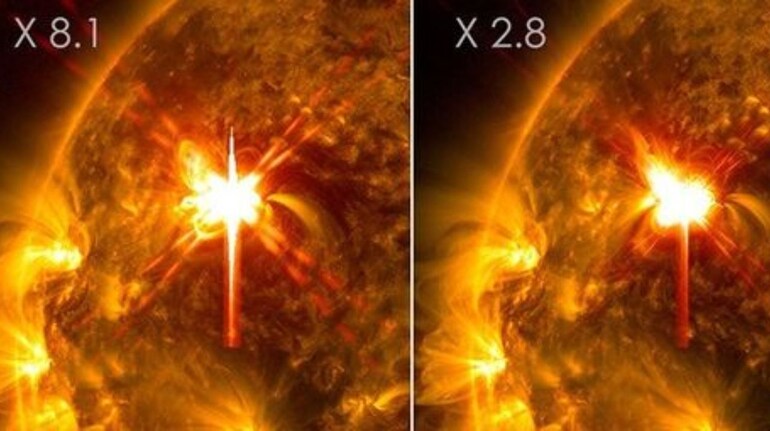

Sun unleashes powerful flares, signalling intense space weather activity globally. Scientists report 4 major solar flares erupting within 2 days. These eruptions highlight rising solar activity during the current solar cycle. Experts warn possible impacts on Earth’s technology and communication systems. The events occurred as a large sunspot region rotated into view.
Four Major Solar Flares Detected Recently
Astronomers observed four strong X-class solar flares in succession. X-class flares represent the most powerful category of solar explosions. One flare measured X8.1, among the strongest recorded in years. Such flares release enormous energy from the Sun’s magnetic fields. They appear suddenly and can last from minutes to hours.
Activity was Observed in Early February
The flares erupted between 1st and 2nd February researchers confirmed. They originated from an active sunspot group on the solar surface. This region faces Earth directly, increasing potential space weather effects. Satellites and observatories monitored the eruptions in real time. Data was collected using solar telescopes and space-based instruments.
The Sun emitted four strong solar flares on Feb 1. and Feb. 2. The flares peaked at 7:33 a.m. ET, 6:37 p.m. ET, and 7:36 p.m. ET on Feb. 1, and 3:14 a.m. ET on Feb. 2. NASA’s Solar Dynamics Observatory captured images of the events, which were classified as X1.0, X8.1, X2.8, and… pic.twitter.com/Wm6V18xC6B— NASA Space Alerts (@NASASpaceAlerts) February 2, 2026
Scientists And Space Agencies Involved
Solar physicists worldwide analysed the flare activity closely. NASA, ESA and NOAA shared observations and forecasts. Space weather centres issued alerts to satellite operators and airlines. Researchers collaborated internationally to assess possible risks. Public updates helped people understand the ongoing solar events.
How Sun Flares occur?
Solar flares occur when twisted magnetic fields suddenly realign. This process releases stored energy as radiation and charged particles. Sunspots mark areas where magnetic activity becomes especially intense. Larger sunspot groups often produce stronger and more frequent flares. Scientists study these regions to predict future solar behaviour.
Why study on These flares matters?
Powerful flares can disturb Earth’s magnetic environment significantly. They may trigger geomagnetic storms when accompanied by coronal mass ejections. Such storms can disrupt radio signals and GPS navigation. Satellites may experience temporary failures or long-term damage. Power grids could face voltage fluctuations during extreme events.
What is Sun’s Eleven-Year Activity Cycle?
The Sun follows an approximately eleven-year cycle of activity. During peaks, sunspots, flares and eruptions become more frequent. The current cycle is approaching its maximum phase. Strong flares are common during such periods. Scientists use long-term data to track these patterns.
Recent flares highlight the Sun’s dynamic and unpredictable nature. They demonstrate how closely Earth depends on solar behaviour. Ongoing research helps reduce risks from space weather.
Discover the latest Business News, Sensex, and Nifty updates. Obtain Personal Finance insights, tax queries, and expert opinions on Moneycontrol or download the Moneycontrol App to stay updated!
Find the best of Al News in one place, specially curated for you every weekend.
Stay on top of the latest tech trends and biggest startup news.