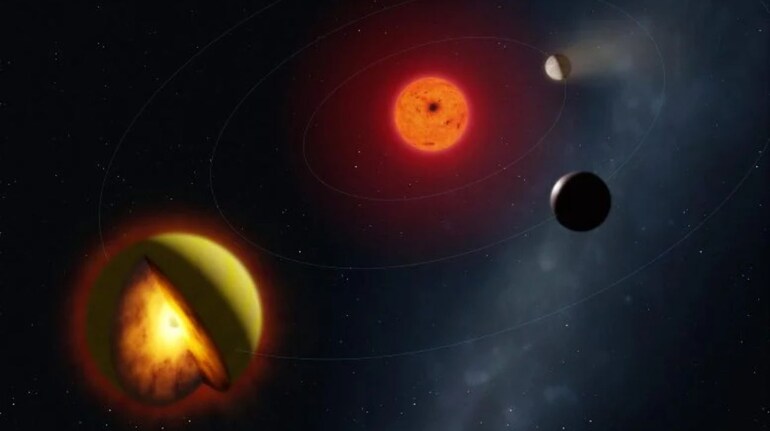

Scientists have reported a newly identified class of exoplanets that remain permanently molten, expanding current understanding of planetary types beyond traditional categories. The findings, published in Nature Astronomy, focus on L 98-59 d, a distant world observed using the James Webb Space Telescope, offering fresh insight into how some planets evolve under extreme conditions.
A new class of molten “liquid planet” discovered
Astronomers have identified a new type of molten exoplanet. This category expands existing classifications used for smaller planets. Traditionally, such worlds were grouped into gas dwarfs or water worlds. The new findings suggest a third distinct planetary class exists. These planets appear to be covered entirely in molten magma. The example studied closely is known as L 98-59 d. It lies about 35 light years away from Earth. The discovery was supported by observations reported by The Guardian. Researchers used advanced data collected by a powerful space telescope.
The planet presents an unusual structure compared with Earth. Its surface is believed to exist in a molten state. Scientists describe it as having a thick, fluid like mantle. The interior likely contains a molten core beneath it. Temperatures on the surface reach nearly 1,900 degrees Celsius. These extreme conditions prevent the planet from cooling over time.
What makes L 98-59 d stay permanently molten
The planet remains hot due to several interacting factors. A strong greenhouse effect traps heat within its atmosphere. This thick atmosphere stops thermal energy from escaping into space. Nearby planets also influence its internal heating processes significantly. Their gravitational pull creates intense tidal forces within the planet. These forces generate heat that keeps its interior active. The result is a constantly shifting global magma ocean surface.
The atmosphere surrounding the planet contains hydrogen sulfide gases. This composition would likely create a strong unpleasant smell. The environment would be extremely hostile to known forms of life. Despite this, scientists view the planet as an important discovery. It reveals how varied planetary systems can be across space.
What this discovery means for future space research
According to Harrison Nicholls, these findings challenge existing planetary classifications. He explained that current categories may be too limited. Many planets previously thought to contain water could differ greatly. Some may actually belong to this newly recognised molten group.
The discovery helps scientists refine how they search for habitable worlds. It also offers insight into Earth’s early formation stages. Such planets act as natural records of molten planetary history. Researchers will now continue studying similar systems for comparison. Future observations may reveal more examples of these extreme worlds.
Discover the latest Business News, Sensex, and Nifty updates. Obtain Personal Finance insights, tax queries, and expert opinions on Moneycontrol or download the Moneycontrol App to stay updated!
Find the best of Al News in one place, specially curated for you every weekend.
Stay on top of the latest tech trends and biggest startup news.