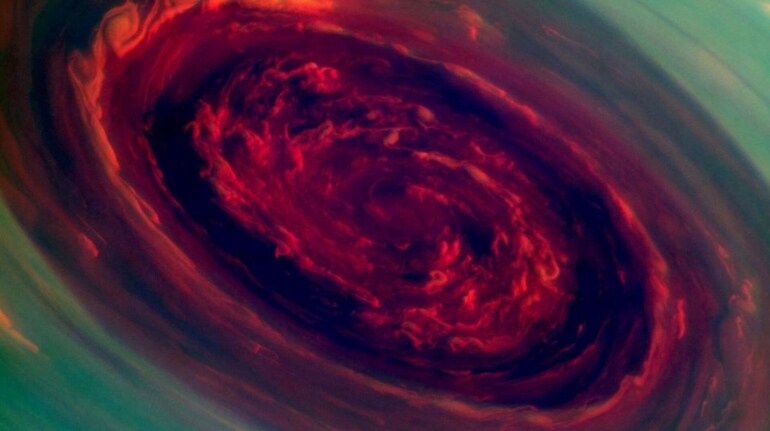

Jupiter and Saturn are famous for their giant storms, but their poles tell very different stories. New research shows that these storm patterns could reveal what lies deep within the planets. While both are gas giants, Saturn has a single massive storm at each pole, whereas Jupiter’s central storm is surrounded by multiple smaller vortices. This stark contrast has puzzled scientists for years.
Giant Storms, Very Different Patterns
Jupiter and Saturn are both gas giants with immense storms, but their poles look very different. Saturn has one massive storm at each pole, while Jupiter’s central storm is surrounded by multiple smaller vortices. This stark difference has puzzled scientists for decades. Both planets are similar in size, composition and distance from the Sun, yet their polar atmospheres behave in dramatically different ways.
Who Did the Study?
The research team from MIT set out to uncover the mystery behind these polar storms. Using advanced computer simulations, they modelled the behaviour of gas giant atmospheres under varying conditions. Lead researchers explain that storms are not just weather phenomena. They are signposts of deeper planetary processes.
How did storms on Jupiter and Saturn form?
Both Jupiter and Saturn generate significant internal heat, far more than they receive from the Sun. This heat rises through the thick layers of gas, creating convection currents.
Jupiter and Saturn rotate very quickly. Jupiter in under 10 hours and Saturn in about 11 hours. This rapid spin creates strong Coriolis forces. Essentially, the storm patterns seen are a surface reflection of deep planetary dynamics.
What the Storms Reveal?
Jupiter’s multi-storm clusters suggest a softer, more turbulent interior, where energy flows prevent storms from merging. Saturn’s single polar storms indicate a denser, more stable internal layer, allowing vortices to combine. In essence, the polar storms act as surface fingerprints of what is happening deep inside.
A Window Into Hidden Worlds
These findings show that storms are far more than weather phenomena. They are a natural window into the otherwise invisible interiors of gas giants. Future observations and more detailed simulations could refine our understanding even further, helping scientists decode the mysteries of the largest planets in our Solar System.
Discover the latest Business News, Sensex, and Nifty updates. Obtain Personal Finance insights, tax queries, and expert opinions on Moneycontrol or download the Moneycontrol App to stay updated!
Find the best of Al News in one place, specially curated for you every weekend.
Stay on top of the latest tech trends and biggest startup news.