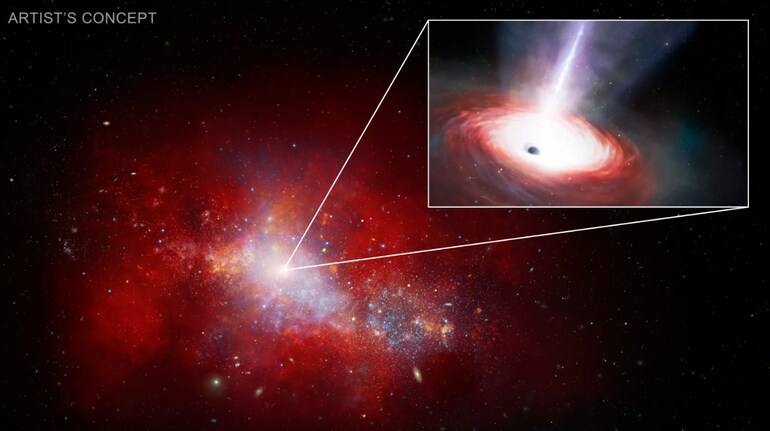
Astronomers have discovered a rapidly feeding black hole in a dwarf galaxy from the early universe, shedding light on how supermassive black holes may have evolved. This low-mass supermassive black hole, spotted with NASA’s James Webb Space Telescope and the Chandra X-ray Observatory, existed just 1.5 billion years after the Big Bang. Remarkably, it is consuming matter at a rate more than 40 times the Eddington limit, a theoretical threshold for black hole growth. Although this accelerated feeding phase may be brief, it could help scientists understand how supermassive black holes expanded so swiftly in the young universe.
Typically, supermassive black holes are found at the heart of most galaxies, but the rapid growth observed in such early cosmic times has long puzzled astronomers. This discovery of a black hole in rapid growth mode shortly after the universe’s formation offers new insights into the formation processes of these colossal entities.
Named LID-568, this black hole was identified within the Chandra X-ray Observatory’s COSMOS legacy survey, which included millions of seconds of X-ray observations. While these galaxies were bright in X-ray emissions, they remained undetected in optical and earlier near-infrared images. The advanced infrared capabilities of Webb enabled astronomers to pinpoint faint emissions, leading to the discovery of LID-568.
LID-568’s exceptional rate of accretion, surpassing its Eddington limit by a factor of 40, suggests that much of its mass growth may have happened during one intense period. This rate signifies that its gravitational pull and the opposing pressure from heated infalling material are imbalanced, leading to extremely high growth.
The findings provide new perspectives on the origins of supermassive black holes from smaller "seeds." According to current theories, these seeds form from either the collapse of the universe’s first stars (light seeds) or from massive gas cloud collapses (heavy seeds). However, observational proof has been limited. This study implies that substantial mass accumulation could occur in one rapid accretion episode, independent of the seed’s origin, said lead researcher Hyewon Suh from the International Gemini Observatory and NSF’s NOIRLab.
These findings are detailed in a paper titled “A super-Eddington-accreting black hole ~1.5 Gyr after the Big Bang observed with JWST,” published in Nature Astronomy.
Discover the latest Business News, Sensex, and Nifty updates. Obtain Personal Finance insights, tax queries, and expert opinions on Moneycontrol or download the Moneycontrol App to stay updated!
Find the best of Al News in one place, specially curated for you every weekend.
Stay on top of the latest tech trends and biggest startup news.