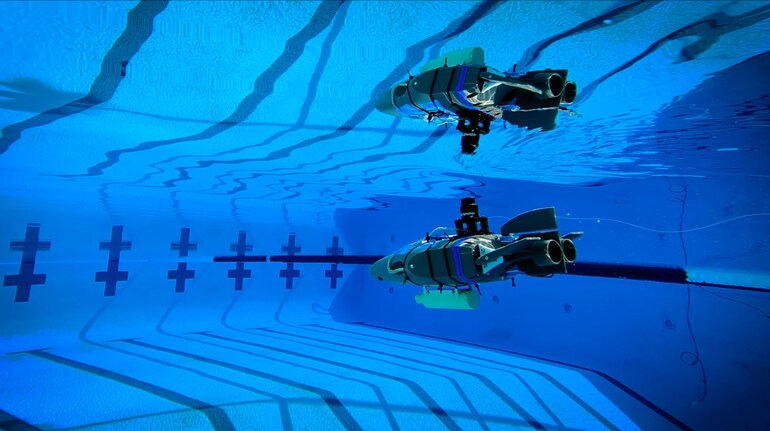
NASA is pushing the boundaries of space exploration with a groundbreaking concept: a swarm of tiny underwater robots designed to explore alien oceans for signs of life. Tested in a swimming pool at Caltech, these futuristic robots could one day dive beneath the icy crust of Jupiter’s moon Europa.
What’s the Mission?NASA’s Europa Clipper, set to reach Europa in 2030, will conduct flybys to study whether the moon’s vast subsurface ocean could sustain life. But scientists are already thinking ahead with the SWIM (Sensing With Independent Micro-swimmers) project. This mission envisions a swarm of cellphone-sized swimming robots that would be delivered to Europa's ocean by a cryobot — a device capable of melting through the ice.
How Do These Robots Work?Each robot in the SWIM swarm would autonomously search for signs of life by detecting chemical signals and temperature changes. Engineers at NASA’s Jet Propulsion Laboratory (JPL) have created prototypes to test the concept. These palm-sized robots, equipped with propellers and steering fins, performed well in pool trials, demonstrating the ability to navigate, correct their course, and even perform search patterns — all without direct human control.
Big Ideas in Tiny PackagesThe robots used in tests are about 16.5 inches long, but the final space-ready versions would be much smaller, around 5 inches. Despite their size, they pack advanced sensors to measure ocean conditions like temperature, pressure, and chemical makeup. Cutting-edge acoustic communication technology would allow the robots to share data and coordinate movements in the alien environment.
From Pools to SpacePool tests showed that the robots could operate efficiently, and computer simulations mimicked conditions on Europa. These simulations helped fine-tune the robots' design, ensuring they can work in extreme conditions while balancing battery life and exploration range.
Why It MattersThe SWIM robots are still years away from being ready for a space mission. However, their potential is enormous, not only for exploring distant moons but also for studying Earth’s oceans or monitoring polar ice conditions. By developing these tiny, autonomous explorers, NASA is taking a significant step toward uncovering the secrets of water worlds beyond our planet.
Discover the latest Business News, Sensex, and Nifty updates. Obtain Personal Finance insights, tax queries, and expert opinions on Moneycontrol or download the Moneycontrol App to stay updated!
Find the best of Al News in one place, specially curated for you every weekend.
Stay on top of the latest tech trends and biggest startup news.