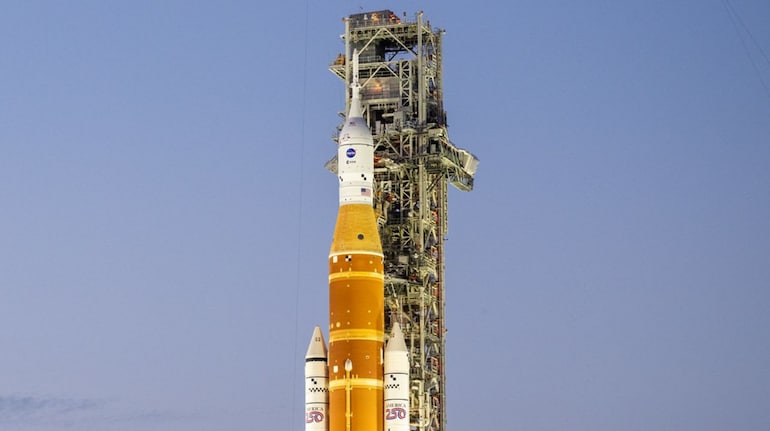

NASA’s Artemis II rocket has officially reached Launch Pad 39B in Florida. The Space Launch System and Orion spacecraft are now ready for tests. This is a critical milestone on the path to the Moon. The mission will carry four astronauts on a crewed lunar flyby. It is the first time humans will orbit the Moon in decades.
What's going on with Artemis II?
NASA’s Artemis II rocket, along with the Orion spacecraft, has reached a major milestone. The massive rocket has been successfully moved from assembly to the Launch Pad 39B in Florida. This step brings the world’s eyes closer to humanity’s next lunar mission.
🚀 Our moonbound Artemis II rocket is on its launch pad!The Space Launch System rocket and Orion spacecraft rolled out from @NASAKennedy’s Vehicle Assembly Building, reaching Launch Pad 39B at 6:42pm ET (2342 UTC). Read more: https://t.co/NdRCRBfQGApic.twitter.com/1oATLb7sTD — NASA (@NASA) January 18, 2026
Where Did the Artemis II Rocket Arrive?
Artemis II arrived at Launch Pad 39B, Kennedy Space Center, Florida. The transport from the Vehicle Assembly Building took roughly 12 hours. The rocket moved at less than 1 mile per hour over a four-mile route. The arrival date was January 17, 2026, marking a historic moment for NASA. The massive crawler transporter ensured every step was precise and careful.
Any Preparation for Launch?
Now at the pad, NASA will conduct critical pre-launch tests. This includes a “wet dress rehearsal”, fueling the rocket without astronauts aboard. Engineers will simulate countdowns and check all systems meticulously.
These procedures ensure crew safety and mission success during the actual flight. Every test is vital for validating deep-space systems for future missions. The preparation phase is the last step before the official launch window.
Meet the Crew of Artemis II
Artemis II will carry four astronauts into deep space:
1. Reid Wiseman (NASA)
2. Victor Glover (NASA)
3. Christina Koch (NASA)
4. Jeremy Hansen (Canadian Space Agency)
The crew will spend approximately 10 days orbiting the Moon, testing critical systems. This mission is their first journey beyond Earth orbit. Each astronaut has specific tasks to monitor life-support and navigation systems. The crew’s work will pave the way for the Artemis III lunar landing.
Main Objective of Artemis II
Artemis II’s main goal is to test Orion’s performance with humans aboard. It will ensure all systems function safely in deep-space conditions. The mission will evaluate life-support, propulsion, navigation, and communication systems. It also serves as a rehearsal for future crewed lunar landings.
When Will Artemis II Launch?
NASA’s launch window is expected between February and April 2026. Exact timing will depend on pre-launch testing and trajectory calculations. The mission will last roughly 10 days, with multiple lunar orbits. After Artemis II, Artemis III aims to land astronauts on the Moon.
Discover the latest Business News, Sensex, and Nifty updates. Obtain Personal Finance insights, tax queries, and expert opinions on Moneycontrol or download the Moneycontrol App to stay updated!
Find the best of Al News in one place, specially curated for you every weekend.
Stay on top of the latest tech trends and biggest startup news.