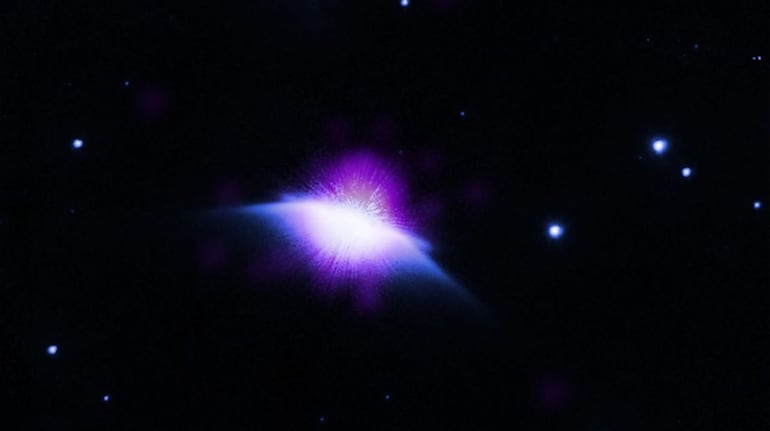

NASA has made an exciting discovery using Chandra X-ray Observatory. A young Sun-like star has been caught blowing a giant bubble. This bubble is made of hot gas surrounding the star. Astronomers call such structures astrospheres, similar to our Sun’s heliosphere. It is the first time such a bubble is seen around a Sun-like star.
Meet the Star: HD 61005
The star, HD 61005, lies 120 light-years away from Earth. It is similar in mass and temperature to our Sun. However, it is very young, only 100 million years old.
This youthful star gives clues about how Sun once behaved. Infrared images show the star’s surrounding dust as wing-like shapes. Astronomers nicknamed this system the “Moth” because of that shape.
What youngster doesn’t love blowing bubbles?For the first time, @NASAChandra caught a young Sun-like star blowing a bubble called an astrosphere. This type of bubble surrounds the star and is made by its solar wind. Our Sun has one, too! https://t.co/lZnGEqoUwgpic.twitter.com/kk8bsagz0U — NASA (@NASA) February 23, 2026
Is This Captured for the First Time?
Yes, this is the first image of a Sun-like star’s astrosphere. HD 61005 lies about 120 light-years away from Earth. The discovery shows what our Sun’s bubble may have looked like. Previous observations could not detect these structures in young Sun-like stars. The star’s stellar wind is stronger and denser than today’s Sun. This makes the bubble more visible in X-ray observations.
How was this Young Sun Detected?
HD 61005 has a dense stellar wind blowing away from its surface. The wind is three times faster and 25 times denser than today’s Sun. It pushes hot gas into the surrounding space, creating the bubble.
Chandra observed the X-rays emitted by the hot gas. The high-energy observations reveal the structure invisible in other light. The bubble surrounds the star like a protective shield in space. This is similar to the heliosphere that surrounds our own solar system. It shows how stellar winds carve space around young stars.
Why This Finding Matters So Much?
The bubble shows how stellar winds shape planetary environments. It gives clues about how the Sun protected planets in its youth. Chandra X-ray Observatory detects these high-energy emissions from space. Astronomers convert X-ray data into images to understand the bubbles.
What Lies Ahead for This Young Star?
Astronomers will continue monitoring HD 61005 for changes in the bubble. They plan to study other young Sun-like stars in X-rays. Future observations may reveal how astrospheres evolve over time.
Researchers are trying to understand interactions between stellar winds and planets. Each new observation brings us closer to understanding our Sun’s early life.
Discover the latest Business News, Sensex, and Nifty updates. Obtain Personal Finance insights, tax queries, and expert opinions on Moneycontrol or download the Moneycontrol App to stay updated!
Find the best of Al News in one place, specially curated for you every weekend.
Stay on top of the latest tech trends and biggest startup news.