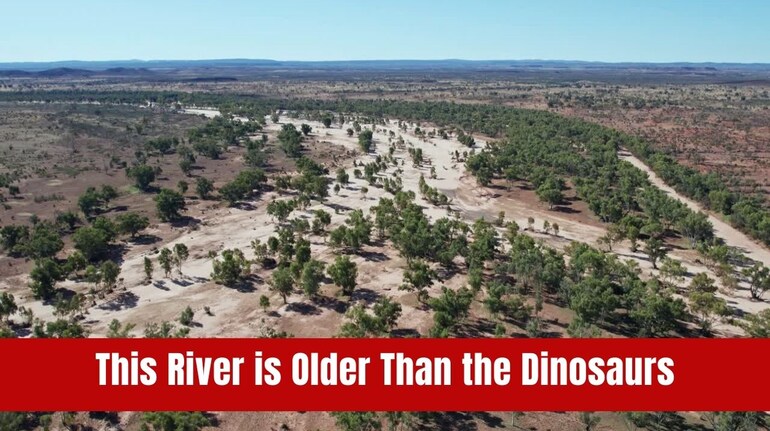

Scientists say one of the world’s oldest rivers still flows today across central Australia. The river, known as the Finke River or Larapinta in the Arrernte language, is estimated to be about 300 to 400 million years old. Stretching across parts of Northern Territory and South Australia, the river crosses one of the driest landscapes on Earth. Researchers say its unusual path and surrounding geology reveal how the ancient waterway survived dramatic planetary changes over immense time.
How the ancient Finke River cuts through mountains
The Finke River travels more than 400 miles across desert land. Unlike most rivers, it does not flow constantly all year. Instead, long dry stretches create chains of isolated waterholes. Channels usually fill only after heavy seasonal rainfall arrives. Despite this irregular flow, scientists say the river remains extremely ancient.
A striking feature appears where the river crosses the MacDonnell Ranges in central Australia. Rivers usually follow easier downhill routes around hard rock formations. The Finke River instead slices directly through tough quartzite rock. At first glance, such a route seems highly unusual.
According to geomorphologist Victor Baker from the University of Arizona, the explanation lies deep in geological history. Scientists believe the river existed before the mountain range formed. During this Alice Springs Orogeny, tectonic movements slowly pushed up the earth around it. As the mountains were pushed up, the river continued to flow and dig into the earth.
This is called antecedence, and it is the scientific reason why this river has taken such a stubborn path. Because the river predates the mountain formation, it preserved its original route.
Geological clues reveal the river’s ancient age
Researchers have also analysed rock formations surrounding the river valley. Geological evidence suggests the river dates back to either the Devonian Period or the Carboniferous Period. These periods occurred between about 419 million and 299 million years ago.
Scientists study weathering patterns and surrounding sediment layers carefully. Chemical signatures left by erosion provide valuable historical clues. Rocks have a natural interaction with water, air, and dirt. These chemicals leave patterns behind, which show scientists what kind of environment existed millions of years ago.
Scientists can also look at the levels of radioactive isotopes in rocks around the river. By knowing how long it takes these isotopes to decay, they can determine how long ago this incredible event happened.
Why the Finke River has survived millions of years
Geologists have stated that rivers tend to cease to exist because change is constant in this world. The change can cause them to fill up with dirt and rocks, or they can change due to tectonic plates. Other changes can occur naturally, causing them to cease to exist.
According to geologist Ellen Wohl from Colorado State University, environmental shifts often destroy ancient river paths. Climate change, drought, and water consumption can also weaken rivers.
However, central Australia lies within a stable tectonic region. The Australian Plate has experienced little movement for millions of years. This geological calm helped the river survive long periods without disruption.
Scientists say the Finke River could eventually disappear someday. If that happens, another candidate may become Earth’s oldest river. One possibility is the New River flowing through parts of Virginia, West Virginia and North Carolina.
For now, the Finke River remains an extraordinary survivor. Its waters began flowing long before dinosaurs appeared on Earth.

Discover the latest Business News, Sensex, and Nifty updates. Obtain Personal Finance insights, tax queries, and expert opinions on Moneycontrol or download the Moneycontrol App to stay updated!





Find the best of Al News in one place, specially curated for you every weekend.
Stay on top of the latest tech trends and biggest startup news.