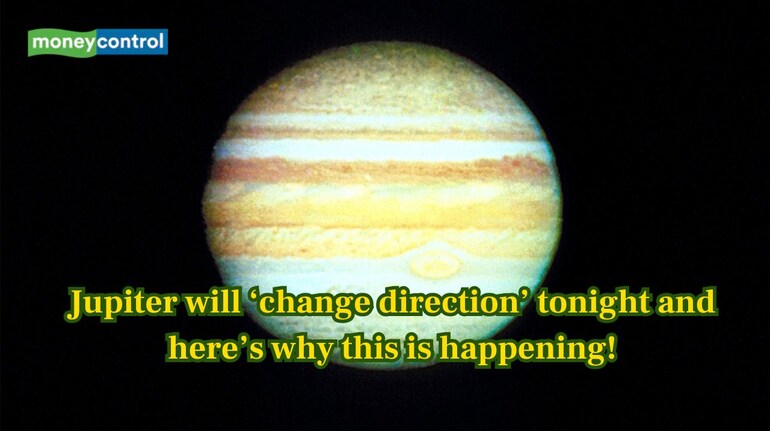

Jupiter is the largest planet of solar system. It normally drifts slowly across the background stars. Tonight, Jupiter will do something that scientists have been eagerly waiting for a long time. Jupiter will pause and begin to move in the opposite direction.
But astronomers believe the giant planet is not actually reversing its orbit, instead it is a fascinating celestial illusion. Around March 10, Jupiter reaches what astronomers call a “stationary point.”
Jupiter: The Giant of the Solar System
The planet Jupiter is the largest world orbiting the Sun. With a diameter of about 143,000 kilometres, Jupiter is so massive that more than 1,300 Earths could fit inside it. Jupiter often shines brightly in the night sky.
It is one of the easiest planets for skywatchers to spot without any special equipment. This giant planet appears to slow down, pause and then reverse its direction among the stars.
Jupiter appears to change direction in the evening sky on March 10: Here's why https://t.co/NzyQs4icZo— SPACE.com (@SPACEdotcom) March 9, 2026
What Is Jupiter’s “Stationary Point”?
Astronomers call this moment a "stationary point". It happens when a planet’s apparent motion across the sky briefly stops before changing direction. So, tonight Jupiter will reach at its stationary point.
This change is part of a well-known astronomical phenomenon called retrograde motion. The stationary point itself is short lived, but the apparent retrogression is far more prolonged.
This Phenomenon is known as Retrograde Motion
In a retrograde motion, a planet would be seen to be in reverse motion across the sky in relation to its normal course. The phenomenon had confused the astronomers over centuries.
The early skywatchers thought that planets were attached to complex celestial sphere since they appeared to be unpredictable. The retrograde motion could only be well explained after scientists got to know how the solar system looked like.
Is This a Rare Event?
No, this Jupiter pause and reverse motion is not rare. Retrograde motion occurs frequently and is a natural process which is due to planetary orbits.
As a matter of fact, similar behaviour may be observed in many planets visible by the earth such as Mars, Saturn and Venus at a certain time of the year.
Because Jupiter is one of the brightest objects in the night sky, it is relatively easy for observers to track its movement.
How Long Will Jupiter’s “Pause” and Reversal Last?
The pause and reverse mode of Jupiter will not last for long. By late June, Jupiter will move closer to the Sun’s position in the sky from Earth’s perspective. As a result, the planet will eventually disappear from view as it approaches Solar Conjunction on July 29.
Then around mid-August, Jupiter will reappear as a morning planet, rising in the predawn sky before sunrise. From that point onward, it will gradually climb higher in the morning sky as the months pass.
Discover the latest Business News, Sensex, and Nifty updates. Obtain Personal Finance insights, tax queries, and expert opinions on Moneycontrol or download the Moneycontrol App to stay updated!
Find the best of Al News in one place, specially curated for you every weekend.
Stay on top of the latest tech trends and biggest startup news.