




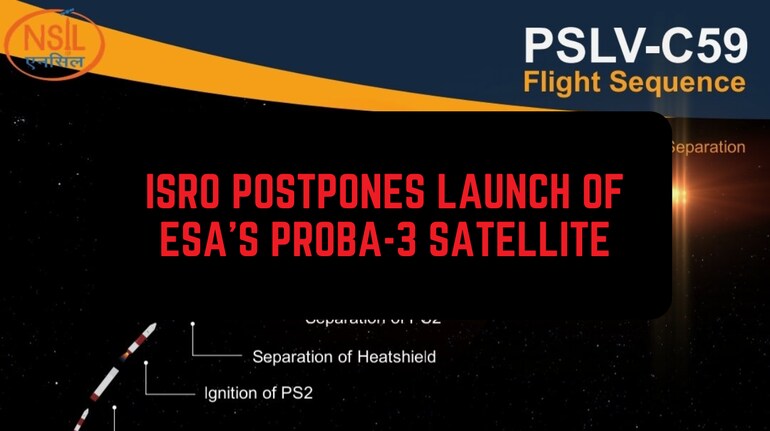
The Indian Space Research Organisation (ISRO) has postponed the launch of the European Space Agency’s (ESA) Proba-3 satellite, originally scheduled for December 4, 2024, at 4:08 PM IST. The delay occurred after an anomaly was detected in the Proba-3 spacecraft, prompting ISRO to reschedule the launch to December 5 at 4:12 PM IST.
This mission, part of the PSLV-C59 project, is a commercial collaboration between ESA and ISRO through NewSpace India Limited (NSIL). The Proba-3 satellite, a groundbreaking initiative to study the Sun’s corona, marks a significant step in international cooperation and scientific exploration.
Due to an anomaly detected in PROBA-3 spacecraft PSLV-C59/PROBA-3 launch rescheduled to tomorrow at 16:12 hours.ISRO (@isro) December 4, 2024
Mission Details: Proba-3 and PSLV-C59
Proba-3, hailed as the world's first mission designed to study the Sun’s outer atmosphere, consists of two satellites: the Coronagraph Spacecraft (CSC) and the Occulter Spacecraft (OSC). These satellites will operate in a tandem configuration, maintaining a formation 150 meters apart to function as a single large solar coronagraph. The Occulter spacecraft will block the Sun's disk, enabling uninterrupted observation of the Sun's faint corona by the Coronagraph spacecraft.
The mission is powered by ISRO's trusted Polar Satellite Launch Vehicle (PSLV), a workhorse for India’s satellite launches. The two satellites will initially be launched together in a stacked configuration and then separate to maintain their unique orbital formation.
How Proba-3 Works
After reaching its target orbit, the Proba-3 spacecraft will demonstrate precision formation flying, a first-of-its-kind achievement. The two satellites will remain aligned for around six hours per orbit, creating a 150-meter-long solar coronagraph to study the Sun’s corona closer to the solar rim than ever before.
The ESA highlighted the importance of this mission, stating that the solar corona, much hotter than the Sun’s surface, is a region of immense scientific interest due to its role in space weather phenomena.
Orbital Path
Once launched, the satellites are expected to reach a high Earth orbit with an orbital period of 19.7 hours. The apogee (farthest point from Earth) will be 60,530 km, while the perigee (closest point to Earth) will be 600 km.
A Proud Milestone for ISRO
ISRO emphasized the significance of the mission, stating that it showcases its proven expertise in delivering cutting-edge scientific missions while fostering global partnerships. The PSLV-C59 mission builds on India’s achievements in space exploration, following the successful launch of the Aditya-L1 mission to study the Sun in September 2023.
This collaborative effort also demonstrates ISRO's commitment to international cooperation, paving the way for future scientific advancements.
What’s Next?
The Proba-3 mission follows its predecessors, Proba-1 (2001) and Proba-2 (2009), and is expected to provide valuable insights into solar science. It will also contribute to ISRO’s growing portfolio of scientific and technological missions, including NISAR, RISAT-1B, and the Resourcesat-3 series.
Discover the latest Business News, Sensex, and Nifty updates. Obtain Personal Finance insights, tax queries, and expert opinions on Moneycontrol or download the Moneycontrol App to stay updated!
Find the best of Al News in one place, specially curated for you every weekend.
Stay on top of the latest tech trends and biggest startup news.