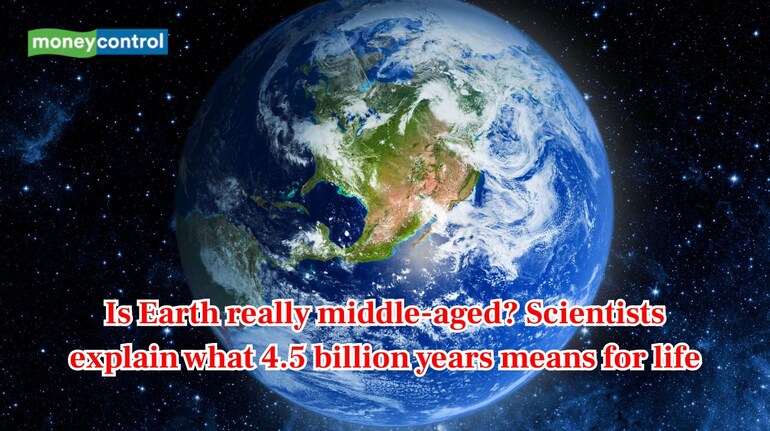

Earth is officially middle-aged. Scientists estimate it is about 4.5 billion years old, roughly halfway through its expected total lifespan. While the number is staggering, Earth is expected to remain habitable for another 4 to 5 billion years. The steady life cycle of the Sun is Earth's energy engine.
As the Sun grows hotter and more luminous, conditions on Earth will gradually change. Scientists predict that in about 1 billion years, rising temperatures could make the planet too hot to sustain complex life.
How Did Scientists Calculate Earth’s Age?
Scientists determined Earth’s age by studying ancient rocks and meteorites. Using radioactive dating techniques, they measured the decay of isotopes like uranium into lead.
These methods revealed that Earth formed roughly 4.5 billion years ago, shortly after the birth of the Sun. Meteorites, considered remnants from the solar system’s formation, provided a benchmark to cross-check Earth’s age.
What Does This Age Factor Means for Earth?
Being middle-aged means Earth is far from its beginning but also not yet near its end. The planet is expected to remain habitable for another 4 to 5 billion years, assuming human activity does not accelerate environmental changes.
Over time, however, Earth’s climate and conditions will change as the Sun gradually grows hotter and brighter. Complex life may face challenges in about 1 billion years, when rising temperatures could make some regions uninhabitable.
How Does the Sun Control Earth?
The Sun, currently about 4.6 billion years old that powers life on Earth through nuclear fusion. This fusion is converts hydrogen into helium. This energy sustains ecosystems, drives weather, and keeps oceans liquid.
As the Sun ages, it slowly becomes hotter and brighter, affecting Earth’s temperature and atmospheric conditions. Eventually, in around 5 billion years, the Sun will become a red giant. It will expand so much that Mercury and Venus could be engulfed. Earth may survive, but it would likely be an uninhabitable, scorched planet.
Is Middle-Aged Earth Dangerous for Humans?
For now, Earth’s middle age poses no danger. The changes described occur on cosmic timescales, far beyond human lifetimes. The message is not fear, but perspective.
Human civilization exists for only a tiny “blink” in cosmic time. What matters most is how we care for Earth today, because our actions determine the survival and quality of life for current and future generations.
Why Studying Earth Still Matters?
Studying Earth’s age, its position in the solar system and the Sun’s evolution helps scientists understand planetary habitability, climate evolution and long-term changes. These studies also remind humanity of the fragility and uniqueness of life. Even a planet as old and seemingly stable as Earth faces eventual change. Earth’s middle age is a scientific milestone and a philosophical reminder.
Discover the latest Business News, Sensex, and Nifty updates. Obtain Personal Finance insights, tax queries, and expert opinions on Moneycontrol or download the Moneycontrol App to stay updated!
Find the best of Al News in one place, specially curated for you every weekend.
Stay on top of the latest tech trends and biggest startup news.